Hanwha Aerospace Co., Ltd. is set to jointly develop the next-generation launch vehicle with the Korea Aerospace Research Institute (KARI), under the Ministry of Science and ICT.
On the 9th, the Public Procurement Service announced that it has selected Hanwha Aerospace as the system integrator company to lead the development of the next-generation launch vehicle and finalized the contract.
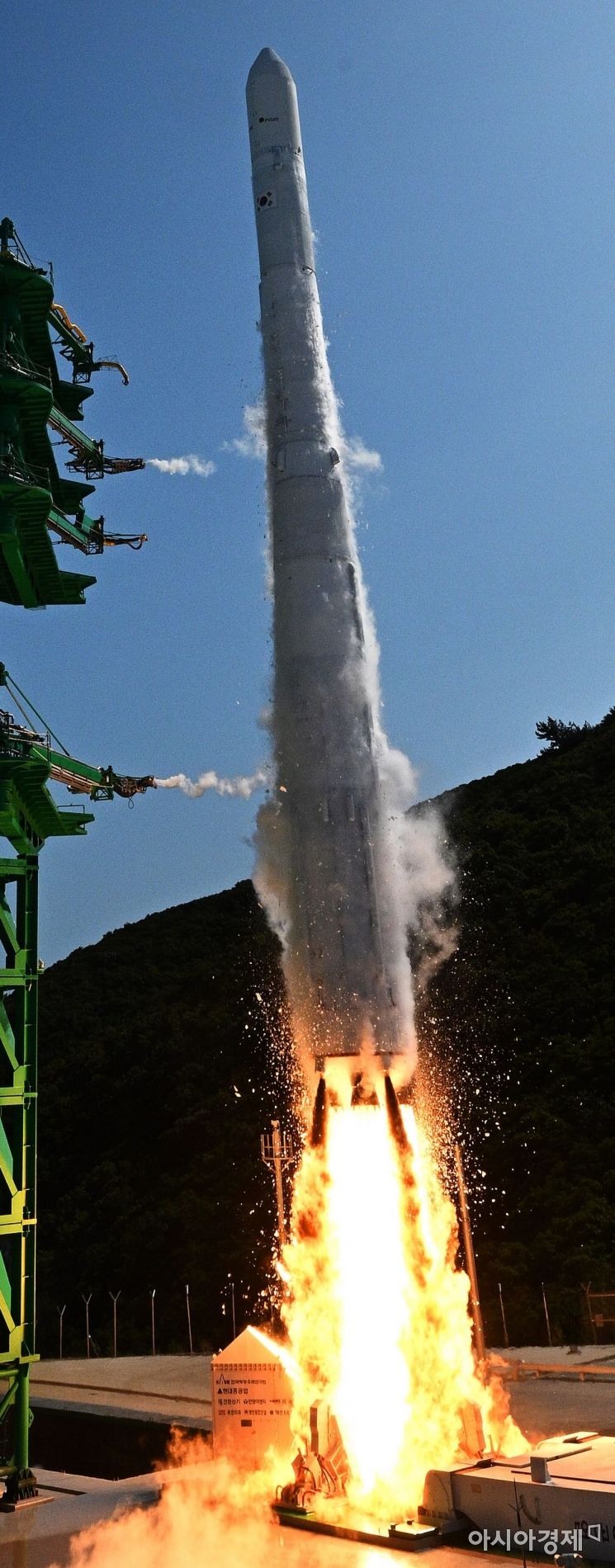 The Korean launch vehicle Nuriho (KSLV-II), designed and manufactured purely with domestic technology, is soaring into space with flames erupting from the launch pad at Naro Space Center in Goheung-gun, Jeollanam-do. / Goheung = Photo by Joint Press Corps
The next-generation launch vehicle will have significantly improved payload capacity and orbital insertion performance compared to Nuri, which primarily performs missions of deploying satellites into low Earth orbit. It is planned to be used for Korea’s future large satellite launches and space exploration.
After development, it is scheduled to be launched a total of three times starting in 2030, with the ultimate goal of being used as the launch vehicle for a lunar lander model in 2032.
The project period spans from this year through 2032, with a total project budget of 2.01324 trillion KRW. The budget allocated for selecting the system integrator company is 950.5 billion KRW.
Hanwha Aerospace will jointly carry out all processes from the design of the next-generation launch vehicle to the final launch with KARI. Through this project, Hanwha Aerospace will secure independent launch vehicle development capabilities and establish itself as a space company. This structure fosters space companies through industry-academia joint development.
The Public Procurement Service received a procurement request from KARI on November 30 last year and initiated the bidding process, overseeing the entire contract process for five months. It emphasized that it shared the overall contract process by signing a memorandum of understanding with the Ministry of Science and ICT and KARI to ensure a swift bidding process and fairness and transparency throughout the bidding.
The contract proceeded according to the schedule of ▲pre-disclosure of specifications ▲bid announcement ▲proposal briefing session ▲submission of proposals and bids ▲price negotiation ▲conformity evaluation ▲selection of preferred negotiation partner ▲additional technical negotiations ▲and conclusion of a private contract.
Jeon Tae-won, Director of New Growth Procurement Planning at the Public Procurement Service, said, “We were able to successfully finalize the contract with the project recipient by establishing a collaborative system with the ordering institutions such as the Ministry of Science and ICT and KARI. We will continue to provide necessary support for contracts by maintaining cooperation with the ordering institutions in the future.”
Lee Chang-seon, Director of Large Public Research Policy at the Ministry of Science and ICT, stated, “The development of the next-generation launch vehicle, which significantly improves transport capacity compared to Nuri, is a prerequisite for carrying out the nation’s pressing space missions such as large satellite launches and space exploration. Now that the system integrator company has been selected, we will begin full-scale design work and proceed with key schedules without delay.”
© The Asia Business Daily(www.asiae.co.kr). All rights reserved.












