Ahead of the monetary policy direction meeting (MPDM) scheduled for the 23rd of this month, the possibility of a fundamental reassessment of the monetary policy direction has increased. This is due to the delayed timing of the U.S. base interest rate cut and the first-quarter domestic real gross domestic product (GDP) exceeding expectations. Another difference from the April MPDM is the increased volatility of international oil prices and the won-dollar exchange rate due to geopolitical tensions.
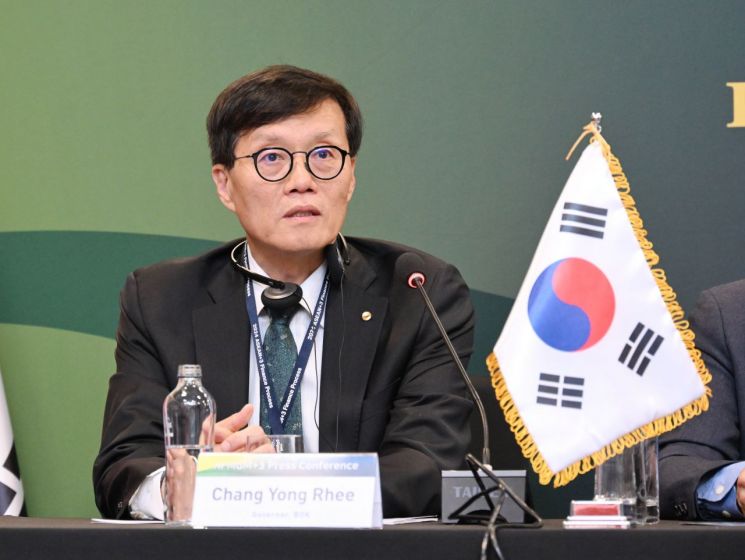
Governor Lee Chang-yong, during a dinner meeting with accompanying reporters on the 2nd (local time) in Tbilisi, Georgia, where he attended the Asian Development Bank (ADB) annual meeting, stated, “The April MPDM has become difficult to serve as the basis for the May MPDM,” adding, “We are in a situation where we need to re-examine the discussions held until April.”
On the same day, Governor Lee pointed out three factors that have changed since the April MPDM: the retreat of expectations for a U.S. base interest rate cut, the unexpectedly strong first-quarter economic growth rate of South Korea, and the increased volatility of oil prices and exchange rates due to geopolitical tensions such as the Middle East crisis.
On the 1st (local time), the U.S. Federal Reserve (Fed) decided to keep the base interest rate at 5.25?5.5%, stating that it is difficult to expect a rate cut until there is greater confidence that inflation is moving toward 2%. Previously, the Federal Open Market Committee had projected three rate cuts this year as of March. This had led the market to expect rate cuts starting in June. The outcome of this meeting is analyzed as lowering the possibility of rate cuts in the first half of the year.
If expectations for a U.S. rate cut retreat, it becomes difficult for South Korea to lower rates before the U.S. Currently, the interest rate differential with the U.S. is 2 percentage points, the largest ever. Therefore, if rates are cut before the U.S., the interest rate gap could widen further. An expanded interest rate gap may lead to capital outflows.
South Korea’s first-quarter growth rate also showed better-than-expected domestic demand indicators, reducing the need for a rate cut. When the economy shows resilience, the urgency to cut rates for economic stimulus decreases. If the growth rate rises, there is a concern that inflation could be stimulated, increasing the need to prolong high interest rates.
Since the April MPDM, geopolitical conflicts in the Middle East have also intensified, increasing volatility in oil prices and exchange rates, which is considered another variable. According to the Korea National Oil Corporation, the international oil price (based on WTI) averaged $84.39 per barrel last month, up $3.98 from the previous month ($80.41). The won-dollar exchange rate touched 1,400 won intraday on the 16th of last month and then somewhat stabilized but has since maintained a high level in the 1,360?1,380 won range.
Governor Lee said on the day, “These three factors have significant implications for our monetary policy,” adding, “I will discuss with the Monetary Policy Committee members later on how to proceed.”
© The Asia Business Daily(www.asiae.co.kr). All rights reserved.












