Atomy, First in Domestic Network Marketing Industry to Publish Report... Wins Minister of Trade, Industry and Energy Award in Comprehensive ESG Category
Sustainable Growth through ESG Management Integration Across Business... Aiming for Mutual Development with All Stakeholders
With the shift in consumers who prioritize value consumption, ESG management has become essential for companies. Atomy, a leading player in the domestic network marketing market, has attracted industry attention with its sustainable growth strategy through the internalization of ESG management across its business after 14 consecutive years of growth since its establishment in 2009. Since its founding, the company has pursued a path of cooperative virtue where all members of society prosper together, based on a culture of sharing and mutual growth, dreaming of becoming a globally exemplary sustainable management company through the principle of one product one partner for collaborators and a consumer-centered management philosophy for customers.
◇ Distribution and consumer goods companies strengthen ESG management in line with the ‘value consumption’ trend
ESG, first used in a 2004 UN Global Compact report, was emphasized as a financial investment principle by the UN PRI (United Nations Principles for Responsible Investment) in 2006, laying the foundation for the ESG framework emphasized in today’s corporate management. As the paradigm shifts from shareholder capitalism to stakeholder capitalism, and issues such as carbon neutrality and supply chain disruptions increase amid the COVID-19 pandemic, ESG management in the distribution and consumer goods industries has emerged as a core keyword in management strategy rather than just a marketing tool.
◇ Nine out of ten citizens prioritize purchasing products from companies fulfilling social responsibility
In the distribution and consumer goods industries, the importance of ESG management is growing in response to changes in consumer purchasing values. While consumers in the past decided on product purchases based on quality, service, or price, today’s consumers emphasize value consumption that considers companies’ environmental and ethical impacts.
According to a 2023 survey by the Federation of Korean Industries (FKI) of 1,000 general citizens nationwide, nine out of ten people responded that they would prioritize purchasing products from companies with high levels of social responsibility fulfillment. The FKI stated, “Companies will have no choice but to strengthen social responsibility efforts valued by consumers to ensure sustainable growth.”
Moreover, boycott and refusal movements frequently occur against companies involved in social controversies such as industrial accidents and unfair practices. Due to these changes in consumers who value value consumption, ESG management has become a necessity rather than an option for companies.
◇ 93% of the top 500 US distribution companies publish reports... What about Korea?
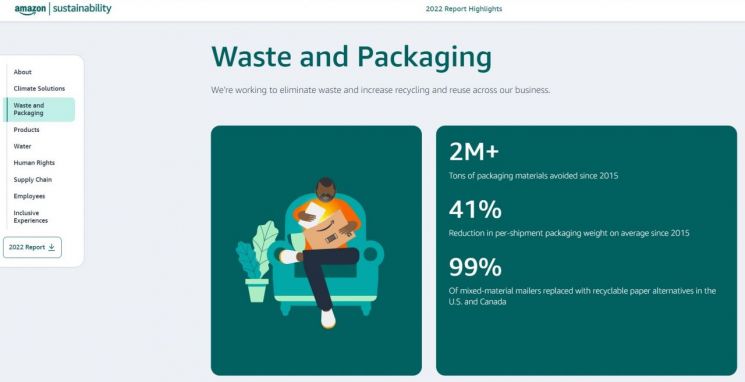
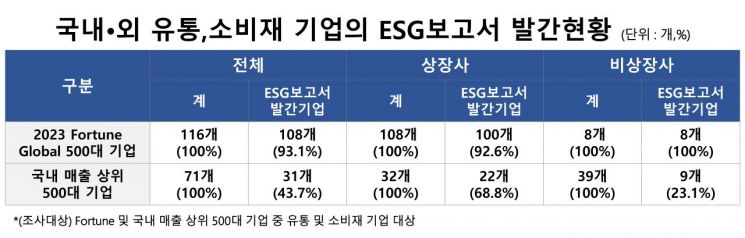
Among the 2023 Fortune Global 500 companies, there are 116 distribution and consumer goods companies, of which 108 (93.1%) published sustainability management reports. In contrast, among the top 500 domestic companies by sales, only 43.7% (31 out of 71) of distribution and consumer goods companies published such reports. Notably, global companies publish sustainability reports 100% even if they are unlisted, whereas the publication rate among 39 unlisted domestic companies is only 23.1% (9 companies). Representative global listed companies include Walmart, a US retail chain, and Amazon, an e-commerce company; unlisted companies include Publix Super Markets, a comprehensive food and beverage retailer, and Land O’Lakes, an agricultural cooperative. Domestic listed companies include Emart and Lotte Shopping, while unlisted companies include Hotel Lotte and Korea Seven.
Meanwhile, Atomy, an unlisted company, has attracted attention by publishing the first sustainability management report in the domestic network marketing industry and winning the ‘Minister of Trade, Industry and Energy Award in the Comprehensive ESG Category’ at the 2023 ‘Sustainability Management Government Awards.’ This award is given to companies that create social value and spread a culture of sustainable management through sustainability management.
◇ Atomy - Industry’s first sustainability management report publication, Ministry of Industry’s ‘Sustainability Management Government Award’
Since its establishment in 2009, Atomy, the first domestic network marketing company to receive the $300 million Export Tower Award and Consumer-Centered Management (CCM) certification in 2021, once again led the industry by publishing a sustainability management report in 2023, advancing toward a sustainable future.
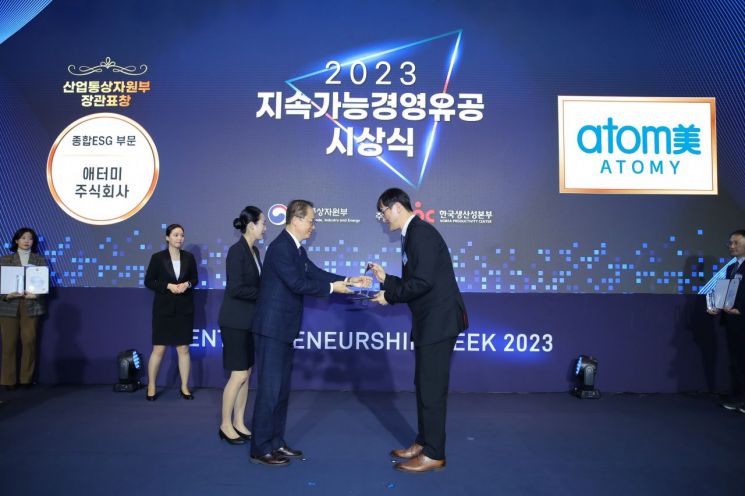 Atomy received the Minister of Trade, Industry and Energy Award in the Comprehensive ESG category at the Sustainable Management Government Awards last December.
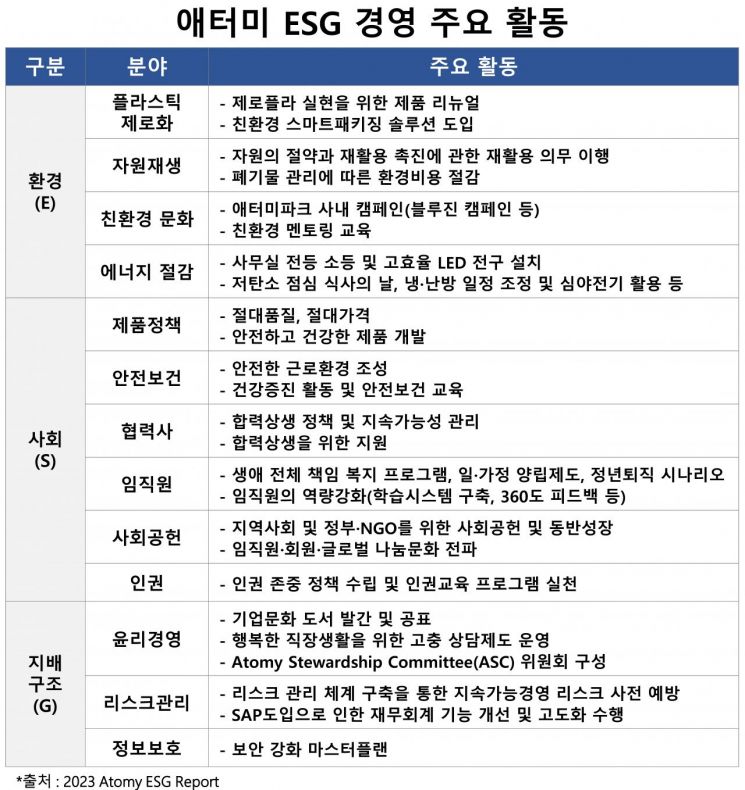
Atomy has established a sustainable growth strategy through the internalization of ESG management across its business based on passion for principles, mutual growth through cooperation, and values of contribution and sharing. Above all, it aims for win-win development with all stakeholders connected not only to management activities but also to human rights, environment, and local communities.
 The 'ZeroPla' project is ongoing, including the use of paper cushioning materials and the application of eco-friendly paper packaging to products.
In the Environmental (E) sector, Atomy is implementing the Blue Marine Project under three visions: achieving zero plastic (ZeroPla), resource recycling and environmental restoration, and leading the spread of a global eco-friendly culture to become a global eco-friendly leading company.
 Since its founding in 2009, Compassion Korea's cumulative donations, including regular sponsorships, have approached 100 billion won.
In the Social (S) sector, based on a culture of sharing and mutual growth started in the early days of its establishment, Atomy pursues a path of cooperative virtue where all members of society prosper together.
Key policies include the one product one partner principle for collaborators, consumer-centered management for customers, and a lifelong responsibility welfare program for employees. In 2021, Atomy began full-scale cooperation with the international child care organization Compassion to provide holistic support until children become adults and with the International Medical Cooperation Group to seek fundamental help for socially vulnerable groups.
In the Governance (G) sector, Atomy established the Atomy Stewardship Committee (ASC) in January 2023 to build an ethical management and risk management system. To become a principle-centered company trusted by all members of society, Atomy published ‘Atomy DNA’ in 2021 to introduce its organizational culture and released a book in 2022 showcasing Atomy’s case as a global ESG company.
Atomy did not stop at publishing a sustainability management report reflecting its ESG management status but also secured the report’s objectivity through third-party verification by the Korea Quality Foundation.
◇ Spread of ‘ESG management’: What ESG issues are distribution and consumer goods companies focusing on?
As the era of ‘ESG management’ spreads and leading domestic and international companies publish sustainability management reports, what ESG issues are drawing attention in the distribution and consumer goods industries?
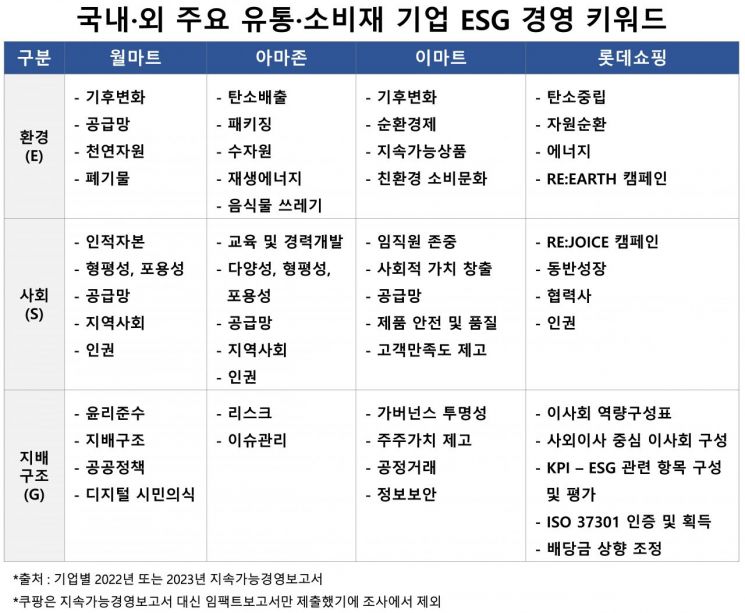
The ESG management goal of Walmart, ranked first among the 2023 Fortune Global 500 companies, is to maximize long-term value for shareholders by providing value to customers, creating economic opportunities for employees and suppliers, and enhancing environmental and social sustainability in communities, businesses, and product supply chains, thereby serving stakeholders.
Amazon, ranked second, focuses its ESG management goals on five impacts: climate strategy, waste reduction, natural resource conservation, human rights promotion, and product and service innovation, aiming to make a positive impact on the world through environmental and social sustainability.
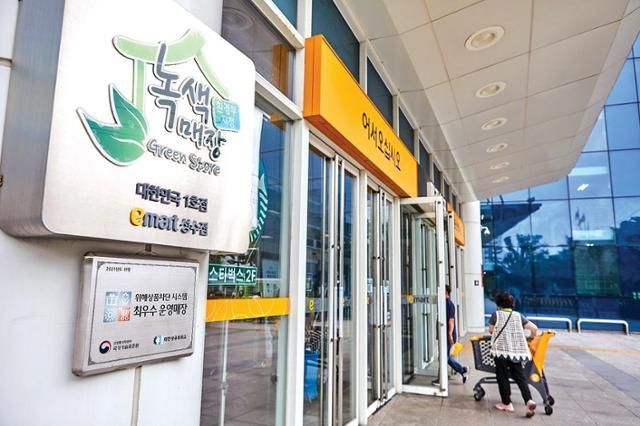
Emart, celebrating its 30th anniversary as Korea’s first discount store, declared social responsibility management as its corporate management paradigm in 2013 and began ESG management activities, publishing a sustainability management report in 2021. Emart has set four key ESG management areas: environmental management, sustainable products, mutual growth, and social responsibility, establishing the goal of ‘sharing the earth’s tomorrow with us’ by building partnerships with stakeholders and considering the entire value chain.
Atomy is also actively engaged in ESG management activities focusing on issues highlighted by major domestic and international distribution and consumer goods companies, such as zero plastic use and resource recycling, respect and career development for employees, human rights respect policies, cooperative win-win with partners, ethical management, and risk management. Having grown continuously for 14 years since its establishment in 2009 and established itself as a leading domestic network marketing company, Atomy dreams of becoming a globally exemplary sustainable management company by communicating and sharing future value with all stakeholders and growing together.
© The Asia Business Daily(www.asiae.co.kr). All rights reserved.














