Siblings' Statutory Share Claims Litigation 'Dismissed' Concludes
Complexities Arise from Uniform Statutory Share Abolition and Recognition of 'Contributory Portion'
The Constitutional Court's ruling declaring the provision of the statutory reserved portion system, which mandates a certain percentage of inheritance to siblings regardless of the deceased's wishes, unconstitutional is expected to have a significant impact on future inheritance lawsuits.
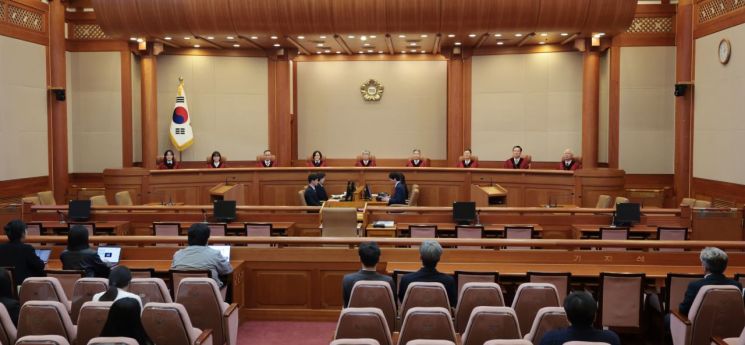 Chief Justice Lee Jong-seok of the Constitutional Court and the justices are seated on the 25th in the Grand Bench of the Constitutional Court in Jongno-gu, Seoul, for the ruling on the constitutional review of Article 1112 of the Civil Act and the statutory system of reserved portions, as well as the constitutional complaint.
 [Photo by Yonhap News]
The Constitutional Court recognized the unconstitutionality of the Civil Code provisions that do not specify the grounds for loss of reserved portion for heirs who fail to fulfill family duties and that do not apply the contribution portion provisions to the reserved portion. However, it decided to maintain the provisional effect of these provisions until December 31 of next year, allowing the legislature time to amend the law.
"Siblings of the Deceased Are Not Reserved Portion Heirs"... Related Cases Dismissed During Litigation
Inheritance return claims based on Article 1112, Clause 4 of the Civil Code, which defines siblings of the deceased as reserved portion heirs, are expected to be dismissed following the Constitutional Court's ruling.
When the deceased has no spouse or children, one-third of the statutory inheritance share is guaranteed as a reserved portion to parents and siblings. The Constitutional Court unanimously ruled this provision unconstitutional, and it immediately lost its effect.
Cases currently under trial based on the law declared unconstitutional by the Constitutional Court are classified as so-called 'parallel cases,' to which the effect of the ruling applies. Since the legal basis has been nullified, all reserved portion return claims filed by siblings are expected to be dismissed, concluding these cases.
There is also an analysis that reserved portion return lawsuits filed by siblings of the deceased will disappear altogether. With the unconstitutional ruling, the motivation to pursue such lawsuits is expected to diminish.
Park Jeong-su, an inheritance and tax specialist at Law Firm Hwawoo, said, "The incentive to utilize the reserved portion system will decrease," adding, "If siblings of the deceased realize that their reserved portion claims are not recognized, those who considered filing such lawsuits will likely refrain from doing so."
Parents and Children Who Commit Filial Offenses Excluded from Inheritance... Contribution Portion Recognition a Variable
The Constitutional Court declared the unconstitutionality of Articles 1112, Clauses 1 to 3 of the Civil Code, which do not separately specify grounds for loss of reserved portion such as long-term abuse of parents, and Article 1118, which does not recognize contributions made by heirs who have long supported the deceased.
The Court's decision reflects the intent to clearly distinguish between parents and children who should not receive reserved portions and those who should receive more.
Ultimately, the National Assembly is expected to amend the law in accordance with the Constitutional Court's decision, but the details of the amendments remain uncertain. This is likely to delay rulings on related cases. The legislative process is expected to address how much contribution will be recognized and how the degree of support will be evaluated.
Park Heung-su, an inheritance specialist at Law Firm Daejong, predicted, "If the deceased contributed to the formation of the heir's property, the reserved portion ratio may increase. Future lawsuits are expected to shift toward claims for larger reserved portions, intensifying disputes over shares."
As the degree of contribution to property formation must be assessed, it is anticipated that courts will postpone rulings until the new law is enacted.
Attorney Park Jeong-su stated, "If the law is amended after the first trial verdict, the appellate court may overturn the first trial. It is highly likely that the amended law will be applied retroactively to lawsuits filed before the Constitutional Court's decision. Since the ruling calls for provisional maintenance of the law until amendment rather than immediate abolition, retroactive application seems reasonable."
© The Asia Business Daily(www.asiae.co.kr). All rights reserved.












