"It is so difficult that we have to cover our ears whenever fighter jets take off, but only four out of 23 households in our village receive compensation."
"Although my home is in another area, I have been working at a workplace severely affected by noise for 17 years. Shouldn't workers like me, who are also exposed to loud noise, receive compensation?"
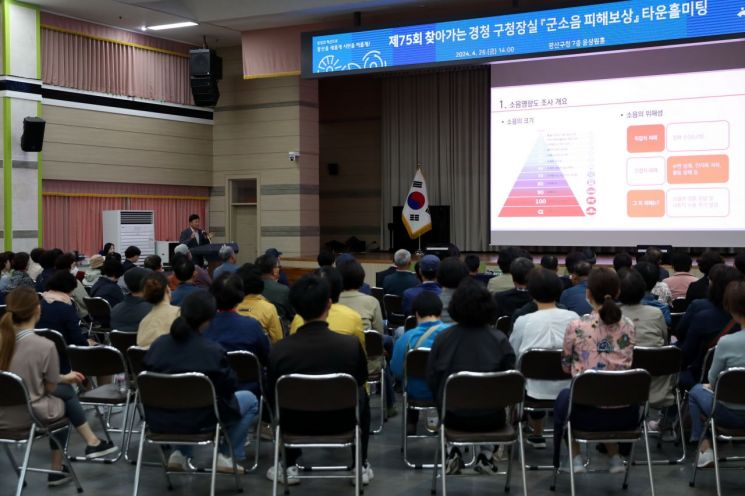
On the 26th, Gwangsan-gu, Gwangju Metropolitan City held a residents' meeting (town hall meeting) to hear citizens' opinions on 'military noise damage compensation' in connection with the visiting listening mayor's office at Yunsangwon Hall on the 7th floor of the district office.
This event was organized to listen to citizens' opinions on the compensation payments made since 2022 following the enforcement of the 'Military Noise Compensation Act (Act on Prevention of Noise and Compensation for Damage from Military Airfields and Military Shooting Ranges)' in November 2020, and to prepare for the second noise impact survey scheduled for 2025.
Residents unanimously stated, "The compensation standards are out of touch with reality," and "The unreasonable and discriminatory compensation criteria need to be improved."
A resident living in Sinheung-dong said, "I don't understand why we don't receive compensation even though the airfield is right in front of us." A resident of an apartment in Usan-dong questioned, "The compensation standards differ by building even within the same apartment complex."
Issues were also raised about workers in noise-affected areas being excluded from compensation because the criteria are based on residence, or about compensation being reduced for those living in Gwangsan-gu but working in other areas.
Another resident pointed out the inconvenience of having to prepare and submit complicated documents every year despite no changes and demanded simplification of the application process. He also made a notable suggestion to conduct annual health checkups to verify how noise actually affects residents' health and to provide compensation accordingly.
Park Byung-gyu, mayor of Gwangsan-gu, stated, "It was confirmed once again today that the current military noise damage compensation standards have many problems," and added, "While urging the prompt relocation of the military airport at its source, we will actively propose to the Ministry of National Defense to reflect residents' voices so that compensation for noise damage can be improved to meet citizens' expectations immediately."
Meanwhile, currently, eight neighborhoods in Gwangsan-gu, including Songjeong 1-dong, Songjeong 2-dong, Dosan-dong, Sinheung-dong, Usan-dong, Sinchang-dong, Donggok-dong, and part of Pyeong-dong, are designated as 'noise control areas.' Since 2022, approximately 2.8 billion KRW in compensation has been paid annually to about 28,000 people.
© The Asia Business Daily(www.asiae.co.kr). All rights reserved.












