'TikTok Ban Bill' Passes US Senate
Implementation Expected to Take Years
A bill mandating the sale of the U.S. operations of TikTok, a China-based short-form video sharing application, has passed the U.S. Senate following approval by the House of Representatives. The expulsion of Chinese apps operating in the United States is becoming a reality. However, even if the TikTok ban law is enacted immediately, it is expected to face years of legal battles over its constitutionality and the entity that will acquire the business.
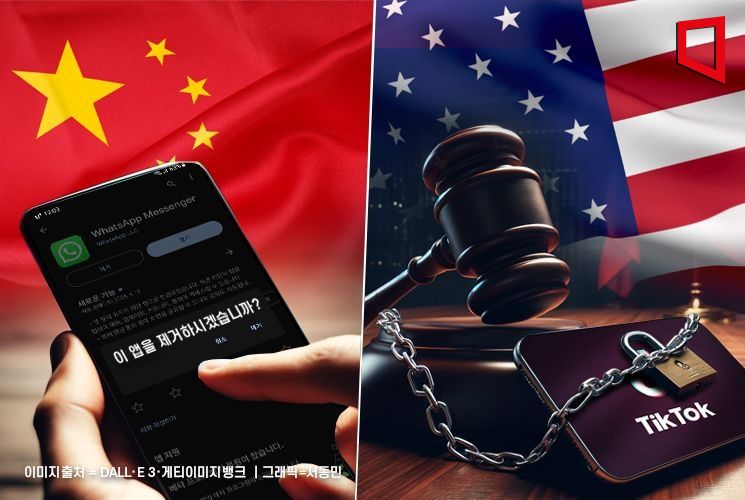
According to foreign media including Bloomberg and The Wall Street Journal (WSJ) on the 23rd (local time), the U.S. Senate passed the so-called 'TikTok Ban Act,' which prohibits TikTok's U.S. service if its Chinese parent company ByteDance does not sell its U.S. operations within 270 days, as part of a foreign security package with 79 votes in favor and 18 against during a late-night session. The TikTok Ban Act, having passed both the House and Senate, will be sent to the White House on the 24th to await President Joe Biden's approval. Since President Biden has expressed strong support for the bill's approval, it is widely expected that the bill will be enacted without surprises.
ByteDance has announced plans to immediately file a lawsuit. Given legal experts in the U.S. have pointed out that "the TikTok Ban Act likely violates the First Amendment, which protects freedom of expression," ByteDance believes there is a high probability that a U.S. federal court will block the bill. For example, a federal court ruled the TikTok ban law introduced by Montana in May last year unconstitutional on grounds of freedom of expression. Michael Beckerman, TikTok's public policy head for the Americas, emphasized, "We will fight to the end against this injustice."
The TikTok Ban Act is also expected to become a key issue in the upcoming U.S. presidential election in November. This is because TikTok holds significant influence among young people, with over 170 million users in the U.S. Former President Donald Trump, who is expected to have a rematch with President Biden in the election, is likely to respond skeptically to the TikTok Ban Act. In 2020, Trump signed an executive order demanding ByteDance sell TikTok within 90 days, but recently he has expressed concerns that "without TikTok, Meta Platforms (Facebook's parent company) could benefit from a spillover effect."
However, it is also analyzed that President Biden will somewhat mitigate concerns about losing voter support due to banning TikTok usage. Originally, when the TikTok Ban Act was first introduced in the House, the sale deadline was set at six months, but the bill was amended to allow the president to extend it by 90 days at his discretion before passing. Bloomberg noted “this means TikTok can at least continue its service until the U.S. presidential election in November.”
It is expected to be challenging to sell the 'social networking service (SNS) giant' TikTok. Democratic Senator Ed Markey said, "The TikTok sale will be one of the most expensive deals in history," adding, "It is unlikely to be completed before early 2025."
Moreover, the Chinese government, which holds the final approval authority over the TikTok sale, is also unlikely to back down easily. If domestic apps are expelled due to national security concerns, other apps like Ali, Temu, and Xian could face similar fates. Especially since the sale involves technology transfer, Bloomberg reported that China is expected to desperately block TikTok from falling into American hands. Bloomberg cited sources familiar with the matter saying, "The Chinese government will not stand by and watch TikTok's valuable algorithms and data fall into U.S. hands."
Some speculate that if TikTok is not sold and is expelled from the U.S. market, American users might secretly continue using it through virtual private networks (VPNs), according to WSJ. Alf Tucker, director at cybersecurity firm NetBlocks, predicted, "In this case, American users' data would be transmitted to TikTok through servers located in other countries, which could pose an even bigger headache for the U.S. government."
The American Civil Liberties Union stated in a press release that "this TikTok Ban Act could set a global precedent for excessive government control over platforms," and "other countries may take similar measures as a result of this case."
© The Asia Business Daily(www.asiae.co.kr). All rights reserved.












