High Prices Centered on Fruits and Vegetables like Apples, Oil Prices Also Unstable
Food Prices Surpass OECD Average for the First Time in Over Two Years
The food price inflation rate in South Korea has once again surpassed the average level of major advanced countries after about two years. While major countries have returned to a normal trajectory as inflation triggered by the Ukraine-Russia war subsides, South Korea is still experiencing high prices mainly in fruits and vegetables, which is analyzed as the cause.
According to data compiled by the Organisation for Economic Co-operation and Development (OECD) on the 21st, South Korea's "food and non-alcoholic beverages" price inflation rate in February was 6.95%, exceeding the OECD average of 5.32%. This is the first time in two years and three months since November 2021, just before Russia's invasion of Ukraine, that South Korea's food prices have surpassed the OECD average.
Recently, South Korea's food price inflation trend has been relatively steep compared to other OECD member countries. As of February this year, South Korea's food and non-alcoholic beverage price inflation rate ranked third highest among the 35 member countries with available statistics, following T?rkiye (71.12%) and Iceland (7.52%).
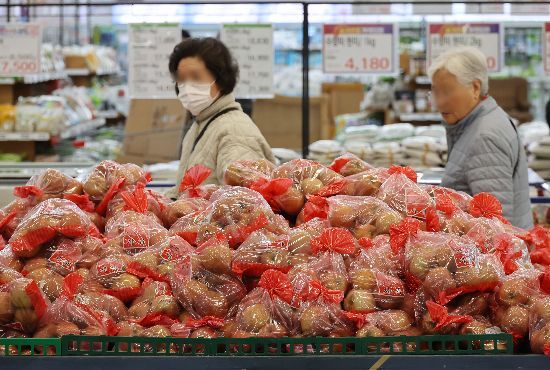 Citizens are shopping at Hanaro Mart Seongnam Branch in Seongnam, Gyeonggi-do.
 [Photo by Jo Yongjun]
South Korea's food prices are mainly driven by fruits such as apples and pears. Last month, apple prices rose by 88.2%, marking the largest increase since statistics began in January 1980.
In addition to food prices, unstable international oil prices following the recent Israel-Iran conflict are also putting pressure on consumer prices.
Despite this situation, the government maintains its previous forecast that prices will stabilize downward in the second half of the year, with the annual inflation rate converging to 2.6%.
On the 19th, Choi Sang-mok, Deputy Prime Minister and Minister of Economy and Finance, met with reporters in Washington DC, USA, and reaffirmed the existing stance, saying, "There are many uncertainties and various situations to observe, but since core inflation is stable, prices in the second half of the year will stabilize downward."
Kim Kwang-seok, head of the Economic Research Department at the Korea Economic Research Institute, said, "The recent high oil prices and strong dollar phenomenon were variables that were not fully anticipated," adding, "If international oil price instability and high exchange rates persist, concerns about a second inflation following 2022 could increase."
© The Asia Business Daily(www.asiae.co.kr). All rights reserved.












