Seo-gu, Gwangju Metropolitan City, is expanding the resource circulation stores, where residents voluntarily participate in separating and disposing of recyclables, to all 18 neighborhoods.
On the 16th, Seo-gu announced that it appointed 148 resource circulation managers and conducted capacity-building training at the Deulbul Hall of Seo-gu Office.
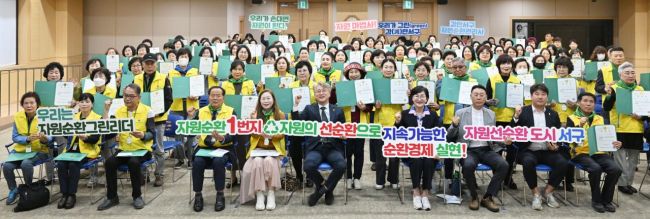 On the 16th, Seogu appointed 148 resource circulation managers at the Deulbul Hall of Seogu Office and conducted capacity-building training.
 [Photo by Seogu]
Resource circulation stores are places where residents earn points based on set criteria such as weight and quantity for recyclables they bring, which can be redeemed for cash or goods. Resource circulation managers educate residents on the proper methods of separating and disposing of recyclables, promoting resource circulation practices.
Last year, Seo-gu operated resource circulation stores in nine neighborhoods including Nongsong 1-dong and Chipyeong-dong, appointing 81 volunteer resource circulation managers and expanding the number of participating members from 332 to 631.
The amount of recyclables collected at the resource circulation stores also increased significantly, including approximately 11 million transparent PET bottles, about 7,500 kg of aluminum cans, around 3,900 kg of paper packs, and about 50,000 used batteries. Residents were compensated with approximately 11 million KRW in cash (points).
Starting from the 17th, resource circulation stores will operate at designated times each week in each neighborhood. The compensation standards per item are 10 KRW per transparent PET bottle, 500 KRW per kg of aluminum cans, 100 KRW per kg of steel cans, and 400 KRW per kg of paper packs (milk packs).
Residents can participate in creating a virtuous cycle culture of recycling waste by bringing cleanly separated recyclables to the nearest resource circulation store, earning points that can be redeemed for cash.
For more details, please refer to the announcements on the Seo-gu Office website or contact the Cleaning Administration Division or the administrative welfare centers of each neighborhood.
Chae Bong-gil, head of the Cleaning Administration Division, said, “Resident interest and participation are necessary for the resource circulation stores, expanded to all neighborhoods, to thrive. The district will also appoint about 150 resource circulation managers to ensure the smooth operation of the resource circulation stores.”
Reporter Shin Dong-ho, Honam Coverage Headquarters, Asia Economy baekok@asiae.co.kr
© The Asia Business Daily(www.asiae.co.kr). All rights reserved.

![Clutching a Stolen Dior Bag, Saying "I Hate Being Poor but Real"... The Grotesque Con of a "Human Knockoff" [Slate]](https://cwcontent.asiae.co.kr/asiaresize/183/2026021902243444107_1771435474.jpg)














