Seong Tae-yoon Policy Director Briefing
Establishment of Special Medical Account
"Investment in Essential Medical Care Finance
is the Foundation of the Healthcare System"
Implementation of National Responsibility System for Resident Training
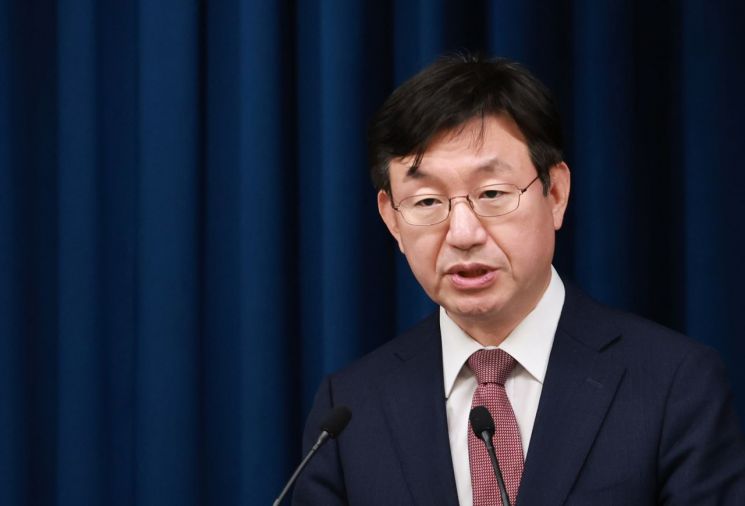 Sung Tae-yoon, Chief of Policy Office at the Presidential Office, is giving a briefing on current issues at the Presidential Office building in Yongsan, Seoul, on the 27th.
 [Image source=Yonhap News]
On the 27th, the Presidential Office stated, "Bold financial investment in essential medical care is the cornerstone for sustaining our country's healthcare system," and announced "five major financial projects for medical reform centered on the national responsibility system for resident training, along with the establishment of a special account for the medical community."
Through measures such as the national responsibility system for resident training and the establishment of a regional medical development fund, the aim is to revitalize essential and regional medical care and improve the quality of healthcare. However, it was reiterated that there is no possibility of adjustment or compromise regarding the '2000 medical school enrollment increase.'
Policy Chief Seong Tae-yoon said in a briefing at the Yongsan Presidential Office that morning, "To properly rebuild the collapsed essential medical care, bold investment beyond previous approaches is essential," adding, "The government will elevate the medical sector to a priority level performing constitutional duties like national security and public safety, and invest intensively."
Seong stated, "Next year's budget will be organized around the five major financial projects for medical reform," and said, "We will solidify resident training and promote appropriate treatment improvements so that residents can focus on their training, nurturing them into competent specialists." This includes supporting improvements in medical education quality, expanding educational and research facilities to secure adequate space, providing educational practice equipment, and faculty salaries to build infrastructure capable of accommodating the medical school enrollment increase.
To enable long-term investment reflecting regional characteristics, a regional medical development fund will be established, and financial support for maintaining essential medical functions such as children's hospitals will be significantly expanded. Efforts will also be made to expand compensation resources for building a safety net against medical accidents. Seong said, "We will provide 50% government funding for resident liability insurance premiums, and review raising compensation limits and expanding coverage for unavoidable obstetric medical accidents," adding, "We will greatly expand essential medical research and development (R&D) budgets to strengthen research functions of regional base hospitals leading future medicine and to build an advanced bio-ecosystem."
Additionally, plans to strengthen capabilities in severe emergency, pediatric, and obstetric care were indicated. Seong emphasized, "We will establish a cooperative treatment system between regional base tertiary general hospitals and secondary hospitals to create an efficient treatment sharing system between the most severe and high-difficulty procedures, rare disease treatment, and general severe and mild care."
Seong also requested active participation from the medical community, stating, "Bold financial investment to enhance the completeness of medical reform must be connected to highly perceptible reforms reflecting field demands, which requires active participation from the medical community." According to the National Finance Act, the government must submit departmental budget requests to the Minister of Strategy and Finance by the end of May, and over the next two months, departments will hold discussions to prepare budgets more efficiently. The government is asking for cooperation from the medical community to ensure that the government's medical reform intentions are actively reflected in the budget.
Seong added, "The next two months are the most critical period for budget formulation as the specific projects and details of next year's budget will be largely decided," and said, "We plan to promptly establish a special committee for medical reform to prepare concrete plans for essential medical financial investment, and we hope for active participation from the medical community."
A senior official from the Presidential Office reaffirmed regarding the possibility of compromise on the 2000-person increase demanded by the medical community, "Currently, the allocation for 2000 has already been completed," confirming that there will be no adjustment in numbers.
© The Asia Business Daily(www.asiae.co.kr). All rights reserved.












