February PCE Inflation Rate Released on 29th in Focus
Fed Officials Including Powell Scheduled to Speak
The three major indices of the U.S. New York stock market were down in early trading on the 25th (local time). Investors appear to be taking a breather amid concerns over high valuations following the recent market rally.
At 9:50 a.m. at the New York Stock Exchange (NYSE) on the day, the Dow Jones Industrial Average was down 0.28% from the previous close, trading at 39,367.30. The S&P 500, which focuses on large-cap stocks, was down 0.26% at 5,220.70, and the tech-heavy Nasdaq index was down 0.4% at 16,362.65.
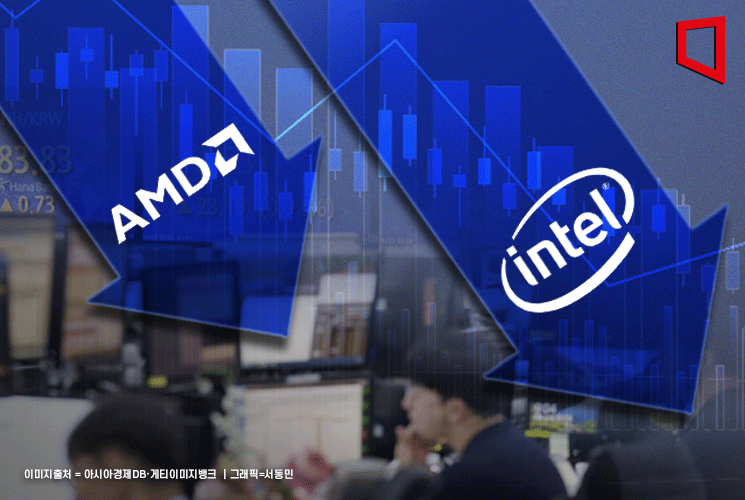
By individual stocks, Intel fell 3.38%, and AMD dropped 1.41%. Shares slid following news that China plans to phase out U.S.-made semiconductors such as Intel and AMD from personal computers (PCs) and servers used by government agencies. United Airlines was down 5.22% amid reports that U.S. authorities are considering growth-limiting measures following recent airline safety incidents. Boeing, which has been embroiled in controversy over a series of accidents involving its 737 model, rose 1.19% on news that CEO and Chairman Dave Calhoun will resign at the end of the year.
The New York stock market continued its rally last week, hitting record highs. The Dow Jones Industrial Average rose nearly 2% over the week, approaching the 40,000 mark. The S&P 500 and Nasdaq indices increased by 2.3% and 2.9%, respectively, during the same period. The U.S. Federal Reserve (Fed) maintained its forecast for three rate cuts this year at the Federal Open Market Committee (FOMC) meeting on the 20th, despite sticky inflation, and technology stocks, especially those benefiting from artificial intelligence (AI), surged, boosting investor sentiment. However, concerns over an excessive rally and the possibility of prolonged high interest rates have led investors to take profits, resulting in a cautious stance.
Jeanne Asseraf-Bittoun, Chief of Research and Strategy at BFT IM, said, "When there are few catalysts for market gains and stock valuations are too high, risks become visible," adding, "The situation is expected to become more complicated in the coming weeks."
Rafael Bostic, President of the Federal Reserve Bank of Atlanta, who is considered dovish (favoring monetary easing) within the Fed, recently revised his rate outlook to a somewhat more hawkish (favoring monetary tightening) stance. While he had predicted two 0.25 percentage point rate cuts this year as of early this month, he has shifted to expecting only one cut. Bostic, who holds voting rights at this year's FOMC, cited higher-than-expected inflation as the reason for revising his rate outlook. This is much more hawkish than the Fed consensus, which anticipates three cuts this year.
As a result, investors are closely watching the core Personal Consumption Expenditures (PCE) price index for February, the inflation gauge most closely monitored by the Fed. The core PCE price index, to be released on the 29th, is expected to rise 0.3% month-over-month, a smaller increase than January's 0.4%. However, the annual increase is forecast to remain steady at 2.8%, the same level as in January. With the Consumer Price Index (CPI) exceeding experts' expectations for two consecutive months in January and February, attention is focused on the PCE price trend. However, since the 29th is Good Friday, a holiday before Easter, market reactions to the inflation data are likely to be observed after the New York stock market opens on the 1st of next month.
This week, remarks from Fed officials are also scheduled one after another. On the day, speeches by President Bostic and Fed Governor Lisa Cook are planned; on the 27th, Fed Governor Christopher Waller is scheduled to speak; and on the 29th, Fed Chair Jerome Powell is set to deliver a speech.
U.S. Treasury yields are steady. The benchmark 10-year U.S. Treasury yield, a global bond yield benchmark, rose slightly to 4.23%, while the 2-year Treasury yield, sensitive to monetary policy, remained at 4.61%, unchanged from the previous day.
International oil prices are rising. West Texas Intermediate (WTI) crude oil increased by $0.97 (1.2%) to $81.60 per barrel, and Brent crude rose by $0.92 (1.08%) to $85.75 per barrel.
© The Asia Business Daily(www.asiae.co.kr). All rights reserved.












