Korea Minting and Security Printing Corporation (KOMSCO) is gearing up to export the Korean-style mobile ID to the Latin American region.
On the 20th, KOMSCO announced that it recently held a meeting with Orlando Vega Quesada, First Vice Minister of the Ministry of Science, Innovation, Technology and Telecommunications of Costa Rica, to discuss mutual cooperation plans, including the introduction of digital IDs in Costa Rica.
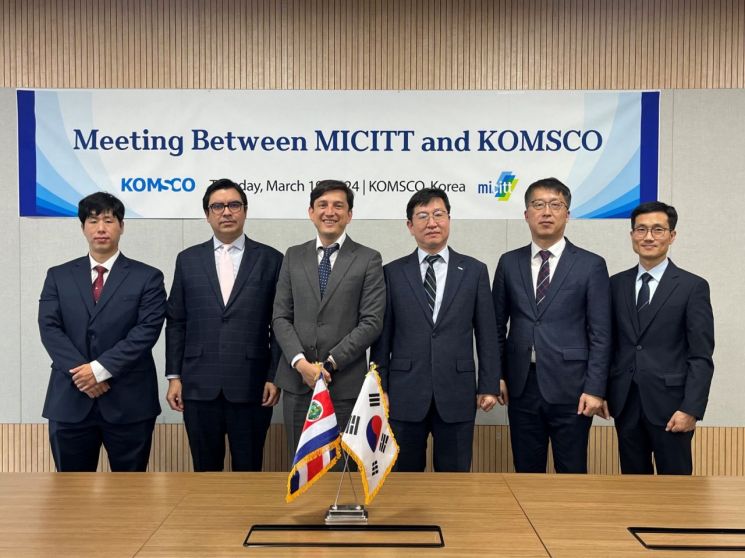 Sung Chang-hoon, President of the Korea Minting and Security Printing Corporation (third from the right), and Orlando Vega Quesada, Vice Minister of Costa Rica (fourth from the right), are taking a commemorative photo after their meeting. Provided by Korea Minting and Security Printing Corporation
Costa Rica is one of the OECD countries in Latin America and is promoting a government-wide digital transformation. In particular, it is actively building the foundation by revising related laws and regulations to introduce digital IDs for all citizens.
The meeting with First Vice Minister Orlando Vega Quesada was held in this context. At the meeting, Sung Chang-hoon, President of KOMSCO, introduced the case of building the Korean-style mobile ID K-DID, enhancing the possibility of cooperation between the two countries in the digital ID field.
KOMSCO introduced mobile IDs consecutively for government employee IDs in 2020, driver’s licenses in 2022, and national veterans registration cards in 2023. Next year, it plans to issue mobile IDs for all citizens aged 17 and older.
Going forward, KOMSCO plans to collaborate with the Costa Rican government to share experiences and strengthen support for the introduction of digital IDs locally, focusing on spreading the Korean-style mobile ID throughout the Latin American region using Costa Rica as a foothold.
Prior to Costa Rica, the Philippine government is also in discussions with the Korean government to introduce the Korean-style mobile ID locally.
Sung Chang-hoon, President of KOMSCO, said, “KOMSCO’s digital transformation (Korean-style mobile ID) is regarded as a success to the extent that other domestic public institutions benchmark it,” and added, “If the Korean-style mobile ID K-DID technology is applied to Costa Rica’s digital ID in the future, it is expected to have a positive impact on the international digital government evaluation conducted by the OECD.”
© The Asia Business Daily(www.asiae.co.kr). All rights reserved.












