Increase in On-site Dining Usage... Delivery and Takeout Decrease
Evening Meals Have the Highest Cost Burden
As the burden of dining out expenses increases due to high inflation, delivery and takeout dining, which rapidly grew after the COVID-19 pandemic last year, have turned to a declining trend, while visits to restaurants and other dining out have increased again.
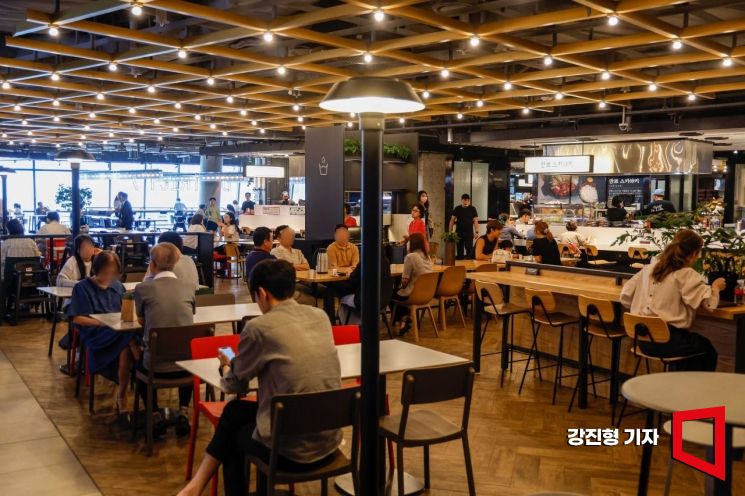
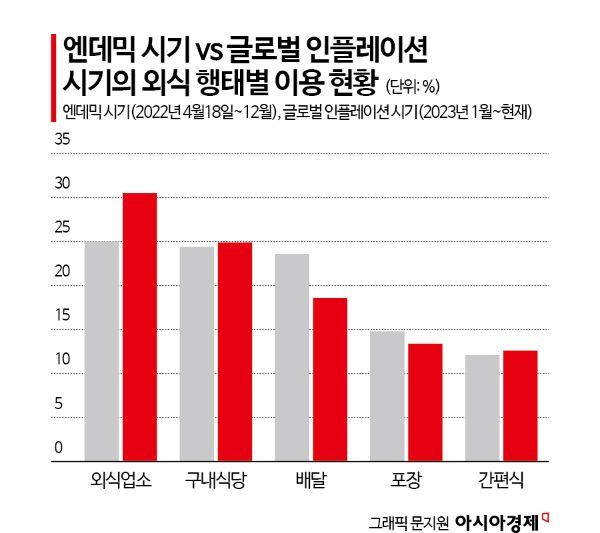
According to the ‘2023 Dining Out Consumption Behavior Survey’ conducted on adults aged 20 to 69 nationwide by the Ministry of Agriculture, Food and Rural Affairs and the Korea Agro-Fisheries & Food Trade Corporation (aT) on the 9th, the proportion of visits to dine out during the global inflation period (January 2023 to present) was 30.5%, which is 5.5 percentage points higher than the endemic period (25.0%) from April 18, 2022, when social distancing was lifted, until December of the same year. In addition, the proportion of people using cafeterias slightly increased from 24.4% to 24.9% due to rising prices.
On the other hand, the proportion of dining out through delivery and takeout, which grew rapidly during the COVID-19 pandemic period (before April 18, 2022) and the endemic period, showed a declining trend. The proportion of delivery dining out, which was 23.6% during the endemic period, decreased by 5.0 percentage points to 18.6%, and the proportion of takeout dining out also decreased by 1.4 percentage points from 14.8% to 13.4% during the same period.
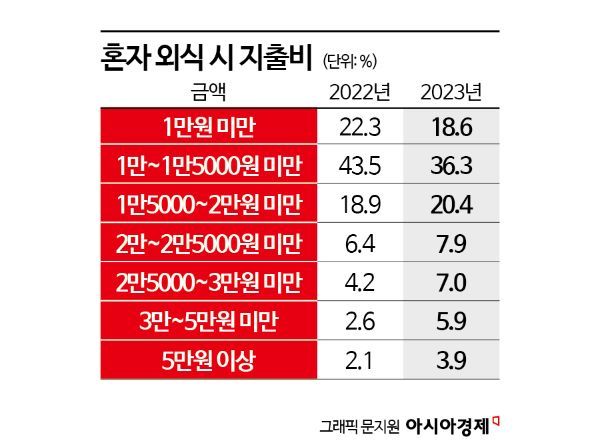
The spending ceiling when dining out is also rapidly rising in line with the high inflation trend. The percentage of respondents who answered that the spending ceiling for dining alone is 15,000 won decreased by more than 10 percentage points from 65.8% in 2022 to 54.9% last year, while the percentage of respondents who answered that it is between 15,000 and less than 30,000 won increased from 29.5% to 35.3%, reflecting the higher prices.
On the other hand, spending per person when dining out with companions was highest at 30,000 to 50,000 won, similar to 2022, but the percentage of respondents who spent between 15,000 and less than 30,000 won slightly increased from 51.9% in 2022 to 53.9% last year. This shows a contrasting result where the spending ceiling ratio increases when dining alone, but decreases when dining with others.
This is interpreted as an effect of the sharply rising dining out prices last year. In 2022, after the lifting of social distancing, small gatherings that had been postponed increased, raising the frequency and spending of dining out with companions. However, last year, due to the increased dining out prices, dining out with companions was reduced to only necessary occasions, while spending was controlled by dining alone, which is relatively easier to manage in terms of cost.
Meanwhile, the greatest burden of dining out expenses was found to be dinner. Regarding sensitivity to payment costs by dining out category, more than half of respondents (53.1%) answered that dinner was the highest, more than twice as high as lunch (23.0%). Dinner is interpreted to be relatively burdensome due to the high rate of various gatherings and continuous price increases. On the other hand, coffee and beverages (5.2%) and bakery and other desserts (2.2%) were found to be relatively less burdensome.
© The Asia Business Daily(www.asiae.co.kr). All rights reserved.













