Jinju, Sacheon, Goseong, Changwon, Gimhae, and Yangsan in Gyeongnam have been selected as the first pilot areas for the Ministry of Education's Educational Development Special Zones.
The Educational Development Special Zones are a government contest project aimed at preventing regional extinction and nurturing outstanding talent through region-led educational innovation, promoting new opportunities for local areas.
The pilot special zones will receive an annual budget ranging from 3 billion to 10 billion KRW for three years.
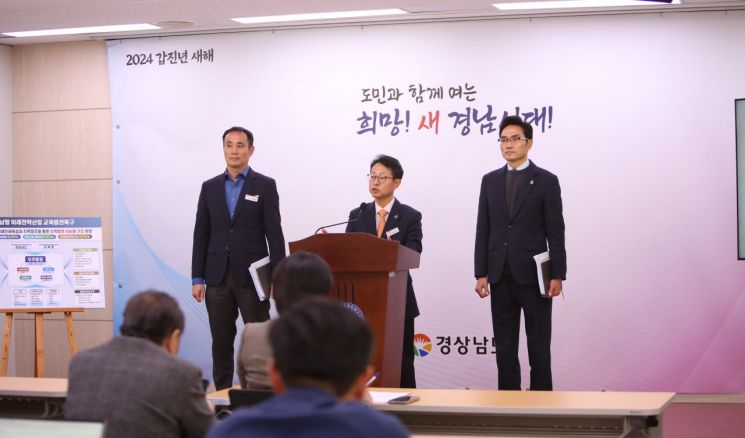 Yoon In-guk, Director of the Youth Education Bureau of Gyeongnam Province, is explaining the operation of the pilot leading areas for the educational development special zone in the province.
 [Photo by Lee Se-ryeong]
According to Gyeongnam Province, a total of 6 metropolitan local governments and 43 basic local governments nationwide were finally selected as pilot areas for the Educational Development Special Zones this year.
In Gyeongnam Province, there are five zones: aerospace in Jinju, Sacheon, and Goseong; smart manufacturing in Changwon; nano technology in Miryang; future shipbuilding in Geoje; and automotive and biomedical education development special zones in Gimhae and Yangsan.
The Ministry of Education announced 31 final pilot areas for the Educational Development Special Zones, including Gyeongnam Province, which had the highest number of designations nationwide with 8 cities and counties.
As a pilot leading area for the educational special zones, Gyeongnam Province will receive additional points in various Ministry of Education project contests, including special grants and designation of specialized high schools under agreement, for three years.
A foundation will also be established to create a virtuous cycle of regional development through nurturing strategic industry talent and regional settlement from elementary school to adults.
In the five educational special zones within the province, about 6,000 industrial skilled workers will be trained over three years in connection with specialized high schools in the province.
The regional talent admission quotas for popular departments such as aerospace at Gyeongsang National University and electronic engineering at Changwon National University will be expanded to over 50%, and those for medical and pharmacy schools will be increased to over 80%.
To promote employment of overseas industrial personnel and regional settlement, overseas students will be attracted, and regulatory exemptions related to visa issuance will also be introduced.
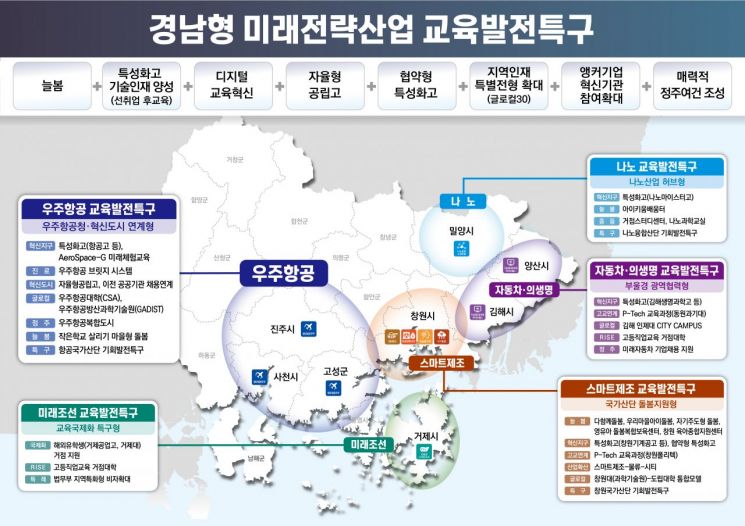 Gyeongnam-type Future Strategic Industry Education Development Zone.
 [Provided by Gyeongnam Provincial Government]
The province plans to promote the gradual expansion of Neulbom, foster technical talent at specialized high schools, and improve settlement conditions within the special zones.
In the aerospace educational development special zone, leveraging the advantage of the opening of the Aerospace Administration and the concentration of the aviation industry, about 1,200 aerospace industrial personnel will be trained in connection with specialized high schools such as Gyeongnam Aviation High School.
Within Jinju Innovation City, the autonomous public high school 2.0, tentatively called Innovation High School, will be promoted, and a joint aerospace practice center will be established within the special zone.
The role of universities will also be strengthened in connection with the high school credit system, including opening university facilities such as Gyeongsang National University and supporting university faculty lectures at high schools.
In the smart manufacturing educational special zone, the largest domestic cluster in machinery, defense, and nuclear power fields, about 1,800 manufacturing industrial personnel will be trained in connection with local specialized high schools such as Changwon Mechanical Technical High School and Masan Technical High School.
Internships linked to recruitment by large and medium-sized enterprises will be expanded to increase the employment rate of local talent in provincial companies.
In the nano educational special zone, about 30 industrial skilled workers will be trained in connection with Nano Meister High School and local companies, and regional linkage programs such as nano science classes will be operated in local middle and high schools.
In the future shipbuilding educational special zone, about 400 shipbuilding industry skilled workers will be trained in connection with Geoje Technical High School, overseas students will be attracted in cooperation with Geoje University, and a separate visa quota for the shipbuilding sector will be secured.
In the automotive and biomedical educational special zone, leveraging the strengths of automotive-related companies in Gimhae and Yangsan and the Gimhae biomedical small-scale research and development special zone, a new specialized high school tentatively called Yangsan Specialized High School, scheduled to open in 2025, will be established, and about 1,400 industrial personnel will be trained in connection with four specialized high schools including Gimhae Construction Technical High School.
Related companies will receive corporate recruitment support funds, and those employed will receive settlement support funds to encourage talent to remain in the region.
Additionally, Gyeongnam Province plans to form a promotion team together with the provincial Office of Education and eight cities and counties to establish an operation plan for the Gyeongnam Educational Development Special Zones.
They will work with the Ministry of Education to specify the project plan, prepare regulatory improvement measures for the operation of the special zones, and propose the abolition of related regulations to the Ministry of Education.
Preparations will also be made for the second contest for the Educational Development Special Zones, which will be designated in June.
A provincial official said, “There are 7,548 unfilled industrial positions in the province, indicating a serious shortage of industrial manpower. With this special zone designation, it is expected that the supply of industrial skilled workers and foreign personnel through vocational education and training institutions will increase, filling the manpower needed by local industries.”
Yoon In-guk, Director of the Office of Education and Youth, said, “Through the operation of the Gyeongnam-type Educational Development Special Zones, we will support everything from care to nurturing outstanding local talent desired by companies, making Gyeongnam a vibrant place where talent gathers and a great place to raise children.”
© The Asia Business Daily(www.asiae.co.kr). All rights reserved.













