Statistics Korea Announces 'Provisional Results of 2023 Birth and Death Statistics'
Last year, the total fertility rate, which is the average number of children a woman is expected to have in her lifetime, hit a new all-time low at 0.72. In the fourth quarter of last year, the total fertility rate fell below 0.7 for the first time, reaching the 0.6 range. The annual number of births dropped to 230,000.
On the 28th, Statistics Korea announced the provisional results of the '2023 Birth and Death Statistics,' revealing that last year's total fertility rate was 0.72, down 0.06 from the previous year (0.78), marking the lowest since statistics began in 1970.
South Korea has ranked last among OECD countries in total fertility rate since 2013. According to the most recent statistics from 2021, South Korea was the only country with a total fertility rate below 1. Spain, which has the second-lowest fertility rate after Korea, had a total fertility rate of 1.19. Last year, Korea's total fertility rate was less than half of the 2021 OECD average of 1.58.
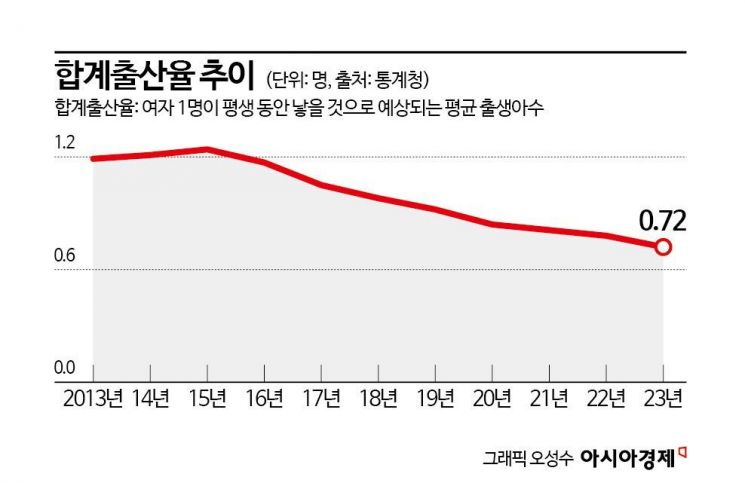
South Korea's total fertility rate has steadily declined from the 4-point range in 1974 (3.77) to the 3-point range, then to the 2-point range in 1977 (2.99), and further down to the 1-point range in 1984 (1.74). It fell below 1.0 in 2018 (0.98) and continued to decline to 0.92 in 2019, 0.84 in 2020, 0.81 in 2021, 0.78 in 2022, and last year. This marks eight consecutive years of decline since 2016. By region, Seoul had the lowest total fertility rate at 0.55, followed by Busan (0.66) and Incheon (0.69). The highest fertility rate was in Sejong at 0.97.
The government expects the total fertility rate to drop to the 0.6 range by next year before rebounding. In the population projection released by Statistics Korea last year, the total fertility rate was forecasted to fall to 0.68 this year. Lim Young-il, head of the Population Trends Division at Statistics Korea, said, "Since the number of marriages has increased since the second half of 2022, there is a possibility of a rebound in births," adding, "The decline in marriages after COVID-19 affected the total fertility rate in 2022 and 2023."
Number of births at 230,000... down 19,200 from previous year... average maternal age rises 0.1 years to 33.6 years
Last year, the number of births was 230,000, a decrease of 19,200 (-7.7%) from the previous year (249,200). The crude birth rate, which indicates the number of births per 1,000 people, also fell by 0.4 to 4.5. Both the number of births and the crude birth rate are at historic lows.
The number of births was 731,000 thirty years ago in 1992 but dropped to the 400,000 range by 2002 (497,000). Five years ago, in 2017, it fell to the 300,000 range (358,000). It further declined to 272,000 in 2020 and broke below 240,000 three years later. Last year's birth count was just over half of the 436,500 recorded ten years ago in 2013.
Of the 239,200 births last year, 138,300 were first-born children, 74,400 were second-born, and only 17,300 were third-born or higher. The number of first-born children decreased by 4.6% from the previous year, while second-born and third-born or higher dropped significantly by 11.4% and 14.5%, respectively. Consequently, the proportion of first-born children among all births increased by 1.9 percentage points to 60.1%. The proportions for second-born and third-born or higher were 32.3% and 7.5%, respectively.
The average maternal age for first and second or higher births was 33.6 years, up 0.1 years from the previous year. The average maternal age has been setting new records every year and remains higher than the OECD average. The proportion of mothers aged 35 and older was 36.3%, up 0.6 percentage points from the previous year. Ten years ago, in 2013, this proportion was only 20.2%.
© The Asia Business Daily(www.asiae.co.kr). All rights reserved.












