The Supreme Court has ruled that truck owners who purchase their trucks directly, enter into consignment contracts with companies, and perform document shredding and transportation tasks are considered workers under the Labor Standards Act, and therefore can receive medical care benefits under the Industrial Accident Compensation Insurance Act if they suffer an accident during work.
According to the legal community on the 22nd, the Supreme Court's Third Division (Presiding Justice Lee Heung-gu) overturned the lower court ruling that dismissed the appeal by Yoon, a document shredding truck owner, against the Korea Workers' Compensation and Welfare Service's denial of medical care benefits, and remanded the case to the Seoul High Court.
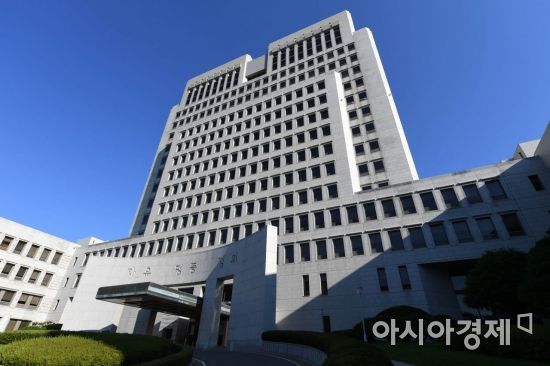
The court stated, "The lower court ruling contained errors in the interpretation of laws concerning workers under the Industrial Accident Compensation Insurance Act and the Labor Standards Act, which affected the judgment," as the reason for overturning and remanding.
Yoon, as a truck owner, purchased an 8-ton document shredding truck in June 2012 from Mr. B, who was performing document shredding and transportation work for Company A, paying 13 million won for the vehicle and 35 million won as goodwill.
Company A, which receives document shredding requests from corporations and performs shredding on-site, outsourced the document shredding and transportation work to transportation company C. Yoon entered into a freight vehicle consignment management operation contract with C, consigning the truck purchased from Mr. B, and performed document shredding and transportation tasks.
From August 2012, Yoon received 4.07 million won per month including VAT from Company A, with fuel costs paid separately, and paid part of his income as consignment fees to Company C.
Yoon's vehicle had shredders and hydraulic and electrical devices necessary for document shredding owned by Company A, and displayed Company A's logo and advertisements. Yoon was also provided with business cards indicating his affiliation with Company A.
In July 2017, while shredding documents at an office in Gangnam, Seoul, Yoon suffered an accident where his left fingers were partially amputated after being caught in the shredder.
Yoon applied for medical care benefits from the Korea Workers' Compensation and Welfare Service, claiming he was injured during work as a worker affiliated with Company A, but the Service denied the claim, leading to a lawsuit.
The first and second instance courts ruled that Yoon could not be considered a worker of Company A and dismissed his claim.
The first trial court stated, "The plaintiff is a truck owner who invested a certain amount of capital to acquire the vehicle in question and performed document shredding and transportation work for Company A through the consignment and consignment management contracts, receiving service fees from Company A. However, it is difficult to consider him a worker providing labor under a subordinate relationship for wages," and judged that the denial was lawful.
Yoon acquired the vehicle from Mr. B by paying a significant goodwill amount on top of the vehicle price, entered into a consignment contract with Company C, and performed Company A's work. However, there was no explicit contract of any form such as an employment contract, subcontract, or service contract between Yoon and Company A, and there was no indication that Yoon went through Company A's hiring process or directly requested employment when starting work for Company A.
Company A performed work not only through consigned truck owners like Yoon but also through directly employed drivers. The directly employed drivers had fixed daily working hours and received daily work assignments from Company A staff before leaving work, and the work content between consigned and directly employed drivers was not different.
The first trial court also acknowledged these facts, stating, "The plaintiff appears to have been exclusively engaged in document shredding and transportation work for Company A," but noted, "However, the plaintiff did not seem to be subject to Company A's employment rules, service regulations, or personnel regulations, filed VAT separately as a business owner, and maintained and managed the vehicle at his own expense."
Yoon appealed, but the second trial court's judgment was the same.
However, the Supreme Court's judgment differed.
The court stated, "Although Yoon, as a truck owner, effectively owned the vehicle and bore some maintenance costs, it is reasonable to consider him a worker under the Industrial Accident Compensation Insurance Act who provides labor to Company A under a subordinate relationship for wages."
The court based this judgment on the following points: ▲ Company A gave Yoon, the consigned truck owner, work instructions and supervised attendance and work performance similarly to directly employed drivers, exercising significant command and control over Yoon; ▲ The shredding equipment essential for document shredding was owned by Company A, and only the vehicle used to transport the shredding equipment to the site was owned by Yoon; ▲ Yoon performed only the tasks assigned by Company A and received a fixed monthly payment directly from Company A, while bearing the fuel costs, which constituted a significant portion of his expenses; ▲ The vehicle, on which Company A's shredding equipment was installed and Company A's name and advertisements were painted, could only be used for Company A's document shredding work and was contractually prohibited from other uses; ▲ Yoon directly purchased the vehicle from Mr. B, who was a consigned truck owner performing document shredding and transportation for Company A, and Company C, as the consignment company and registered owner of the vehicle, played no role in the vehicle's sale process; Yoon entered into a consignment contract with Company C because a freight vehicle transportation business permit was required to operate the vehicle; ▲ Company C, as the registered owner, only handled administrative support such as insurance premium payments and did not mediate or manage Yoon's work for Company A; ▲ Although Yoon did not directly contract with Company A and appeared as a business owner by registering a business and paying VAT, these circumstances do not reflect the substance of labor provision and are insufficient to strongly indicate that Yoon is not a worker.
© The Asia Business Daily(www.asiae.co.kr). All rights reserved.











