Over 3.6 Trillion Won Overseas Real Estate Fund Yet to Recognize Losses
Concerns Persist Over Earnings Pressure on Securities Firms with Large Overseas Real Estate Exposure
Domestic securities firms suffered a hit to their performance last year due to overseas real estate valuation losses, and the possibility of additional losses remains. As the risk of domestic real estate project financing (PF) defaults increases, the burden of losses related to overseas real estate is expected to continue exerting downward pressure on the profitability of securities firms.
According to the report "Status of Securities Firms' Overseas Real Estate Exposure and Related Loss Review" released by NICE Credit Rating on the 15th, as of the end of September last year, the total overseas real estate exposure (risk exposure amount) of 25 securities firms analyzed by NICE Credit Rating (Mirae, NH, Hantoo, Samsung, KB, Hana, Meritz, Shinhan, Kiwoom, Daishin, Hanwha, Yuanta, Kyobo, Shinyoung, Hyundai Motor, Hi, IBK, BNK, Eugene, Ebest, DB, Daol, Buguk, SK, Hanyang) was 14.4 trillion KRW. Most of this exposure was structured to receive cash flows such as rental income from completed real estate, with the largest investment type being real estate funds, REITs, and equity investments amounting to 8.7 trillion KRW. Contingent liabilities totaled 4.4 trillion KRW, consisting of credit extensions provided for securitized products backed by real estate funds. By region, the United States and Europe accounted for the largest shares at 6.6 trillion KRW and 5.4 trillion KRW respectively, and by usage, commercial real estate made up most of the exposure at 8.8 trillion KRW.
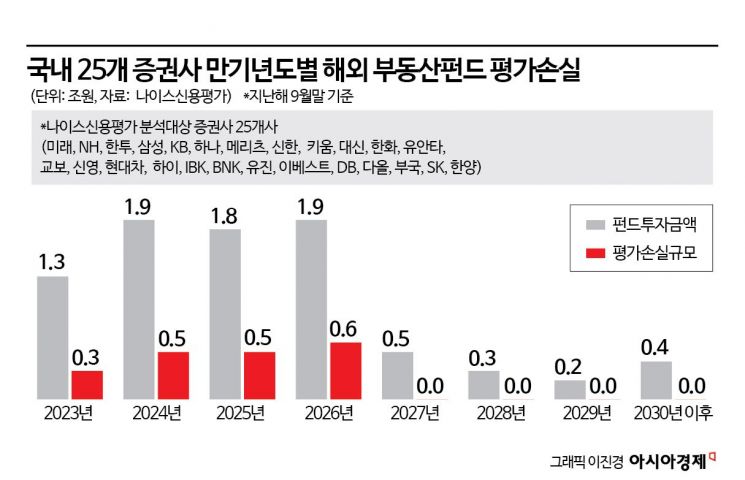
Among these 25 securities firms, approximately 1.8 trillion KRW, or 22% of the 8.3 trillion KRW in overseas real estate funds, was recognized as valuation losses. More than half of the funds (worth 4.6 trillion KRW) showed a high valuation loss rate of about 40%, while approximately 3.6 trillion KRW of overseas real estate funds have yet to recognize any losses.
Ye-ri Lee, Senior Researcher at NICE Credit Rating's Financial Evaluation Division, pointed out, "Although additional losses related to overseas real estate were recognized in the fourth quarter of last year, the decline in rental demand and the continuation of a high-interest-rate environment are negative factors for the overseas real estate market, so the possibility of additional losses on overseas real estate exposure by domestic securities firms remains."
Among the 25 securities firms, six firms?Mirae Asset, NH, Hana, Meritz, Shinhan, and Daishin Securities?had overseas real estate exposure exceeding 1 trillion KRW as of the end of September last year. Their overseas real estate exposure relative to their equity capital was about 31%. Securities firms with high overseas real estate exposure showed a notable decline in performance compared to the previous year. Researcher Lee analyzed, "The decline in performance was particularly significant among four firms: Mirae, Hana, Meritz, and Shinhan. Considering the substantial overseas real estate-related losses these four firms recognized last year, the large-scale recognition of losses on overseas real estate exposure appears to be the main cause of their performance decline."
Mirae Asset Securities recorded a net profit of 298 billion KRW last year, down 57.8% from the previous year. Hye-jin Park, a researcher at Daishin Securities, explained, "Among the total investment-purpose assets of 7.5 trillion KRW held by Mirae Asset Securities, a valuation loss of 350 billion KRW was reflected in the fourth quarter of last year. Most of these are overseas commercial real estate, with overseas commercial real estate exposure of 2 trillion KRW as of the end of December 2023, mainly in the United States, Europe, and Hong Kong, where large-scale losses occurred." Hana Securities recorded a net loss of 267.3 billion KRW last year, turning to a deficit. Hana Securities attributed this performance to provisions and valuation losses on held assets.
There are forecasts that securities firms with large overseas real estate exposure will continue to face performance burdens. Do-hyung Woo, a researcher at IBK Investment & Securities, said, "Concerns are being raised about overseas commercial real estate following domestic real estate PF, and for securities firms with large overseas alternative investment exposure, performance burdens are expected to persist."
© The Asia Business Daily(www.asiae.co.kr). All rights reserved.











