Growing Expectations for Interest Rate Cuts Gradually Being Pushed Back
Various U.S. macroeconomic indicators such as consumption and employment continue to show resilience, and with oil prices also rising, expectations for a cut in South Korea's benchmark interest rate are being pushed back.
The recently released U.S. January Consumer Price Index (CPI) exceeded market forecasts, and employment data showed an increase in average hourly wages. International oil prices have also turned upward this month, exacerbating inflation concerns. Since South Korea's monetary policy is strongly influenced by the U.S., the market had been raising expectations for a rate cut in the second quarter of this year. However, if economic indicators continue to deviate from the expected path, uncertainty may increase further.
Expectations for a U.S. rate cut have been steadily delayed. As of mid-last month, according to the Chicago Mercantile Exchange (CME) FedWatch, the probability of a rate cut in March exceeded 80%, but following hawkish remarks from Federal Reserve officials and multiple employment data releases, it dropped to around 20% last week. Consequently, expectations shifted to a possible cut in May, but this also plummeted immediately after the U.S. January CPI release. Currently, the market sees about a 60% chance that the Fed will keep rates unchanged in May.
The Bank of Korea's (BOK) outlook on the U.S. economy has also changed significantly from late last year to early this year. In the economic outlook report released by the BOK's Survey and Research Team in November last year, a slowdown in the U.S. economy in the first half of this year was anticipated. However, the BOK New York Office's report published in January dismissed these concerns. A BOK official explained, "At the end of last year, there was a judgment that a slowdown in the economy might be felt in the first half of this year, but recent indicators have incorporated many changes, and internally, perspectives have shifted considerably."
Accordingly, the market views that not only have early expectations for a U.S. rate cut faded, but even a rate cut in the first half of the year has become uncertain. Seongwoo Park, an analyst at DB Financial Investment, said, "I still believe the possibility of a cut in May is high," but added, "The risk of delay in the Fed's rate cut timing has increased." Economist Geonhyung Ha of Shinhan Investment Corp. also explained, "The Fed may attempt to postpone the timing of rate cuts more than the market expects to stabilize inflation," and "It is necessary to keep open the possibility that expectations for a rate cut in the first half may shift to the second half."
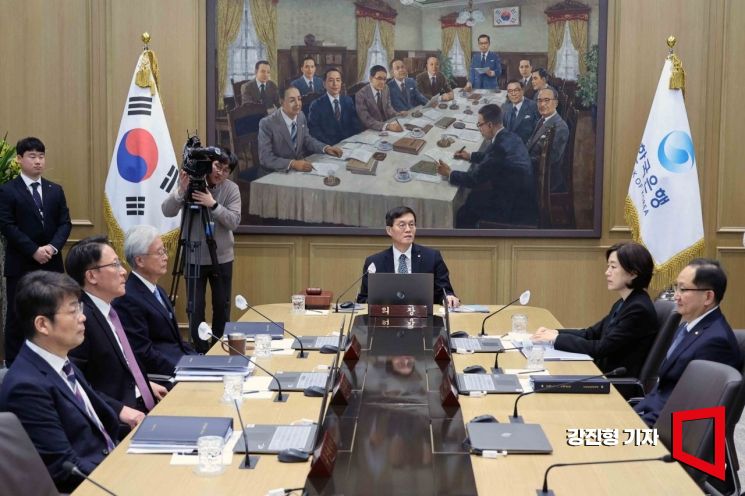
Lee Chang-yong, Governor of the Bank of Korea, mentioned in this year's financial sector New Year's address that there is a growing possibility of placing greater weight on domestic conditions in policy decisions, but this also means that the focus could shift again if external circumstances change. Sensing the changed mood regarding the U.S. economy, Governor Lee stated at the Korea CEO Forum earlier this month, "Since U.S. growth is strong, our monetary policy is influenced by the Fed not lowering rates quickly, so the pace of rate cuts may slow down."
Due to international oil prices, which had been declining for the past two months but have turned upward this month, consumer prices are in an unpredictable situation. The prolonged Middle East conflict could disrupt supply, and China's economic stimulus efforts are expected to increase oil demand. In particular, after news last week of delays in Israel-Hamas ceasefire negotiations, international oil prices rose for seven consecutive trading days. JP Morgan predicted that Brent crude oil prices could rise by an additional $10 per barrel in the first half of the year, assuming voluntary production cuts by major oil-producing countries.
The Korea Development Institute (KDI), which revised its economic outlook the day before, expects the consumer price inflation rate to be slightly lower at 2.5% compared to the previous forecast of 2.6%, but expressed concern that geopolitical factors causing oil price increases pose a persistent risk of upward pressure on inflation. In the recently released minutes of the January Monetary Policy Committee meeting, one committee member noted, "Consumer prices are expected to exceed the target level for more than a year, and upside risks from the supply side also remain."
Among the inflationary concerns is the effect of liquidity that has been supplied so far, suggesting that even if international oil prices stabilize, the issue will not end as a short-term problem. Professor Junmo Yang of Yonsei University's Department of Economics explained, "Even after COVID-19, as financial markets tightened, the government's liquidity injections have had side effects causing inflation to rise," adding, "Because of this effect, the timing of our rate cut is likely to be further delayed, and policymakers are aware of this."
© The Asia Business Daily(www.asiae.co.kr). All rights reserved.












