"Starting with Groups Agreeing to the Agreement"... Securing Leadership
Green Justice Party, Progressive Party, and New Progressive Union Prioritize 'In the Assembly'
Park Hong-geun: "Unify Constituencies with 'Winning Candidates'"
The Democratic Party of Korea has begun full-scale efforts to establish a 'proportional satellite party' as part of a broad opposition coalition. The Democratic Party has made it clear that it will prioritize alliance work with party groups that agree to the 'agreement' and intends to firmly hold the initiative.
On the morning of the 8th, Park Hong-geun, head of the Democratic Reform Progressive Election Alliance (Democratic Alliance) Promotion Team, told reporters at the National Assembly, "(The opposition election alliance) is most important to handle smoothly and swiftly through agreement," but added, "If an agreement is not reached by an appropriate deadline, we will have no choice but to prioritize the alliance centered on the party groups that agree with our agreement."
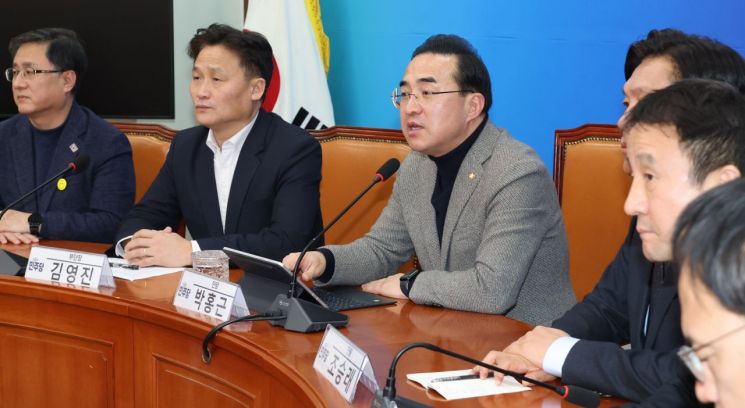 Park Hong-geun, head of the Democratic Reform and Progressive Election Alliance Promotion Team of the Democratic Party of Korea, is holding a press briefing at the National Assembly on the 8th.
 [Image source=Yonhap News]
The Democratic Alliance Promotion Team plans to start discussions with the Alliance Political Civic Meeting, which has advocated for maintaining the 'mixed-member proportional representation system' along with three progressive parties in the National Assembly based on 'national representativeness.' The three parties are the Green Justice Party, the Progressive Party, and the New Progressive Alliance. Park said, "We will hold a 'Joint Meeting of the Alliance Political Civic Meeting' with these groups as soon as possible and officially propose their participation in the discussions."
Regarding the composition of the Democratic Alliance, three pillars were presented: ▲policy alliance ▲proportional alliance ▲regional alliance. Each will promote joint general election pledges with a priority on people’s livelihood, establish a rational and democratic selection system, and aim to win by unifying 'winning candidates' in constituencies.
The policy of 'prioritizing promotion with groups that agree to the agreement' mentioned by Park on that day is interpreted as the Democratic Party signaling its intention to take the lead in the broad opposition coalition process. On the 5th, Lee Jae-myung, the party leader, announced the plan to promote a 'unified proportional party,' emphasizing, "Because the Democratic Party is the eldest brother with the largest share of the progressive reform camp and democratic camp in the opposition, it inevitably must bear great responsibility and naturally should have authority commensurate with that responsibility." At the Supreme Council meeting the day before, he said, "To preserve even a little of the purpose of the semi-proportional system, we will look for ways to share some proportional seats with minor parties or civil society."
Before the last general election, the Democratic Party also formed the satellite party, the Together Citizens' Party. Negotiations were held with groups such as the 'Political Reform Alliance,' centered on the Justice Party and civil society elders, but an election alliance was not formed. At that time, Basic Income Party lawmaker Yong Hye-in and Transition Era lawmaker Cho Jung-hoon joined through the Citizens' Party. The key issue in this opposition election alliance is how to divide the order on the proportional representation list. The Democratic Party, Green Justice Party, Progressive Party, and New Progressive Alliance must divide the 1st to 20th positions, which correspond to the winning ranks on the proportional representation list. In this context, the 'agreement' mentioned by Park is also interpreted as a signal to exclude minor parties that demand excessive shares.
© The Asia Business Daily(www.asiae.co.kr). All rights reserved.












