S&P Rises for 5 Consecutive Trading Days... Surpasses Year-End Forecast
7 Major Tech Stocks Lead Market Amid AI Boom
Concerns are emerging on Wall Street about the relentlessly rising U.S. stock market in the new year.The S&P 500 index has already surpassed its year-end forecast within 24 days, reminiscent of the 1990s 'dot-com bubble.'
On the 24th (local time), Bloomberg reported that the S&P 500 index in the New York stock market rose for five consecutive trading days, exceeding its own forecast. Bloomberg's internal survey had predicted that the S&P 500 would average 4867 around November, but it closed at 4868.55 on that day.
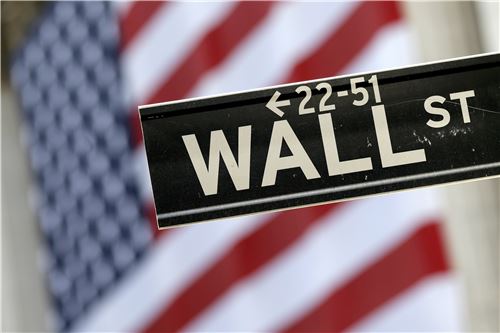 Wall Street Sign (Asia Economy = Yonhap News)
The S&P 500 index fell 19% in 2022 due to the Federal Reserve's (Fed) interest rate hikes and concerns over economic slowdown. However, buoyed by the strong performance of the seven major tech stocks, known as the 'Magnificent 7' (Apple, Amazon, Alphabet, Microsoft, Meta Platforms, Tesla), the index surged 24% over the year. Gaining momentum from last year's rally, it continues to rise daily this year.
Consequently, voices of concern about the S&P 500's soaring trajectory have also surfaced. Ed Yardeni, founder of the investment advisory firm Yardeni Research and a leading bull on Wall Street, stated in a memo, "The main concern now is whether the S&P 500 index could start a collapse similar to the dot-com bubble burst in the late 1990s." He added, "We wonder if irrational overheating could inflate speculative bubbles in the stock market and raise price-to-earnings ratios as it did in the late 1990s." He predicted the S&P 500 could soar to 5400 by year-end. Nonetheless, he finds the current pace of increase worrisome.
Mayung Yoo, Chief Investment Officer (CIO) at BMO Wealth Management, said, "We cannot say a bubble is forming, but it is increasingly overheating," adding, "The question is whether companies can meet the high expectations set for them year after year."
Driven by the artificial intelligence (AI) boom, the Magnificent 7's stock prices have nearly doubled over the past year. According to Bloomberg estimates, the Magnificent 7's earnings increased by an average of 39%.
On the other hand, some argue that the market overheating is not comparable to the past dot-com bubble. Bloomberg explained, "Looking at the Magnificent 7, they are trading at a price-to-earnings ratio of 49 times earnings. Considering the average stock in the S&P 500 trades at 17 times, this seems very expensive," but added, "However, compared to the bubble era of the late 1990s, valuations are relatively moderate."
According to recent analysis by Bank of America (BoA) strategists including Benjamin Bowler, even if the Magnificent 7 only reach half of the peak multiples of the seven major tech stocks during the late 1990s dot-com bubble, they would each need to rise an additional 55% from current prices. This implies the S&P 500 would need to increase by 15% more.
Wall Street issued a conservative forecast in December last year, predicting the S&P 500 would rise 1.3% this year. This reflected recession concerns following the Fed's aggressive rate hikes amid escalating geopolitical tensions worldwide. Bloomberg described this as the lowest forecast since it began compiling data in 1999.
However, since January, the mood has shifted as the S&P 500 has charted an upward curve. According to data compiled by Morgan Stanley Prime Brokerage, hedge funds that reduced their tech stock holdings from mid-August to December last year are returning to tech stocks in the new year. Bloomberg also reported similar patterns in JP Morgan Chase client data. Ron Adler, head of U.S. cash trading at JP Morgan, stated in a recent memo to clients, "The market is rising amid a mix of cheers and FOMO (Fear Of Missing Out)."
© The Asia Business Daily(www.asiae.co.kr). All rights reserved.











