2024 Top 7 Domestic Trend Report
South Korea's Potential Economic Growth Rate Expected to Remain Around 2.2% Until 2028
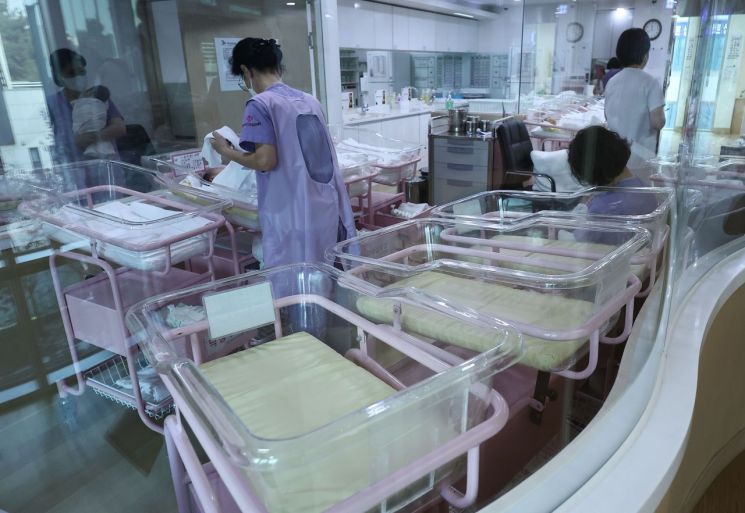
It has been predicted that a mid- to long-term low-growth era will arrive in South Korea due to a significant decline in the potential growth rate caused by low birth rates and an aging population.
On the 14th, Hyundai Research Institute released the '2024 Seven Major Domestic Trends Report,' estimating that South Korea's potential growth rate will remain at around 2.2% until 2028 following the COVID-19 crisis.
South Korea's potential growth rate has gradually decreased from an average annual rate of 7.3% during 1991?1997 before the foreign exchange crisis, to 5.1% during 1998?2008 after the crisis, 3.0% during 2009?2019 after the financial crisis, and 2.2% during 2020?2028 after the pandemic (global outbreak).
Looking at the past trends of the Korean economy, the potential growth rate tends to sharply decline immediately after a 'mega crisis' (large-scale economic crisis). It is explained that the potential growth rate dropped significantly from 3.0% to 2.2% around the COVID-19 pandemic crisis.
The institute analyzed that the main causes of the sharp decline in potential growth rate are the rapid decrease in the working-age population due to low birth rates and aging, and the reduction in capital accumulation.
It is also explained that the potential growth rate declines because the pace of expansion of qualitative production factors such as technological innovation and social capital, which compensate for this, is not fast enough.
The institute argued that to raise the potential growth rate, it is urgent to expand quantitative production factors such as labor and capital, as well as to strengthen the competitiveness of qualitative production factors such as technology and human capital.
In response to the decrease in the working-age population, comprehensive efforts are needed, including expanding childcare infrastructure to increase birth rates, introducing immigration systems at the level of advanced countries, and encouraging economic participation of the elderly and women.
Meanwhile, to improve the level of qualitative production factors, an efficient research and development ecosystem that can promote rapid technological innovation in the industry should be established through the establishment of a role-sharing structure between the private sector and government in national research and development, and enhancing the performance of government R&D projects, the report added.
© The Asia Business Daily(www.asiae.co.kr). All rights reserved.












