The Bank of Korea: "Liquidity Deterioration Precedes Volatility Expansion"
When major events such as the COVID-19 pandemic occur, a phenomenon of market function deterioration appears in the government bond markets of major countries, where market liquidity shrinks or prices fluctuate sharply within a short period. An analysis has emerged emphasizing the urgent need to establish a system that can monitor this in real time.
On the 21st, the Bank of Korea announced through its analysis titled "Monitoring Market Dysfunction in the Government Bond Market Using High-Frequency Real-Time Data" that market liquidity deterioration generally occurs alongside increased volatility. It also revealed that when unexpected news related to the government bond market is reported, liquidity deterioration precedes the expansion of volatility.
This study used large-scale big data, specifically high-frequency bid and transaction data, to calculate and analyze market monitoring indices such as illiquidity, volatility, and market depth. The research was conducted by analyzing bid and transaction data of the 3-year benchmark government bond and the nearest month 3-year government bond futures in the on-the-run government bond market (government bond specialized distribution market) and the government bond futures market.
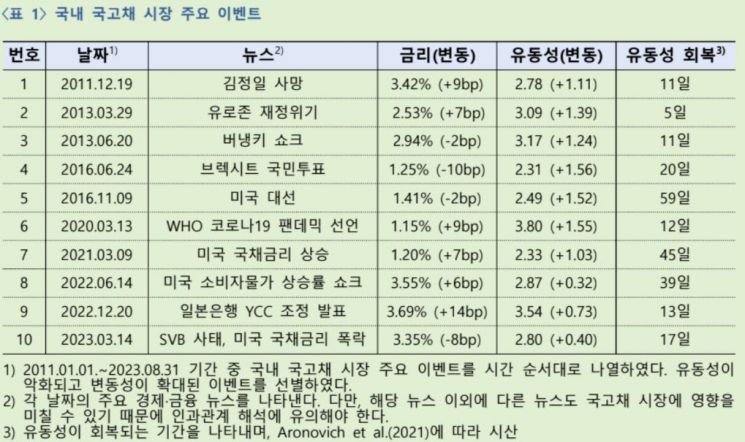
Specifically, the study analyzed intraday market movements on days when the market liquidity index was high or volatility expanded during the period from January 2011 to August 2023. For example, on December 19, 2011, when Kim Jong-il passed away, the interest rate change was +9bp (1bp = 0.01 percentage points). On June 24, 2016, dominated by news of the United Kingdom's European Union (EU) withdrawal (Brexit) referendum, the interest rate change was -10bp. On December 20 of last year, when the Bank of Japan announced an adjustment to its Yield Curve Control (YCC), the interest rate change reached +14bp. The liquidity recovery periods for these events were 11 days, 20 days, and 13 days, respectively.
Lee Min-young, Manager of the Digital New Technology Team at the Digital Innovation Office of the Bank of Korea, explained, "When market liquidity deteriorates significantly, slow recovery is often observed, and volatility tends to be higher than usual." She added, "After the COVID-19 pandemic declaration (March 11, 2020), a cash hoarding demand phenomenon appeared, confirming a sharp deterioration in liquidity."
The report expects that by calculating indices such as market liquidity and market depth in real time using large-scale big data of high-frequency bid and transaction data, it will be possible to quickly capture market movements such as sudden expansions in price volatility and improve the timeliness of responses.
Lee emphasized, "Major countries are developing systems to monitor bond and foreign exchange markets in real time using high-frequency data," and added, "In Korea as well, with increasing foreign trading and advancements in algorithmic trading technology, uncertainties related to the government bond market are rising, making it urgent to establish a system that can closely monitor intraday market conditions."
© The Asia Business Daily(www.asiae.co.kr). All rights reserved.












