Discussion on Party Charter and Regulations Amendment at Central Committee on 7th
Vote on 'Reduction of Delegate System, Expansion of Penalties for Low Evaluators'
Byeonggye Faction Appeals Against Rejection, Calling It 'De Facto Abolition of Delegate System'
The Democratic Party of Korea is experiencing intensified internal conflict ahead of the resolution on the party constitution and regulations amendment, which includes adjusting the deduction rate for lower-ranked incumbent lawmakers and reducing the authority of the delegate system. Previously, with Rep. Lee Sang-min's declaration of withdrawal, internal disputes over electoral reform, and the emergence of former leader Lee Nak-yeon, who has risen as a centrifugal force to unite the non-Lee Myung-bak faction, the Lee Jae-myung loyalist regime is under pressure, and the 'reduction of the delegate system' to be discussed at the Central Committee meeting on the 7th is expected to bring party conflicts to a peak.
On that day, the Democratic Party will hold a Central Committee meeting at the National Assembly and conduct a public debate on the proposal to significantly increase the proportion of votes from party members with voting rights in the party convention scheduled for next August, where the party leader and supreme council members will be elected, and the proposal to expand the deduction for lower-ranked incumbents in next year's general election.
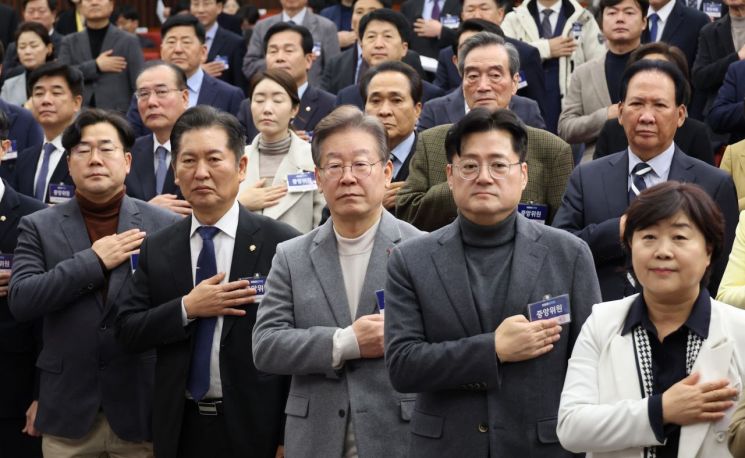
Party leader Lee Jae-myung said in his opening remarks, "There are many opinions about today's party constitution amendment proposal," adding, "A political party is a gathering of people with diverse opinions, so it is certain that the pros and cons of this amendment will be fiercely opposed." He continued, "The party leadership believes that from the perspective of party member democracy and party democratization, the party should move toward a democratic party where the will of the members is more reflected in the party," and explained, "On the other hand, there are opinions that maintaining the system is desirable, so although we cannot satisfy both sides completely, we are attempting to ensure a certain degree of vote equivalence." He emphasized, "I hope a decision that meets the reasonable expectations of party members will be made." Floor leader Hong Ik-pyo also said, "We will collect various opinions on the amendment proposal and reach a conclusion well, and Lee Jae-myung and the leadership will responsibly lead the party."
The Central Committee plans to announce the results after conducting a three-hour vote starting at noon following the morning debate.
On the 27th of last month, the Democratic Party held a party affairs committee meeting and passed two agenda items: 'reduction of the delegate system' and 'expansion of deductions for lower-ranked incumbents.' The core of the first is to reduce the authority of delegates and increase the proportion of party members with voting rights in the rules for advancing to the final round of the party convention candidates. Currently, votes are reflected at a ratio of 30% delegates, 40% party members with voting rights, 25% public opinion, and 5% general party members. The proposal adjusts this to 30% public opinion survey and 70% combined delegates and party members with voting rights, with the reflection ratio adjusted to less than 20 to 1. Considering that currently 60 votes from party members with voting rights correspond to one delegate vote, the value of a party member's vote will increase more than threefold under this adjustment. Additionally, for next year's general election, the deduction rate for primary votes of incumbent lawmakers ranked in the bottom 10% in the 'elected official evaluation' will be raised from the current 20% to 30%. Both agenda items face strong opposition within the party, making it uncertain whether they will pass the Central Committee. Especially regarding the reduction of the delegate system, the non-Lee Myung-bak faction strongly opposes it, claiming it is to strengthen the voice of a specific faction.
On the previous day, Rep. Jeon Hae-cheol criticized on Facebook, saying, "In a situation where we must focus on winning the general election, creating controversy over the delegate system unrelated to the election undermines party unity," and added, "Adjusting the proportion of delegate votes should be sufficiently discussed and publicized during the party convention preparation committee process ahead of next year's party convention." Rep. Lee Won-wook also sent a letter to the Central Committee members, stating, "Considering the actual voter turnout at the party convention where Lee Jae-myung was elected party leader, one delegate vote corresponds to about 23 votes of party members with voting rights," and argued, "If adjusted by this proposal, one delegate vote will be worth about 10 to 15 votes of party members with voting rights. This is effectively the abolition of the delegate system."
On that day, Rep. Lee said on BBS Radio in response to the host's question, "Do you think the vote should be rejected at today's Central Committee?" "I think it should be rejected, so I sent text messages to Central Committee members asking them to reject it," he replied. However, he was skeptical about the actual possibility of rejection.
Rep. Lee criticized, "It's a sneaky agenda with a sneaky Central Committee," and said, "(The vote) will not be held offline in person but mixed online and offline. I have experienced many online Central Committee meetings, but if voting is done online, they only do the final vote and do not listen to the debate," pointing out. He added, "If they don't listen to the debate, most votes will just follow the leadership's thoughts. Why does the Democratic Party keep making the word 'democracy' embarrassing?" He questioned, "Anyway, it should be rejected this time, but since the Lee Jae-myung leadership system is firmly established, I am curious whether it will reach rejection."
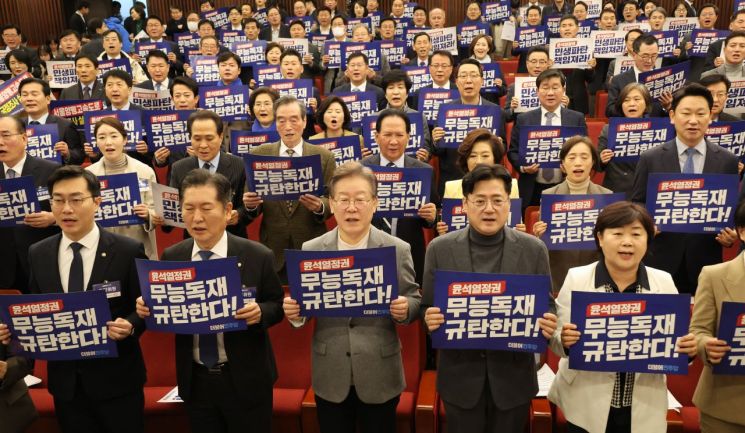
Criticism also arises regarding the attempt to revise the nomination rules to expand deductions for lower-ranked incumbents. The Democratic Party passed a proposal last month at the party affairs committee to raise the deduction rate for primary votes of incumbent lawmakers ranked in the bottom 10% in the 'elected official evaluation' from the current 20% to 30% for next year's general election.
Rep. Park Yong-jin sent a letter directly to Central Committee members on the 5th, urging, "I earnestly ask you to reject the party constitution amendment proposal at the Central Committee vote on the 7th," and said, "The elected official evaluation committee has already been formed, and various evaluations of incumbent lawmakers have been conducted, along with public opinion surveys targeting party members and local residents. Changing the rules or scoring during the game is an unfair act that invites controversy." He continued, "Whenever concerns about factional nominations or nomination massacres arise, the Democratic Party has denied them by emphasizing system nominations and has won elections several times based on this system. Suddenly shaking the system nomination through party constitution amendments will also shake party democracy and unity for winning the general election. Since there was no proper internal discussion or opinion gathering process before the Central Committee agenda, it is inviting a convenience-oriented approach and factional nomination controversy."
However, pro-Lee Jae-myung faction member Rep. Jung Sung-ho appeared on KBS Radio that day and said, "It is said to be a 'violation of the party constitution' because the party constitution related to nominations is supposed to be finalized one year before the election, but if that rule itself is changed, it would be possible if there is consensus among members." Rep. Jung emphasized again the purpose of expanding deductions for lower-ranked incumbents, saying, "Currently, the barrier of vested interests of incumbent lawmakers is too high, making it very difficult for new figures to enter." He said, "Currently, a 20% deduction for the bottom 10% is not enough; it should be 30%. I think that level of penalty is necessary for new figures to have a chance to enter." He added, "In my view, even with a 30% deduction, if new figures do not have additional points, it is not easy to defeat incumbents," and said, "In that sense, I hope Rep. Park Yong-jin and other lawmakers understand that the revision of nomination rules to expand deductions for lower-ranked incumbents is about incumbent lawmakers relinquishing vested interests."
© The Asia Business Daily(www.asiae.co.kr). All rights reserved.