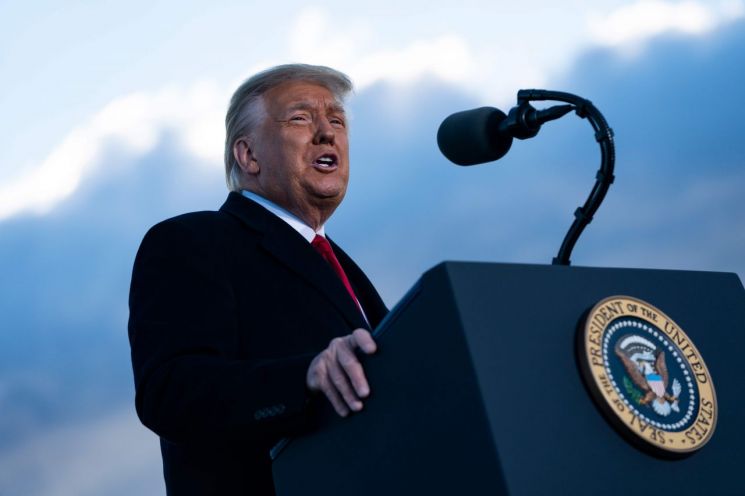
There are many predictions that if former President Donald Trump succeeds in re-entering the White House in next year's presidential election, he will revive his bromance with North Korean Supreme Leader Kim Jong-un and escalate conflicts between South Korea and the U.S. over the level of defense cost-sharing for U.S. troops stationed in South Korea. During his first term, Trump demonstrated that he values political flexibility and prioritizes actions that bring immediate tactical political advantages. Scott Snyder, director of the Korea Economic Institute of America (KEI), a U.S. research institute specializing in Korea-U.S. relations, outlined three reasons why Trump's bromance with Kim may not be revived even if he wins re-election, based on new realities he may face in his next term, in a contribution to the U.S. security media outlet National Interest.
First, unlike the previous Moon Jae-in administration, which pursued dialogue and cooperation with Kim Jong-un, the Yoon Suk-yeol administration is expected to advise Trump to pursue a deterrence strategy against North Korea's increasing threats. Since the South Korean president no longer supports the restoration of inter-Korean relations, Snyder believes that if the U.S. attempts to restore relations with North Korea, it will come at a greater cost. The Yoon administration is likely to oppose Trump's efforts to resume talks with North Korea until Pyongyang expresses a willingness to denuclearize, and Snyder predicts it will be reluctant to mediate such efforts.
The second reality is that Kim Jong-un may not feel the need to engage in talks with Trump because he is receiving more support from Russia and China. Snyder speculated that Kim, who suffered the humiliation of the failed negotiations at the second North Korea-U.S. summit held in Hanoi in February 2019, might make demands that Trump cannot bear as conditions for resuming talks. In this case, tensions and the risk of military conflict could escalate again, with North Korea and the U.S. mocking each other's leaders as "crazy sick old man" and "rocket man," as before.
Third, Snyder believes South Korea may feel tempted to achieve a nuclear balance with North Korea. If Trump leads the U.S. again, it will be difficult to fully trust the U.S. extended deterrence commitment, especially since Trump made remarks during his past candidacy that seemed to tolerate South Korea's nuclear armament. Snyder predicted that Trump's unpredictable leadership could dramatically change the security dynamics between the two Koreas and shake the U.S. defense commitment to South Korea in unprecedented ways.
He further anticipated that, rather than repeating his first-term policies toward South Korea and North Korea, the results would be difficult to predict due to new geopolitical conditions arising from the expanding U.S.-China competition. He added, "(The second-term foreign policy) will be rooted in Trump's transactional nature, which focuses on leveraging immediate events to create political gains, regardless of precedent."
© The Asia Business Daily(www.asiae.co.kr). All rights reserved.












