Korean Society of Digital Therapeutics Autumn Conference
"Domestic Market Led by Government
Expecting Approval Applications for 3rd and 4th Products"
Clinical Adverse Reactions and Compliance Should Be Viewed Differently
Developers Say "The Problem Is Users Not Using the App"
Improving Compliance Emerges as a New Challenge
With the emergence of digital therapeutics (DTx) devices in South Korea, the appearance of a third DTx device is expected as early as this year. Amid this, there have been calls for discussions on 'adherence,' which refers to the extent to which patients actually use DTx, as a key factor for the future development of the DTx industry.
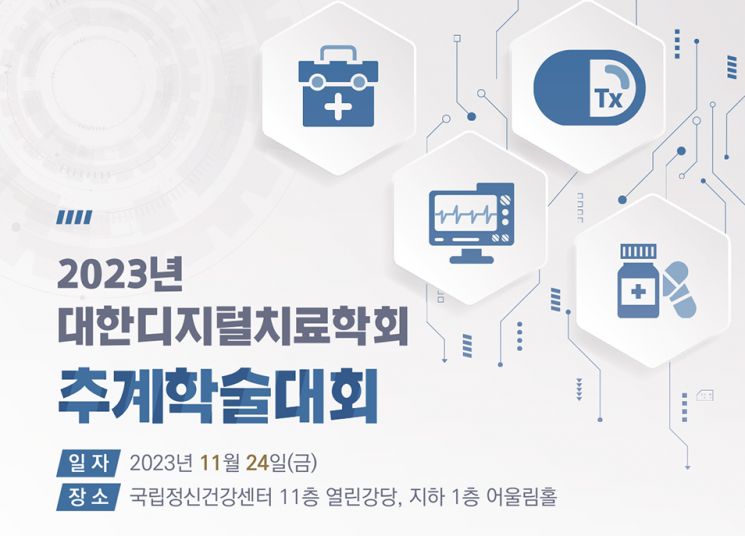 2023 Fall Academic Conference Poster of the Korean Society of Digital Therapeutics [Photo by Korean Society of Digital Therapeutics]
At the 'Smart Clinical Trial New Technology Development' session held on the 24th at the National Center for Mental Health in Gwangjin-gu, Seoul, during the '2023 Autumn Academic Conference of the Korean Society of Digital Therapeutics,' various suggestions for the advancement of the DTx industry were presented. Among them, speakers from academia and industry involved in clinical analysis and actual development processes discussed new evaluation methods suitable for DTx and simultaneously emphasized the need to increase adherence so that patients can properly utilize the applications (apps) to prove actual therapeutic effects.
Discussion Needed on Adverse Reactions and Cybersecurity Suitable for DTx
Professor Shin Jae-yong of the Department of Preventive Medicine at Yonsei University College of Medicine (CEO of Evertry) who gave the first presentation said, "Applications for approval of the third or fourth DTx devices are expected to be submitted to the Ministry of Food and Drug Safety within this year," adding, "Although there have been unfavorable situations abroad, the domestic market has had medical approaches for prevention, treatment, and maintenance, and the government is leading the development of approval and reimbursement systems, which will further improve the situation."
 On the 24th, at the National Center for Mental Health in Gwangjin-gu, Seoul, Shin Jae-yong, professor of preventive medicine at Yonsei University College of Medicine and CEO of Evertly, is presenting at the "2023 Autumn Academic Conference of the Korean Digital Therapeutics Society."
 [Photo by Lee Chun-hee]
Professor Shin pointed out the need for safety issues and non-inferiority evaluation studies in preparation for first-line treatment. He said, "Regulatory agencies emphasize cybersecurity, but from the developer's perspective, this is often overlooked or it is difficult to obtain personal information protection certification," and stressed that this should be a focus going forward. He also mentioned, "Since DTx could be the first-line treatment for those who cannot take medication, we also plan to conduct non-inferiority evaluation studies against standard treatments."
Following this, Professor Cho Joo-hee of Samsung Seoul Hospital presented various methodologies related to clinical trials for DTx development, emphasizing that "applying past technologies to new ones results in all being wrong," highlighting the need for new methodologies for this new technology. He also sharply pointed out that the current DTx market has not expanded significantly because "medical professionals do not use it," and stressed that sufficient research to prove actual effectiveness must be conducted.
Professor Cho also said that developers need development strategies tailored to the characteristics of DTx. He explained that aspects typically addressed in conventional clinical trials, such as adverse reactions and dose escalation, should be handled somewhat differently in clinical trials for DTx.
 On the 24th, Professor Jo Ju-hee from Samsung Seoul Hospital is presenting at the '2023 Autumn Academic Conference of the Korean Digital Therapeutics Society' held at the National Center for Mental Health in Gwangjin-gu, Seoul.
 [Photo by Lee Chun-hee]
He emphasized, "(DTx) is said to have no adverse reactions, but this only means there are no symptoms like nausea or headaches that occur with pharmaceuticals," adding, "DTx can also have adverse reactions or side effects, and a process to organize these is necessary." He also said, "so far, aspects like dosage and frequency related to DTx seem to have been little studied," and "research on how much and when to use it should be conducted at the proof-of-concept (PoC) stage."
Lastly, Professor Cho emphasized 'intention-to-treat' in relation to clinical trials. He said, "Usually, major academic journals do not accept papers if the dropout rate of clinical patients exceeds 15%, but DTx typically has a dropout rate exceeding 40%," stressing, "Except for messenger apps, there are no apps used daily, so making patients use DTx apps consistently every day is extremely difficult."
"The problem is that the app is not used"... Improving Adherence is Important
Im Jae-hyun, CEO of Lumen Lab, and Yoon Chan, CEO of EverX, who are actually developing DTx, also cited adherence as one of the core issues in development. Im Jae-hyun, who is developing the DTx 'LUCET' for improving and intervening in children's behavioral problems, emphasized that "the biggest problem with DTx is that the app is not used," and stressed the need to overcome such adherence difficulties.
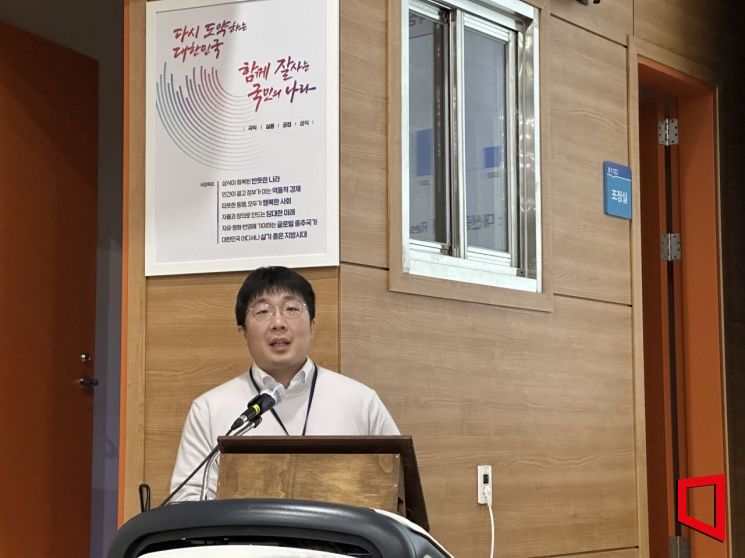 On the 24th, Lim Jae-hyun, CEO of LumenLab, is presenting at the '2023 Autumn Academic Conference of the Korean Digital Therapeutics Society' held at the National Center for Mental Health in Gwangjin-gu, Seoul.
 [Photo by Lee Chun-hee]
Lumen Lab is developing a solution that assesses developmental delays in children through videos and surveys and provides intervention therapy. CEO Im highlighted their technological capabilities by saying, "Video AI is much more difficult in terms of data preprocessing, such as labeling which parts of the video to analyze and judge," and explained that they overcame this by developing classification algorithms and collecting and labeling data considering children's developmental levels, age, and growth to create indicators enabling rapid behavioral assessment.
However, CEO Im lamented, "Although guardians download all the apps, more than half do not open them without separate intervention," adding, "It is a fantasy to think that they will use the app well without any intervention."
The solution he found through focus group interviews (FGI) was an 'easy app.' CEO Im said, "The word 'intervention' is comfortable for me but should not be used," and "We avoided difficult words like 'sleep' as much as possible." He also added various improvements to reduce inconvenience and incorporated many visualization elements. Furthermore, he emphasized the importance of regular intervention by saying, "The most effective way to enhance participation is reminders via alarms," and "Since it is for children, guardians have a strong will, so they tend to use it well when reminded."
Following this, CEO Yoon Chan of EverX also mentioned that although their musculoskeletal disorder solution 'MORA' currently has high adherence, they are considering future development directions.
 On the 24th, Yoon Chan, CEO of EverX, is giving a presentation at the "2023 Autumn Academic Conference of the Korean Digital Therapeutics Society" held at the National Center for Mental Health in Gwangjin-gu, Seoul.
 [Photo by Lee Chunhee]
EverX is developing 'MORA-DTx,' a DTx version of MORA, primarily targeting patellofemoral pain syndrome (PFPS). CEO Yoon said, "At the International Patellofemoral Research Retreat (iPFRR), exercise therapy is recommended as the first-line treatment for PFPS," emphasizing the development direction as a new form of multidisciplinary DTx combining cognitive behavioral therapy (CBT) that considers psychological factors. Currently, MORA-DTx has a patient exercise adherence rate exceeding 60%. CEO Yoon explained, "Achieving an adherence rate above 50% itself is not easy, so this is a positive rate."
CEO Yoon continued, "Since PFPS patients are those without arthritis, their age is mostly up to their 50s," and explained future challenges by saying, "The next task is to achieve similar effects with DTx for arthritis patients, so at that time, a different interpretation will be needed regarding how mobile devices work for the elderly."
© The Asia Business Daily(www.asiae.co.kr). All rights reserved.


















