Criminal Justice Information System Flaw
Avoiding Parliamentary Notification Despite Fines
A basic council member in Busan was caught driving under the influence and received a fine, but this information was not reported to the council, so disciplinary procedures did not proceed. The council member concealed their identity as a company employee, and the criminal justice information system failed to detect this.
According to a Yonhap News report on the 19th, Council Member A of Buk-gu Council in Busan was caught by police around 12:10 a.m. on June 8 while driving on a road in Dongnae-gu, Busan, after drinking at a level warranting license cancellation. After police investigation, Council Member A was summarily prosecuted by the prosecution and received a fine of 6 million won by summary order in August.
The problem is that Buk-gu Council in Busan did not recognize the DUI fact even three months after the sentence was finalized, and naturally, no disciplinary procedures were initiated. Regarding this, a Buk-gu Council official told Yonhap News, "Usually, when a sentence is finalized, the investigative or judicial authorities notify the relevant institution, but we learned about the DUI incident through media reports," adding, "We have inquired with the prosecution about why the notification was not made."
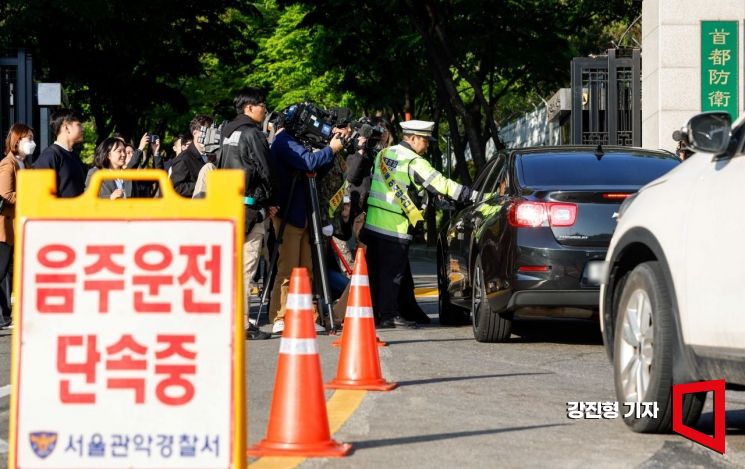 In April, a joint military and police operation conducted a morning drunk driving crackdown in front of the Capital Defense Command in Gwanak-gu, Seoul. The photo is not related to the specific content of the article. Photo by Jinhyung Kang aymsdream@
Generally, under the Local Public Officials Act, investigative agencies must inform the relevant institution of the investigation results concerning public officials. If the DUI fact had not been disclosed externally even belatedly, Council Member A could have closed the case without any disciplinary procedures because after being caught for DUI, A lied about their identity as a company employee.
A bigger problem is that unlike ordinary public officials, there is virtually no system for the police, prosecution, and courts to verify if an elected public official has concealed their identity. During the investigation, the police searched their internal criminal justice information system to check whether Council Member A was a public official but could not confirm it. When the case was transferred from the police, the prosecution recorded A as a company employee in the indictment and proceeded with summary prosecution.
According to the Local Autonomy Act, when a local council member’s criminal case is finalized, the court must notify the relevant local council of the fact. However, it is known that courts do not notify cases involving summary orders. A summary order is when a prosecutor requests a fine or penalty through written examination only, and the court issues a sentence by reviewing documents without a formal trial.
A legal expert said, "If it had been a formal trial, A’s identity might have been revealed, but if one is determined to conceal their identity until the end, it might not have been possible to verify," adding, "Elected public officials are positions that require not only internal disciplinary action but also public judgment, so the system where criminal case results are not notified to the institution and the crime facts remain unknown externally needs improvement."
© The Asia Business Daily(www.asiae.co.kr). All rights reserved.












