Conflict Intensifies Between Innovation Committee and Senior Members
Possibility of Independent Candidacy Amid Withdrawal Pressure
Lee Jun-seok "Will Accept Some Negotiations Behind the Scenes"
The People Power Party's Innovation Committee is continuing a standoff with the targeted senior and pro-Yoon (pro-Yoon Suk-yeol) faction lawmakers by recommending that the leadership, senior members, and pro-Yoon faction lawmakers declare they will not run in next year's general election or run in difficult constituencies. Although the Innovation Committee is applying pressure by saying it will "wait," since the innovation plan was announced on the 3rd, there has been virtually no ruling party lawmaker who has declared they will not run. Inside and outside the party, there are observations that the core pro-Yoon members will find it difficult to accept the non-candidacy innovation plan, citing three reasons.
① Senior Members Who Can Win as Independents
First, key senior pro-Yoon members have previously won elections as independents. Representative examples include lawmakers Kwon Seong-dong and Jang Je-won, who are considered pro-Yoon, and senior Yeongnam member Joo Ho-young. They have experience winning as independents in past general elections. Kwon, whose constituency is Gangneung in Gangwon Province, was not nominated during the 21st general election because he lost to Hong Yoon-sik, a former Minister of the Ministry of the Interior and Safety under the Park Geun-hye administration. Consequently, Kwon left the United Future Party (the predecessor of the People Power Party) and ran as an independent, winning with 49,618 votes (40.8%), defeating Kim Kyung-soo of the Democratic Party, who received 47,088 votes (38.7%). The United Future Party candidate Hong received only 13,704 votes (11.2%).
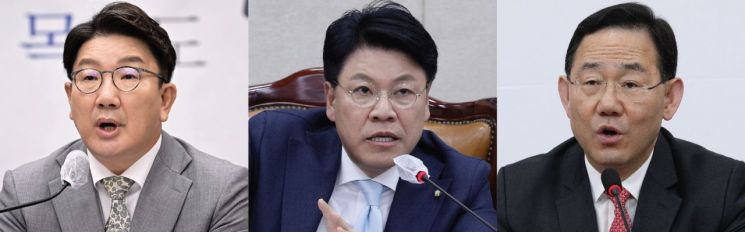
In Jang's case, during the 20th general election in 2016 under the Saenuri Party, Son Su-jo, known as a 'Park Geun-hye kid,' was strategically nominated in Busan Sasang District, which led Jang to run as an independent in protest and win. At that time, Joo (Daegu Suseong District B) also lost the nomination to pro-Park candidate Lee In-seon and ran as an independent, winning the election.
These lawmakers have effectively expressed refusal to comply with the Innovation Committee's non-candidacy demand. Jang said in a video released yesterday on his YouTube channel 'Jang Je-won TV,' "I have been in politics since I was 40 years old, already 15 years. I have faced difficulties and storms, once took a four-year break, and once ran as an independent and experienced the miracle of being elected with the love of local residents." He added, "These days, they tell me to run in a difficult constituency," and said, "The path I have walked for 16 years was not a shortcut but a difficult road, but I will do my best to work hard," indicating he will not accept the Innovation Committee's recommendation.
Joo recently held a legislative report meeting at the Daegu Suseong District Office auditorium and said, "Don't worry. I am not going to Seoul," and asked, "Did President Biden move his constituency after serving 40 years as a U.S. senator? Did YS (former President Kim Young-sam) move his constituency?" He reportedly said, "Only our country has such strange ideas."
Therefore, it is expected that senior members, especially some pro-Yoon faction members, will reject the Innovation Committee's recommendation and may run as independents if they are not nominated in next year's general election. A People Power Party official said, "Even if senior lawmakers are not nominated due to the Innovation Committee this time, they can always come back alive."
② People Power Party Support Higher Than President Yoon's Approval
Another factor hindering the second innovation plan is the recent decline in President Yoon's approval rating. The People Power Party's party support rate tends to be less affected by external factors than President Yoon's government approval rating, as its fixed support base holds firm. According to a survey conducted by polling specialist Realmeter for Energy Economy Newspaper from the 6th to the 10th among 2,503 people (sampling error 95% confidence level ±2.0 percentage points, wireless and wired automated response method, response rate 2.6%, detailed information available on the Central Election Poll Deliberation Commission website), President Yoon's government approval rating fell by 2.1 percentage points from the previous week to 34.7%. However, in the same survey, the People Power Party's support rate dropped by only 0.7 percentage points to 37%.
A survey conducted by Gallup Korea from the 7th to the 9th among 1,001 voters aged 18 and over nationwide (sampling error 95% confidence level ±3 percentage points, wireless phone virtual number interview, response rate 14%) also showed that President Yoon's positive job performance rating was 36%, while the People Power Party's support rate was 37%.
Typically, in mid-term general elections, the president's approval rating is considered a decisive factor in the election outcome. With no clear card for President Yoon's approval rating rebound so far, and the opposition party pushing the 'Kim Geon-hee Special Prosecutor Act,' public opinion may worsen further as the general election approaches next year. A party official said, "Running in a difficult constituency outside the existing district is ultimately fighting with the 'president's face,' and if the president's approval rating continues to fall, it is effectively being driven to the brink," adding, "Low government approval is one of the reasons why it is difficult to declare running in a difficult constituency prematurely."
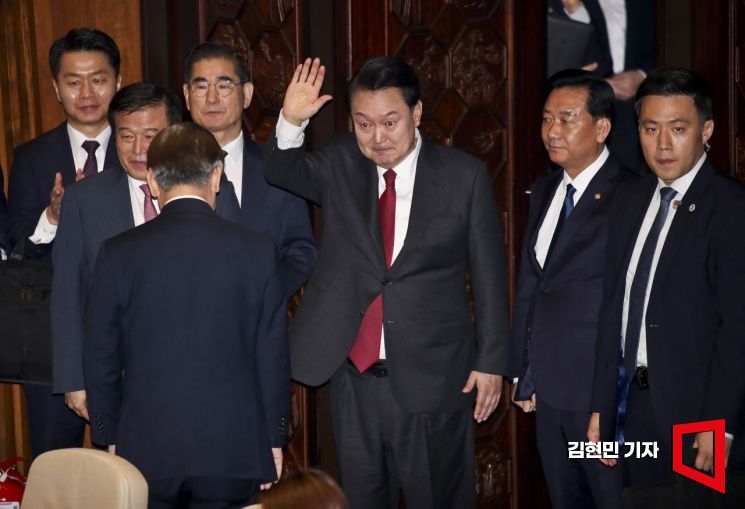 President Yoon Suk-yeol raised his hand in greeting as he left the plenary hall after delivering the policy speech on next year's government budget at the National Assembly on the 31st. Photo by Hyunmin Kim kimhyun81@
③ 22nd National Assembly Term Longer Than Presidential Term
The presidential office also lacks suitable cards to offer pro-Yoon lawmakers as compensation for 'sacrifice.' The term of the 22nd National Assembly, elected on April 10 next year, runs from May 30 of the same year to May 29, 2028. President Yoon, inaugurated in May last year, has a term until 2027, which is one year shorter than that of the lawmakers. Even if a lawmaker loses due to non-candidacy or running in a difficult constituency and is appointed as a cabinet member in the Yoon Suk-yeol administration, the term would be shorter than that of a lawmaker, making it an unattractive alternative.
Those who joined the Yoon Suk-yeol administration are also in a situation where they cannot guarantee their future political life. Kim Eun-hye, presidential secretary for public relations who held the Gyeonggi Bundang Gap Eul constituency, and Lee Young, Minister of SMEs and Startups who was a proportional representative lawmaker, are considering running in the general election, but their constituencies are currently unclear. Another People Power Party official said, "Since ministers can concurrently hold a lawmaker position, it is not a very good card that the presidential office can use in the current situation," adding, "It would be better to be elected as a constituency lawmaker."
Some expect that two to three pro-Yoon faction lawmakers may accept the non-candidacy recommendation. Former People Power Party leader Lee Jun-seok said in a BBS radio interview, "They will package it as a decision for the salvation of the country," but "they will try to propose some other negotiations behind the scenes." Lee said, "From the perspective of mutual assured destruction, the Yoon core group (key associates of President Yoon Suk-yeol) will do something," adding, "That will become leverage to package it as a national salvation decision and send them off amicably in some way."
© The Asia Business Daily(www.asiae.co.kr). All rights reserved.













