25 Consecutive Weeks of Increase as of the First Week of November
Prices Rise by Hundreds of Millions Mainly in High-End New Constructions in Gangnam
"High Interest Rates Shift Purchase Demand to Jeonse"
#An exclusive 84.6㎡ unit at Gaepo Xi Presidents in Gangnam-gu, Seoul, set a record high jeonse price of 1.4 billion KRW on the 1st. Last year, due to the impact of high interest rates originating from the U.S., the phenomenon of 'jeonse avoidance and monthly rent preference' deepened, and this complex was trading in the 1 billion to 1.1 billion KRW range during the move-in season in March this year. A representative from a real estate agency in Gaepo-dong said, "As monthly rents rise, tenant demand is shifting back to jeonse, and recently more people are choosing jeonse over buying, causing jeonse prices to jump by more than 300 million KRW."
Seoul apartment jeonse prices have risen for 25 consecutive weeks. Especially in high-priced complexes centered in the Gangnam area, jeonse prices have surged by several hundred million KRW compared to the beginning of the year. With the government's tightening of loans and prolonged high interest rates, sales demand is shifting to rental demand, causing a sharp rebound in the jeonse market.
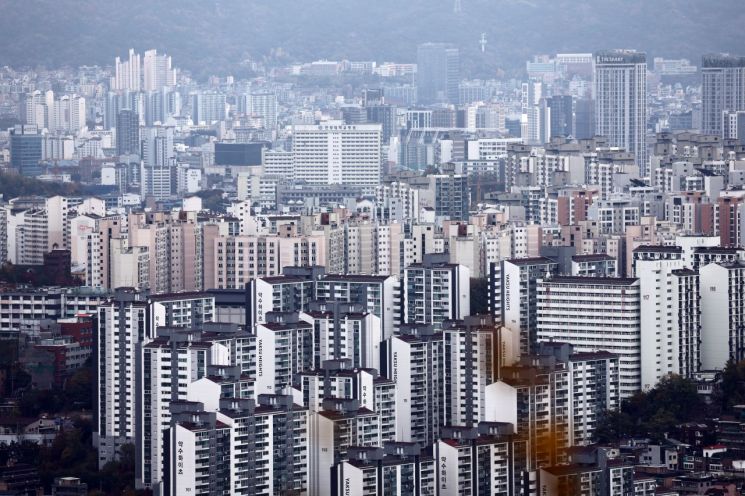
According to the Korea Real Estate Board on the 10th, Seoul apartment jeonse prices in the first week of November rose 0.21% from the previous week, continuing the upward trend for 25 consecutive weeks. The rate of increase was also larger than last week's 0.19%.
By region, Seongdong-gu (0.52%) showed the highest increase rate. This was followed by Yangcheon-gu (0.37%), Yongsan-gu (0.35%), Songpa-gu (0.35%), Dongdaemun-gu (0.27%), and Gangdong-gu (0.25%), all showing steep rises.
In fact, checking the Ministry of Land, Infrastructure and Transport's actual transaction price disclosure system reveals that many complexes, especially high-priced ones, have seen jeonse prices rise by several hundred million KRW compared to the beginning of the year. For example, an 84.97㎡ unit at Raemian One Bailey in Banpo-dong, Seocho-gu, found a jeonse tenant at a record high price of 2 billion KRW on the 11th of last month. In mid-August, the actual transaction price was 1.7 billion KRW, meaning it rose by 300 million KRW in just two months.
It is analyzed that the prolonged high interest rates have increased uncertainty, reducing sales demand and causing jeonse prices to rise. A Korea Real Estate Board official explained, "There is a lot of demand for jeonse instead of buying, especially in popular large complexes near subway stations."
Since the government has tightened loans to curb the increase in household debt, this trend is likely to continue. Kim Seong-hwan, a senior researcher at the Construction Industry Research Institute, said, "Due to the reduction in sales demand, additional demand inflow into the rental market is expected, and with a decrease in move-in volume next year, there are factors for jeonse prices to rise." However, there is also a forecast that if high interest rates persist and the real estate market weakens, jeonse prices will inevitably turn downward.
Meanwhile, as Seoul apartment jeonse prices rise, the proportion of tenants using the right to request contract renewal is increasing. According to an analysis by Real Estate R114 of the Ministry of Land, Infrastructure and Transport's actual transaction price disclosure system, among the jeonse and monthly rent renewals (renewal contracts) signed from July to October this year, 34.5% used the right to request contract renewal. This is a 1.7 percentage point increase compared to 32.8% in the first half of this year.
The right to request contract renewal is a system that allows tenants to demand a renewal contract with rent increases limited to within 5% after the expiration of a 2-year lease contract. For tenants, it is advantageous to use the right to request contract renewal when jeonse prices are on the rise.
© The Asia Business Daily(www.asiae.co.kr). All rights reserved.












