Monthly Fiscal Trends November Issue
National Debt 1,099.6 Trillion Won

As of September this year, the national budget deficit has exceeded 70 trillion won. The deficit worsened by 4.6 trillion won compared to the previous month, surpassing the government's target by more than 12 trillion won. National debt (based on the central government) was recorded at 1,099.6 trillion won, down 10.4 trillion won from the previous month due to monthly issuance and repayment of government bonds. Previously, as of the end of August, the national debt had surpassed 1,100 trillion won for the first time in history.
According to the 'Monthly Fiscal Trends (November issue)' released by the Ministry of Economy and Finance on the 9th, the managed fiscal balance as of the end of September was recorded at a deficit of 70.6 trillion won. The managed fiscal balance is the figure obtained by subtracting social security funds from the integrated fiscal balance (total revenue - total expenditure), representing the overall national budget status. The deficit increased by 4.6 trillion won in one month from 66 trillion won at the end of August. Compared to the same month last year, it improved by 21.2 trillion won.
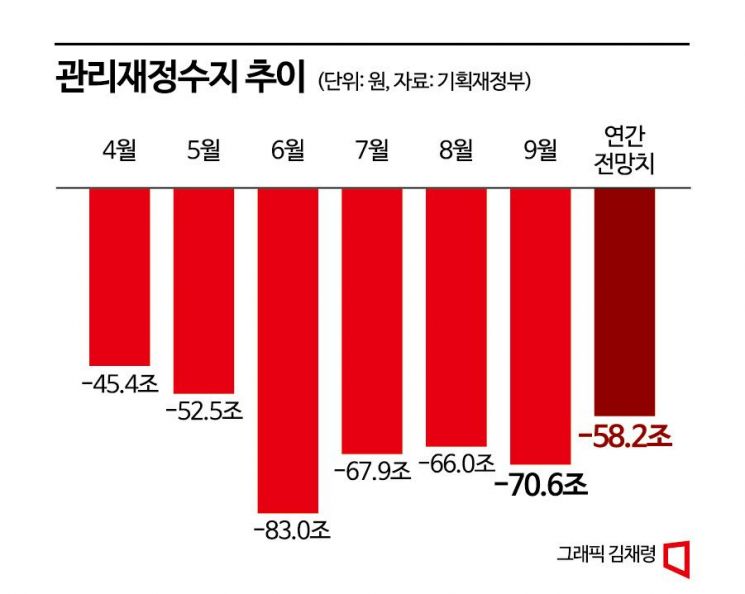
The Ministry of Economy and Finance predicted that the national debt would converge to the government's forecast of 1,101.7 trillion won by the end of the year but was cautious about forecasting the managed fiscal balance. However, as the managed fiscal balance deficit increased again after two months of decline, the possibility of exceeding this year's government forecast (-58.2 trillion won) has grown. A ministry official said, "Since expenditure conditions continuously change, it is difficult at this point to definitively say whether the managed fiscal balance will worsen or improve by the end of the year."
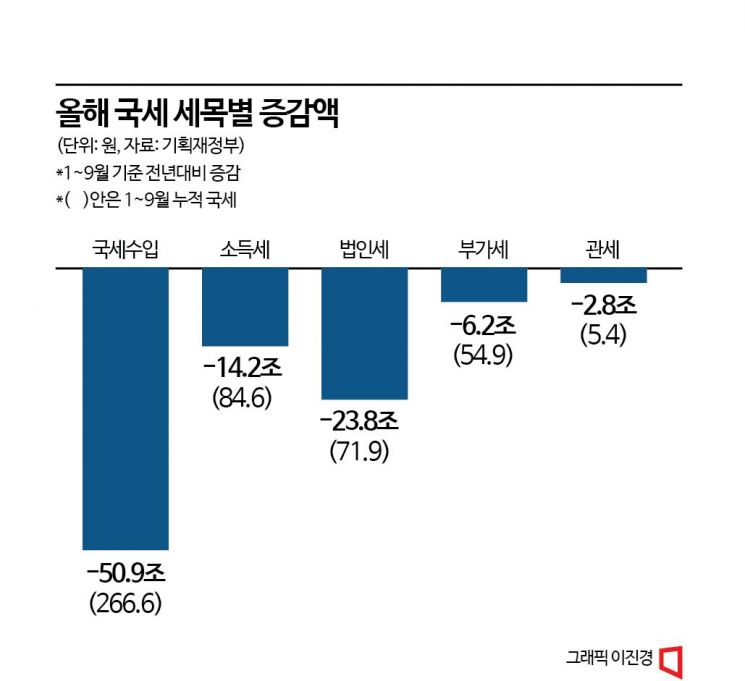
The reason the managed fiscal balance deficit exceeds the government forecast is largely due to decreased government revenue caused by economic downturn. Total revenue decreased by 4.69 trillion won year-on-year to 436.3 trillion won due to reductions in national taxes and non-tax revenue. In particular, national tax revenue was 266.6 trillion won, down 50.9 trillion won compared to the same period last year. This was due to contractions in income tax (-14.2 trillion won), corporate tax (-23.8 trillion won), and value-added tax (-6.2 trillion won) caused by a slowdown in real estate transactions and poor corporate performance. Regarding non-tax revenue, it was recorded at 20.8 trillion won, down 2.8 trillion won due to factors such as a decrease in surplus funds at the Bank of Korea.
Fortunately, the government tightened its belt, slightly reducing the national debt. As of the end of September, total expenditure was 467.5 trillion won, down 68.5 trillion won year-on-year, and central government debt also decreased by 10.4 trillion won from the previous month to 1,099.6 trillion won. Although this is 66.1 trillion won higher than last year's final debt (1,033.4 trillion won), it aligns with this year's forecast. The national debt in the Monthly Fiscal Trends refers only to central government debt, while local government debt is calculated and announced once a year.
Last month, the issuance of government bonds was 10.5 trillion won, and based on competitive bidding, it was 8.5 trillion won. Government bond yields, which had risen due to expectations of prolonged monetary tightening in major countries, recently declined following the U.S. Treasury's announcement to adjust the pace of long-term bond issuance. From January to October, government bond issuance totaled 154.8 trillion won, which is 92.3% of the annual total issuance limit (167.8 trillion won).
The Ministry of Economy and Finance expects that continuous government bond repayments will further reduce the debt amount to the government's forecast level by the end of the year. A ministry official said, "Since 2014, after September, the debt amount tends to converge to the forecast by the end of the year," adding, "Due to large-scale repayments last month, the total government bonds and debt decreased as of September, and it is predicted that central government debt will converge to the original budget level (1,101.7 trillion won) by the end of this year."
© The Asia Business Daily(www.asiae.co.kr). All rights reserved.














