Health and Environment Research Institute Investigates Indoor Air Quality Inside Train Cars of Busan Metro Lines 1-4
PM-2.5, Pollution Levels, and CO2 Concentrations Affected by Passenger Congestion
The Busan Metropolitan City Health and Environment Research Institute announced that the indoor air quality of subway trains on all four subway lines measured during the summer of 2023 met the recommended indoor air quality standards, indicating that the indoor air quality is very good.
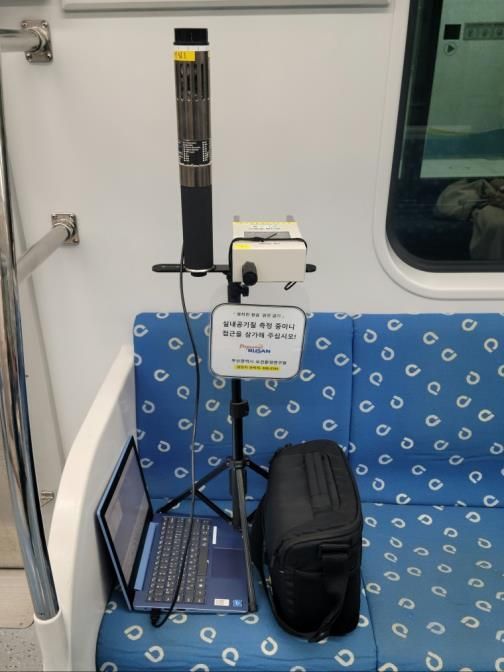
The institute conducted round-trip surveys twice, dividing the indoor air quality measurements inside subway cars into peak hours (weekdays from 7:30 AM to 9:30 AM or 6 PM to 8 PM) and off-peak hours (times outside peak hours) from departure to arrival stations. The measured items were fine particulate matter (PM-2.5) and carbon dioxide (CO2).
First, the fine particulate matter (PM-2.5) ranged from 2.2 to 17.1 ㎍/m3, showing 4.4% to 34.2% of the recommended standard (50 ㎍/m3).
By time of day, the average concentration during peak hours was 7.5 ㎍/m3, and during off-peak hours, it was 7.2 ㎍/m3, indicating no significant difference between time periods.
On the other hand, changes in fine particulate matter concentration inside the train were observed depending on the concentration of fine particulate matter on the platform at the station stops, which was analyzed to be caused by the inflow of platform air when the screen doors open and close. The concentration of fine particulate matter inside the train was about 75% of the platform concentration (9.7 ㎍/m3), which was judged to be the effect of the air purification devices installed inside the train.
The carbon dioxide concentration was measured at 753 to 1398 ppm (average 1131 ppm) during peak hours (standard: 2500 ppm) and 735 to 1137 ppm (average 906 ppm) during off-peak hours (standard: 2000 ppm), all meeting the standards. Concentration levels were higher during peak hours than off-peak hours on all lines.
In particular, on Line 3, on the day of the survey (August 11), due to a game at Sajik Baseball Stadium (starting at 6:30 PM), many passengers boarded and alighted, resulting in the highest concentrations during both peak (1349 ppm) and off-peak hours (1007 ppm).
Additionally, on Line 4, which has relatively fewer passengers, carbon dioxide concentrations were measured below 1000 ppm at all times, indicating that CO2 levels were greatly influenced by passenger density inside the cars.
Jeong Seung-yoon, Director of the Busan Metropolitan City Health and Environment Research Institute, stated, “The survey results show that the indoor air quality of subway cars is maintained at a safe level,” and added, “To maintain a safe indoor environment in the subway, it is necessary to properly operate ventilation and air purification facilities on platforms and inside cars, regularly replace filters, and extend the operating hours of air purification systems during peak congestion times to keep indoor air quality comfortable.”
© The Asia Business Daily(www.asiae.co.kr). All rights reserved.












