"A pause in interest rate hikes does not mean it will be difficult to raise rates again." Jerome Powell, Chair of the U.S. Federal Reserve (Fed), which kept the benchmark interest rate unchanged, reaffirmed that the war against inflation is not over yet. He also made it clear that it is not yet time to discuss rate cuts. However, the market largely expects the Fed to maintain its pause next month as well, citing the recent rise in Treasury yields, tightened financial conditions, and easing core inflation trends.
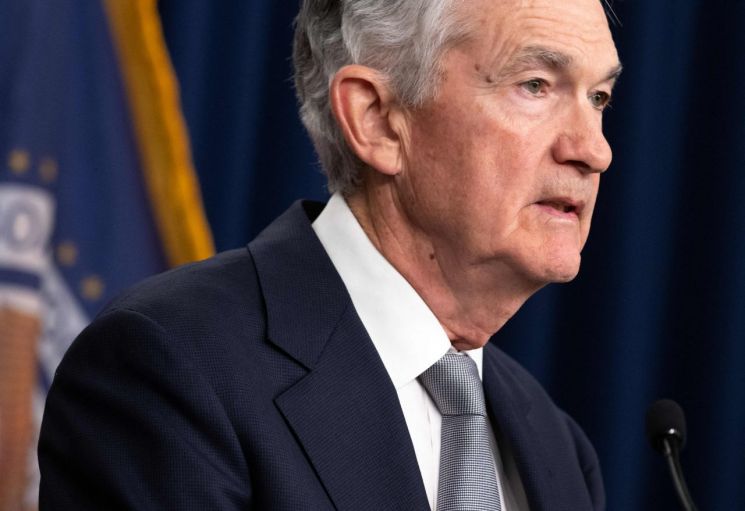
At a press conference following the Federal Open Market Committee (FOMC) regular meeting on the 1st (local time), Chair Powell stated, "The recent indicators of slowing inflation are just the starting point for building confidence toward achieving the 2% target." He noted, "Although inflation has eased, there is still a long way to go," and emphasized, "We will maintain a restrictive monetary policy until we are confident that inflation is declining."
The Fed unanimously decided at this meeting to keep the federal funds rate unchanged at 5.25?5.5%. This marks the second consecutive pause following September. Despite strong economic data, the decision is interpreted as reflecting tightened financial conditions due to the recent sharp rise in Treasury yields. The policy statement released that day added the term "financial" to the existing phrase "tight credit conditions."
Chair Powell also acknowledged at the press conference that financial conditions have tightened further due to the sharp rise in long-term Treasury yields since this summer. He assessed, "Considering the overall financial situation, including rising long-term rates, a strong dollar, and declining stock markets, these factors could influence future monetary policy." He added, "The rise in long-term Treasury yields is not due to Fed monetary policy. What matters is that the (surging) long-term rates can affect borrowing costs and the economy."
Earlier, at the September FOMC, the Fed hinted that an additional rate hike could follow this year’s pause, but many inside and outside Wall Street have since analyzed that the recent surge in Treasury yields has reduced the need for further tightening. According to Deutsche Bank, the rise in Treasury yields since September has tightened financial conditions enough to reduce next year’s economic activity by 0.6 percentage points.
However, Chair Powell also expressed the view that financial conditions are not yet sufficiently restrictive to achieve the inflation target. He said, "We cannot be sure if conditions are sufficiently restrictive," and added, "We will assess at every meeting whether additional tightening is necessary." When asked if the December FOMC meeting, the last of the year, would mark the "peak" if rates are not raised, he responded, "No decision has been made yet," and said, "We will consider data on the economy, inflation, and the labor market. There is significant uncertainty," showing a cautious stance.
Despite the Fed’s aggressive rate hikes since March last year, strong economic indicators and an overheated labor market are still seen as factors that could reignite inflation at any time. The U.S. GDP for Q3, released last week, grew 4.9% year-on-year, marking the highest growth since Q4 2021. The Department of Labor’s JOLTS (Job Openings and Labor Turnover Survey) report released that day showed September job openings at 9.55 million, exceeding both the previous month and Wall Street expectations, confirming labor market strength.
The policy statement released after the FOMC adjusted the economic assessment phrase from "solid pace" to "strong pace" and changed the wording related to job growth from "slowed" to "moderated." This reflects the background of strong economic data alongside the rate pause. For the Fed, this leaves room for further rate hikes while keeping rates on hold. Chair Powell emphasized, "A pause in rate hikes does not mean it will be difficult to raise rates again," and added, "No decisions have been made about future meetings. We will always act as appropriate at the time."
Chair Powell also confirmed that rate cuts are not being considered at all. He said, "The Committee is not considering rate cuts at all. We are not discussing them," and added, "We are focusing on whether we have achieved a sufficiently restrictive monetary policy stance." He continued, "The second question is how long to maintain the stance. For now, we are focused on the first question, so rate cuts are not being considered yet." He also asserted that the current balance sheet reduction plan will not be changed.
Regarding the September dot plot that hinted at one more rate hike this year, he previewed, "We will release a new dot plot in December." Powell, who has repeatedly emphasized a cautious approach in recent official appearances, said, "The dot plot is a forecast, not a commitment. Many things can change." He also expressed concerns about recent developments such as the United Auto Workers strike, the possibility of a federal government shutdown, and geopolitical risks stemming from the war between Israel and Hamas in the Middle East. He stated, "It is important whether the war escalates and how it affects oil prices. Although this has not yet been reflected in oil prices, there are risks," and added, "The Ukraine war is also directly linked to commodity prices."
Currently, the market strongly expects the Fed to keep rates unchanged at the last FOMC meeting of the year in December. According to the Chicago Mercantile Exchange (CME) FedWatch tool, as of that day, the federal funds futures market reflects an 84% probability that the Fed will hold rates steady at 5.25?5.5%. The probability of a 0.25 percentage point rate hike (a "baby step") in December stands at about 19%.
Most investors, regardless of the expectation of prolonged high rates, see a low possibility of additional rate hikes. Many interpret Chair Powell’s hawkish remarks during the press conference as rhetorical measures to prevent a rise in inflation expectations. Dean Maki, Chief Economist at hedge fund Point72 Asset Management, emphasized, "If the Fed completely rules out rate hikes, the next question becomes 'When will rate cuts come?' So it is important to keep the possibility of rate hikes on the table."
This pause maintained the interest rate gap between South Korea and the U.S. at 2 percentage points (based on the upper bound of U.S. rates). The Bank of Korea had earlier kept its rate unchanged at 3.50% last month.
Meanwhile, the New York stock market closed higher, extending gains during Chair Powell’s press conference. The Dow Jones Industrial Average rose 0.67% from the previous session. The large-cap S&P 500 index gained 1.05%, and the tech-heavy Nasdaq index increased by 1.64%.
© The Asia Business Daily(www.asiae.co.kr). All rights reserved.












