Legislative Proposals Also Hear Opinions from Seoul, Gimpo, and Gyeonggi
If Incorporated, Converted to 'Gu'... Eup and Myeon Become 'Dong'
The issue of ‘Gimpo City's incorporation into Seoul,’ triggered by Kim Gi-hyeon, leader of the People Power Party, has become an issue black hole. With the ruling party actively pushing ahead ahead of next year’s general election, the possibility of realization is not small. Amid this atmosphere, confusion related to the incorporation process into Seoul has also arisen due to its complexity. There are also considerable changes that would occur if Gimpo City is incorporated into Seoul.
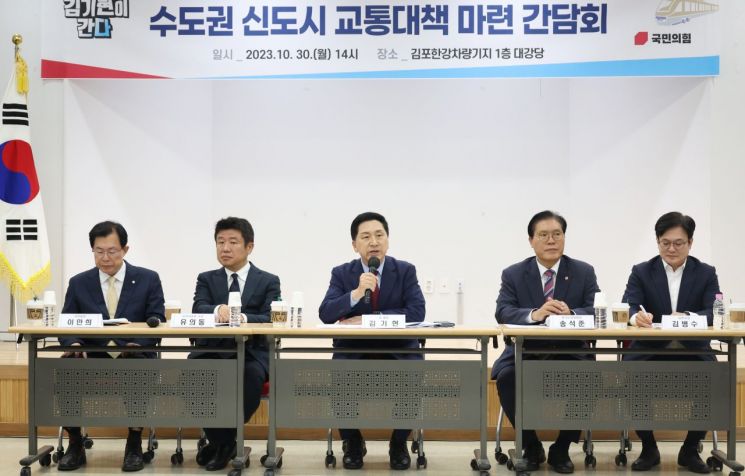 Kim Ki-hyun, leader of the People Power Party, is speaking at a meeting held on the 30th of last month at the Gimpo Hangang Vehicle Depot, which manages the Gimpo Gold Line, to discuss transportation measures for new towns in the metropolitan area. At the meeting, Representative Kim stated, "We will promote the plan to incorporate Gimpo, Gyeonggi Province into Seoul as the party's official stance." Photo by Yonhap News
▲‘Opinion hearing’ such as local council and residents’ referendum is essential= Legal amendments are required to change the jurisdiction of local governments. However, before that, the process of ‘hearing opinions from residents and local councils’ must be conducted first. Article 5 of the Local Autonomy Act stipulates that ‘when abolishing, establishing, dividing, or merging local governments, the opinions of local councils must be heard’ and ‘however, if a residents’ referendum is conducted, (hearing opinions from local councils) is not necessary.’ To change jurisdiction, either both the local council opinion hearing and residents’ referendum must be conducted, or at least one of them must be done.
Since Gimpo City’s incorporation into Seoul also affects Gyeonggi Province, opinion hearings from local councils and residents’ referendums must be conducted for all three local governments involved. However, there is no obligation to hear opinions from the heads of local governments. Although local council opinion hearings and residents’ referendums are ‘opinion gathering’ and have no legal binding force, they actually have a significant impact. The integration of Jeonju and Wanju in Jeonbuk in 2013 was canceled due to strong opposition from Wanju County in the residents’ referendum.
▲If integrated into Seoul, it becomes ‘Gimpo-gu,’ not ‘Gimpo-si’= If Gimpo City joins Seoul, it will be converted into Gimpo-gu. Article 3 of the Local Autonomy Act stipulates that ‘cities belong under provinces or special autonomous provinces, counties under metropolitan cities or special autonomous provinces, and autonomous districts under special cities and metropolitan cities.’ Since Seoul is a special city, it cannot have cities or counties under it, only districts are allowed. Therefore, if Gimpo City joins Seoul, it becomes ‘Gimpo-gu,’ and the six eup and myeon under Gimpo City will all be converted into dong. According to the Local Autonomy Act, only dong can be under an autonomous district, not eup or myeon. In this case, support for the current eup and myeon, which are classified as rural areas in Gimpo City and receive benefits, will be cut off. For example, Gochon-eup in Gimpo City currently qualifies for special rural admissions in university entrance exams, but if changed to Gochon-dong in Gimpo-gu, this benefit will be lost. Benefits such as basic income for farmers, property tax reductions, high school tuition reductions, interest-free student loans, and manufacturing of prescription-free medicine will also disappear.
There is a case where an eup was converted into a dong and then reverted back to eup. When Hwaseong County was promoted to Hwaseong City in 2001, Namyang-eup was converted into Namyang-dong. However, as residents lost rural area benefits after the change to dong and expressed dissatisfaction by conducting a petition for restoration, it reverted back to eup in 2014, 14 years later. In the case of ‘Gimpo-gu,’ since it will be an autonomous district under Seoul City, which cannot have eup under its jurisdiction, there is no way for the eup and myeon under it to revert to their original status.
© The Asia Business Daily(www.asiae.co.kr). All rights reserved.











