Worsening Air Quality Amid Industrial Recovery in China
Possibility of More Frequent Fine Dust in Korea This Winter
Will this winter be accompanied once again by the tiresome fine dust? As China's industrial activities recover, air quality has rapidly deteriorated, and it is expected to affect South Korea as well.
On the 1st (local time), according to the China Central Meteorological Observatory and others, both fine dust warnings and fog advisories were issued simultaneously in the Beijing area. Consequently, eight highway routes including G1 Beijing-Harbin, G2 Beijing-Shanghai, and S15 Beijing-Tianjin were closed. The Central Meteorological Observatory expects this smog to continue until the night of the 2nd.
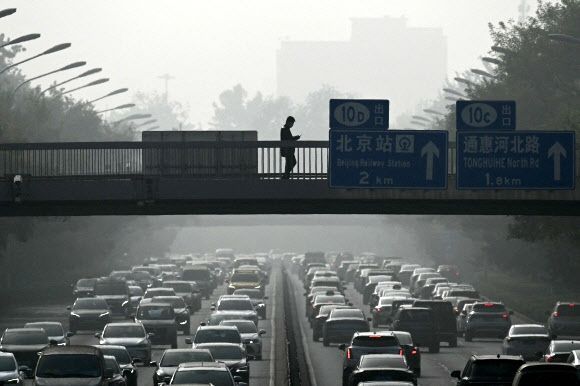 On the 1st (local time), an orange fine dust warning was issued in Beijing, China.
 [Image source=AFP Yonhap News]
This smog began on the 22nd of last month, after the China Belt and Road (land and maritime New Silk Road) forum ended, and its severity is quite serious. Beijing city authorities have issued an orange air quality warning (severe pollution stage) until the 2nd, advising the elderly and those with respiratory diseases to refrain from going outside.
South Korea, which is close to China, is also expected to be affected. According to 'Air Korea,' an air quality information site operated by the Korea Environment Corporation, as of the 31st of last month, the concentration of fine particulate matter (PM2.5) rose to a 'bad' level. Some areas, such as Seo-gu in Incheon, even recorded a 'very bad' level.
On the weekend of the 4th, fine particulate matter concentrations in Incheon, southern Gyeonggi, and Chungnam regions are also expected to reach 'bad' levels.
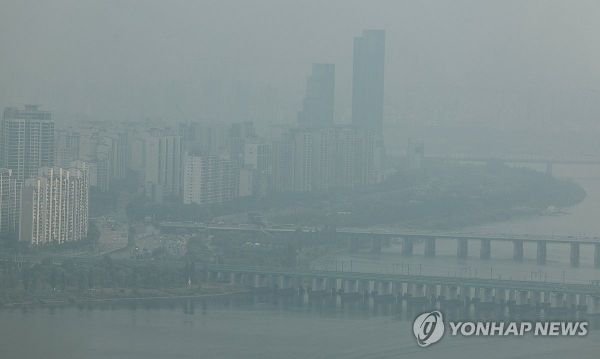 Seoul's fine dust (PM2.5) concentration recorded as 'Bad' on the 26th of last month [Image source=Yonhap News]
Chinese meteorological authorities analyzed the cause of the worsening smog as an 'increase in industrial activities due to economic recovery.' During October, industrial power consumption in the Beijing vicinity increased by about 5%. The number of large truck passages also increased by 14% during the same period.
The Chinese government is also focusing all efforts on economic recovery and may somewhat relax supervision that disrupts industrial activities such as environmental regulations. Accordingly, this winter, smog originating from China may occur more frequently compared to previous years, raising concerns about its impact on South Korea's air quality.
© The Asia Business Daily(www.asiae.co.kr). All rights reserved.

![Clutching a Stolen Dior Bag, Saying "I Hate Being Poor but Real"... The Grotesque Con of a "Human Knockoff" [Slate]](https://cwcontent.asiae.co.kr/asiaresize/183/2026021902243444107_1771435474.jpg)















