Current System Discriminates Against Domestic Buyers in Acquisition Tax
Unprotected Against Foreign Real Estate Speculation
‘Seodaemun Sense(稅)ation Team’ Wins Excellence Award at National Competition
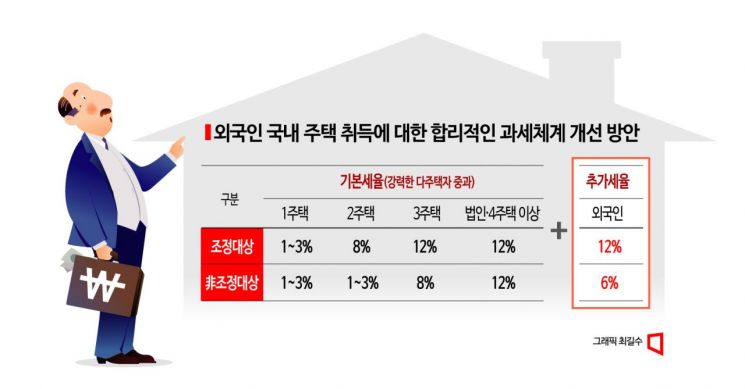
The issue of acquisition tax discrimination between domestic and foreign nationals and the problem of fairness have been consistently pointed out but remain unresolved. Although the recent cooling of the real estate market has slowed down foreign purchases of Korean real estate, the problem persists.
Tax officials at district offices have stepped up to address this issue. The tax departments at district offices work on the front lines of local tax administration and thus understand the on-site problems better than anyone else.
The ‘Seodaemun Sense(稅)ation’ team (Chairman Kang Hwan-bok, Director of the Planning and Finance Bureau), a local tax research club in Seodaemun-gu, Seoul, won the Excellence Award at the ‘National Local Government Local Tax Research Club Competition’ held on the 26th of last month. They received the award for presenting ‘Rational Tax System Improvement Measures for Foreigners’ Domestic Housing Acquisition’ at this year’s competition hosted by the Korea Local Tax Research Institute.
The Senseation team focused on the issues of acquisition tax fairness between domestic and foreign nationals, the resulting tax revenue gaps, and the management of foreign real estate speculation.
The team explained that by properly correcting the irrationalities and applying only an ‘Additional Foreign Acquisition Tax’ of about 6-12% (in the housing sector) to foreigners, an annual increase in tax revenue of 83.5 billion KRW nationwide and 43.2 billion KRW in Seoul alone could be achieved.
Currently, South Korea does not impose additional taxation on foreigners. Moreover, under the current system, it is difficult to accurately identify whether foreigners own multiple houses. Most foreigners pay taxes equivalent to those of domestic non-homeowners or single-homeowners when acquiring housing. This causes reverse discrimination and, since there are no restrictions on loans, there are no brakes on foreign real estate speculation.
The solutions proposed by the Senseation team to enhance acquisition tax fairness and prevent foreign real estate speculation include: ① Amending related laws such as the Immigration Control Act and the Local Tax Act to create a unified ‘Registered Foreigner Record Table’ that includes information on foreign household members. However, there is a limitation in identifying household members for foreigners who are not subject to registration or non-resident foreigners. Therefore, the team suggests requiring submission of a certificate of foreigner registration or a certificate of domestic residence report along with the housing acquisition report. This requires legal amendments.
② Revising forms, such as adding a nationality field to the acquisition tax report, to accurately grasp foreigners’ housing acquisition status, and building specific data and conducting surveys to understand the current situation of speculative housing acquisitions by foreigners.
③ Introducing a separate ‘Additional Foreign Acquisition Tax’ to prevent reverse discrimination against domestic nationals. The proposal also includes a refund system for foreigners who meet certain conditions such as obtaining permanent residency, to block speculative housing acquisitions by non-resident foreign speculators without violating the principle of reciprocity. The Senseation team suggested adding 12% to the basic tax rate in regulated areas and 6% in non-regulated areas as the additional tax rate.
Although there are claims that the introduction is difficult due to violation of the principle of reciprocity, these arguments lack persuasiveness. Many countries have already introduced additional acquisition taxes on foreigners out of concern for skyrocketing domestic real estate prices.
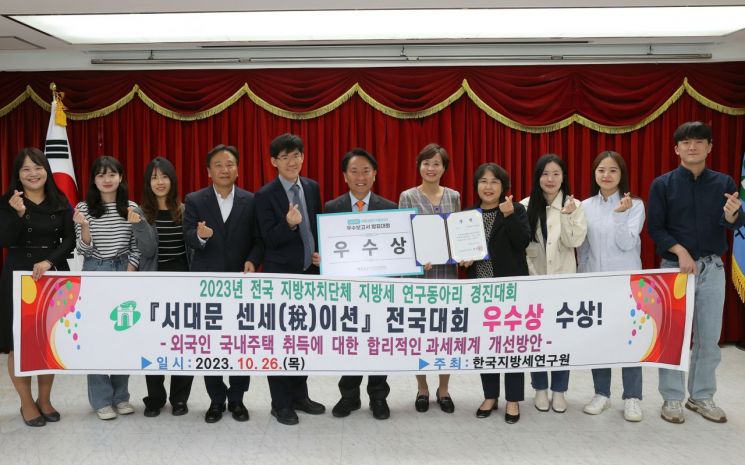 The local tax club "Seodaemun Sense(稅)ation" team, composed of employees from the Tax Department of Seodaemun-gu, Seoul, won the Excellence Award at the "2023 National Local Tax Research Club Outstanding Paper Presentation Contest" held on the 26th of last month. Seongheon Lee, Mayor of Seodaemun-gu (center), is taking a commemorative photo with the employees. (Photo by Seodaemun-gu Office)
Lee Sang-gu, Head of Tax Division 1 in Seodaemun-gu, explained, "If a refund system is introduced in the new heavy taxation measures, it can prevent foreign real estate speculation without violating the principle of reciprocity and realize effective taxation. Adjusting the ratio between national and local taxes and securing local tax resources, which are smaller in scale compared to national taxes, is also important for securing autonomous financial resources for local governments."
According to the ‘Foreigners’ Housing Ownership Statistics (as of the end of 2022)’ announced by the Ministry of Land, Infrastructure and Transport this year, there are 83,512 housing units (81,626 people) owned by foreigners in Korea, of which 75,959 units are multi-family housing (apartments, row houses, multi-unit houses), accounting for 91% of the total. In particular, Chinese nationals own 44,889 housing units, which is more than half, accounting for 54% of the total.
© The Asia Business Daily(www.asiae.co.kr). All rights reserved.













