Mitigation of Penalties for Non-compliance by Social Workers
Outdoor Advertising Fines Set at 5 Million Won
Prevention of Minor Offenders Becoming Repeat Violators
Criminal penalties (imprisonment or fines) imposed on debtors who flee to evade court summons will be converted into administrative fines. Additionally, failure to fulfill the continuing education obligations of social workers will result in administrative fines instead of the existing fines.
On the 12th, the government announced the "3rd Improvement Task for Economic Penal Provisions," which includes these measures, at the "Economic Penal Regulation Task Force (TF) 3rd Meeting" held at the Government Seoul Office. The inter-ministerial task force for improving economic penal provisions, jointly formed by the Ministry of Economy and Finance and the Ministry of Justice, was launched in July last year to alleviate excessive burdens on citizens caused by unreasonable economic penalties.
Kim Byung-hwan, 1st Vice Minister of the Ministry of Economy and Finance, stated, "We plan to curb excessive penalties for minor violations related to economic activities such as document preparation or reporting, improve side effects such as the proliferation of criminal records, and resolve the imbalance in penalties for identical or similar violations."
The inter-ministerial task force finalized improvement plans for 46 penal provisions across 22 laws from 10 ministries as part of the 3rd task. By type of improvement, there are 14 regulations related to daily life, 15 related to administrative duty violations, 10 obsolete regulations, and 7 regulations reviewed at the legal unit level. Through analysis of the 국민신문고 (People’s Petition) database, they focused on discovering "daily life-related regulations" that cause the greatest inconvenience among direct complaints from self-employed and small business owners. They also analyzed the Ministry of Justice’s Supreme Prosecutors’ Office database to identify and improve obsolete regulations with no cases filed in the past five years.

Specifically, for daily life-related regulations, the penalty for displaying outdoor advertisements without notification in urban areas will change from the existing "fine of 5 million KRW" to an "administrative fine of 5 million KRW." Considering that advertisements are an important business tool for small business owners and self-employed individuals, advertisements that do not cause serious harm to safety or scenery will be regulated by administrative sanctions.
In cases where business waste disposal site information is not entered or falsely entered, the current penalty of imprisonment up to 2 years or a fine up to 20 million KRW will be changed to an administrative fine of up to 1 million KRW for simple negligent entries. However, penalties will remain for intentional or false entries. Also, for those who allow youth prohibited from viewing restricted rating films to enter or allow entry into video theater businesses during restricted hours, the current penalty of imprisonment for 2 to 3 years or fines of 20 to 30 million KRW will be adjusted to imprisonment for 1 to 2 years or fines of 10 to 20 million KRW. This reflects that some penalties were excessive compared to similar provisions in the Youth Protection Act.
Obsolete regulations such as those in the Road Traffic Act and the News Communication Act will also be improved. Regulations with no cases filed in the past five years and those enacted or amended more than five years ago were selected. For traffic safety diagnosis agencies that performed traffic safety diagnosis work during a business suspension period after receiving a business suspension order, the penalty will be changed from imprisonment up to 2 years or fines up to 20 million KRW to an administrative fine of 20 million KRW. This change responds to criticism that imposing both administrative sanctions and criminal penalties for the same act is excessive.
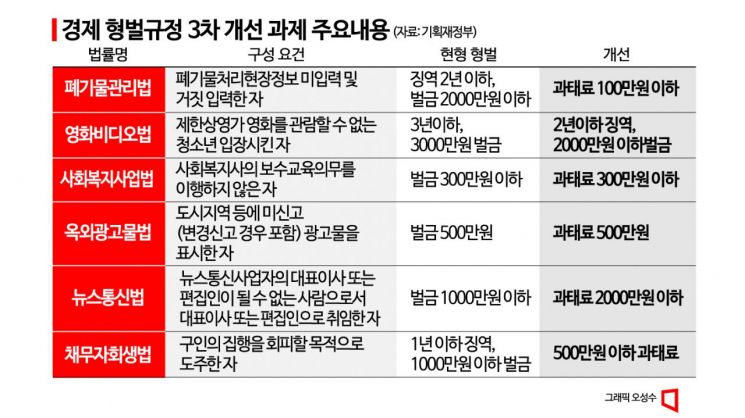
For persons who are disqualified from becoming CEOs or editors of news communication businesses but have assumed such positions, the penalty will change from the existing fine of 10 million KRW to an administrative fine of 20 million KRW. According to Article 9, Paragraph 1 of the News Communication Act, such appointments are legally invalid, and regulating already invalid matters with criminal penalties is considered ineffective and of low public interest significance.
The Debtor Rehabilitation Act was included in the legal unit review improvements. For debtors who flee to evade detention execution, the penalty will change from "imprisonment up to 1 year or a fine up to 10 million KRW" to an administrative fine of up to 5 million KRW. The task force explained, "Evading detention itself does not infringe on the interests of creditors or others and is for administrative convenience, thus violating the principle of last resort of criminal penalties." However, evasion of detention itself will remain a non-exemptible reason to ensure smooth procedural execution.
The 3rd improvement plan for economic penal provisions prepared by the task force will be submitted to the National Assembly this month through a unified amendment procedure led by the Ministry of Government Legislation. The previously submitted 1st and 2nd tasks will also be promptly revised through National Assembly deliberations.
© The Asia Business Daily(www.asiae.co.kr). All rights reserved.














