5.3% of All Examinees 'Pass' Mathematics
In the 2024 College Scholastic Ability Test (CSAT) scheduled for November 16, the proportion of test-takers who did not choose the mathematics section reached the highest level in eight years.
According to the Korea Institute for Curriculum and Evaluation's '2024 CSAT Applicant Status' released on the 2nd, among this year's CSAT applicants (504,588 people), 5.3% (26,505 people) did not take the mathematics section. This rate is the highest since the 2016 academic year (6.4%).
It is 1.1 percentage points higher than last year's 2023 CSAT (4.2%) and 1.2 percentage points higher compared to the 2022 academic year (4.1%), when the current integrated CSAT system was introduced.
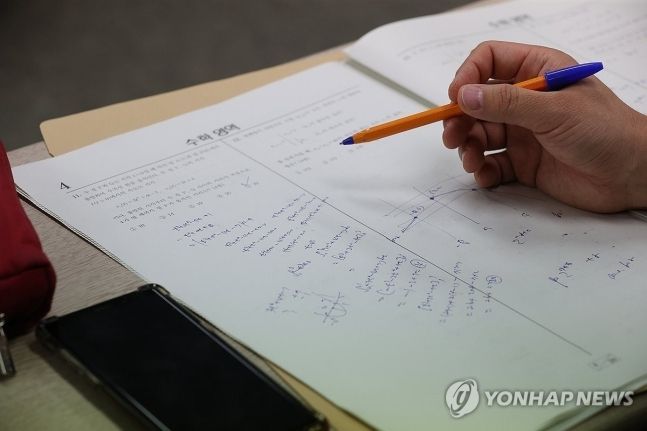
 On the 6th, students are preparing for the exam at Bangsan High School in Songpa-gu, Seoul, where the September mock test for the 2024 College Scholastic Ability Test was held.
 [Photo by Joint Press Corps]
The admissions industry views the record-high proportion of early admissions this year, at 78.8% (based on four-year universities), as the reason for the increase in students not taking mathematics. Universities usually require scores in two or more CSAT sections as a minimum academic standard for early admission successful candidates.
In this situation, it is explained that more test-takers gave up on mathematics, which is difficult to achieve high grades in, while focusing on relatively easier subjects like English or the inquiry sections.
There is also an analysis that the third year of the integrated CSAT system has intensified the concentration of mathematics test-takers choosing specific elective subjects. Among the mathematics elective subjects in the CSAT, 53.2% of test-takers chose Calculus or Geometry. If students who choose Calculus and Geometry, mainly required in natural science departments, are considered 'science track' students, this is the highest rate since the CSAT was introduced in 1994.
During the 1994?2004 academic years when the track system was in place, the science track proportion ranged from 26.9% to 45.8%. After the track system was abolished, the proportion classified as science track based on mathematics elective subjects ranged from 22.9% to 51.8%.
 On the morning of the 6th of last month, when the September mock test for the 2024 College Scholastic Ability Test (CSAT) was conducted, instructors were analyzing questions in the question analysis room inside an academy in Seoul.
 [Photo by Yonhap News]
Along with the increasing preference for medical and pharmaceutical fields, the perception that Calculus is advantageous in standard scores has spread, leading even top-tier liberal arts students to gravitate toward mathematics electives chosen by science track students.
Meanwhile, this year's CSAT will be held on the 16th of next month. Among the 2024 CSAT applicants, 326,646 are currently enrolled students, which is a 35.83% decrease compared to 509,085 enrolled students who took the test ten years ago in the 2014 academic year. On the other hand, the number of graduates taking the test increased by 25.15%, from 127,635 to 159,742 during the same period. Among this year's test-takers, 31.65% are repeat test-takers (N-su students). The proportion of N-su students, including those who took the qualification exam and repeaters, has reached the highest level in 28 years.
© The Asia Business Daily(www.asiae.co.kr). All rights reserved.













