Political Direction Shakes Greatly Depending on Dismissal or Acceptance
Lee Jae-myung's Extreme Conflict Situation Unless He Extends a Hand for Reconciliation
Pro-Lee and Anti-Lee Factions Lose Common Ground, Increasing Likelihood of Split
Lee Jae-myung, leader of the Democratic Party of Korea, stands at the crossroads of detention. Depending on the result of the pre-trial detention hearing (warrant substantive examination) for Lee scheduled on the 26th, not only the Democratic Party but also the political sphere is expected to be swept into a whirlpool of upheaval. Especially since the arrest consent bill was passed due to rebel votes within the party, it is anticipated that chaos within the Democratic Party is inevitable regardless of the outcome.
According to political circles on the 25th, the result of the warrant substantive examination can only be either 'approval' or 'dismissal.' If approved, Lee will be detained; if dismissed, he can stand trial without detention. Although this process determines the personal detention of Lee, it also signifies that the court will evaluate the legitimacy of the prosecution's investigation that has lasted over two years. Furthermore, it holds importance as a critical turning point that will decide the fate of the Democratic Party's leadership system.
Dismissal Decision = Lee Jae-myung's Counterattack as a 'Free Man'
The Democratic Party currently hopes that the court will side with Lee and issue a 'dismissal' decision. If the court dismisses the warrant, the party can argue the unfairness of the prosecution's investigation over the past two years, and Lee can directly manage the party's pressing issues. This is the most positive scenario the Democratic Party can hope for at present.
However, even if dismissal occurs, the reasons for dismissal will be crucial in future public opinion battles. The key issue is whether the warrant substantive examination will simply state that there is no evidence destruction or flight risk, or whether it will question the legitimacy of the prosecution's investigation due to insufficient evidence of charges.
In the former case, the Democratic Party can claim the investigation was excessive and engage in a battle with the prosecution, but in the latter case, it will not only gain an advantageous position in the trial but also launch an offensive against the entire prosecution investigation so far. The Democratic Party has been opposing the prosecution's investigation of the opposition party as a 'prosecutor dictatorship regime,' and it is highly likely to mount a large-scale counterattack through the National Assembly audit and other means.
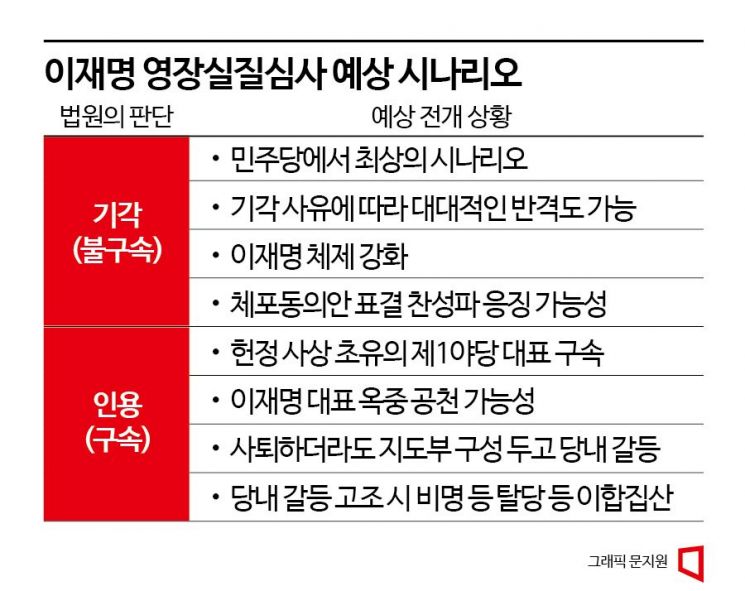
Another clear point in the case of dismissal is that Lee's leadership system will be further strengthened. Until now, there has been talk in political circles that Lee would step down around the end of the year and an emergency committee would be formed to lead the general election. However, if dismissal is decided, it is more likely that Lee will directly lead the election until next year's general election.
In this case, factional conflicts within the party may escalate to the extreme. The pro-Lee faction within the Democratic Party has already labeled some lawmakers who voted in favor of the arrest consent bill as 'those who committed the act.' Accordingly, a large-scale purge and retaliation are expected. Since challenges from non-incumbent figures prominently representing the pro-Lee faction are fierce in constituencies of lawmakers known as the anti-Lee faction, clashes are anticipated during the candidate nomination process. Lee may also adopt a 'reconciliation' mode by putting 'unity' at the forefront.
'Approval Decision' = Year-end Resolution Demanding Lee Jae-myung's Release vs. Prison Campaigning
If approved, an unprecedented situation of the ruling party leader being detained during the regular session of the National Assembly will unfold, and many extraordinary scenarios are being discussed. For example, there is a possibility that the Democratic Party will use the card of a resolution demanding Lee's release at the end of the year. Article 44, Paragraph 2 of the Constitution states that "If a member of the National Assembly is arrested or detained before a session, they shall be released during the session upon the request of the National Assembly, unless they are caught in the act." While this is not possible during the regular session, after the regular session ends on December 9, the Democratic Party can convene a special session and demand Lee's release. The release request can be proposed by at least one-quarter of the total members and passed by a majority of the total members present and a majority of those present at the plenary session.
However, the Democratic Party would have to bear the full political burden of being labeled a 'shielded National Assembly' in this case. Given that the general election is only about four months away, it is practically doubtful whether the party would use such a card to secure Lee's release.
The biggest interest lies in whether Lee will maintain his position as party leader while detained and decide on prison campaigning. For now, the pro-Lee faction insists that resignation is not an option. Lee himself stated in his first public statement after the passage of the arrest consent bill, "I will do my utmost to make the Democratic Party more reformist, more competent, and more democratic." The political circles interpret this message as a declaration that he will not resign.
Within the party, there are openly voiced opinions to maintain Lee's leadership system. On the afternoon of the 26th, Kim Min-seok, a Democratic Party lawmaker running for the floor leader position, said, "I propose that the floor leader candidates jointly request the dismissal of Lee's detention warrant and clearly declare the principle of fighting the general election centered on Lee, and jointly declare that there will be no emergency committee before this general election." This means that even if Lee is detained, they want to keep the leadership system unchanged.
The key question is whether this strategy will actually be implemented. In fact, prison campaigning is the scenario most desired by the People Power Party. For them, it is the easiest general election strategy to win. Conversely, for the Democratic Party, carrying Lee's judicial risks until the general election is a burden.
Even if Lee resigns as party leader, a complex equation must be solved. According to the Democratic Party's constitution and regulations, if Lee resigns, a new party convention must be held to elect a new party leader. However, if this method is chosen, the Democratic Party is likely to enter an internal power struggle ahead of the general election. Moreover, even if another party convention is held, it is highly likely that Lee's close aides will assume the party leadership. In the last party convention, Lee secured 77.8% of the vote, indicating strong will among party members to form a new pro-Lee leadership. Because of this, the anti-Lee faction argues that an emergency committee system should be implemented. They are expected to pressure the current leadership by presenting a strategic argument that the party must consider the centrist voter base.
Is the Democratic Party Split Becoming a Reality?
Regardless of Lee's detention, there is another important point to watch: the possibility of a party split. With the passage of the arrest consent bill due to internal rebel votes, internal conflicts within the Democratic Party have intensified. The party is at its peak internal turmoil, including efforts to identify those who voted in favor within the party. Based on past experiences with party splits, the Democratic Party agrees that 'split means certain defeat' in terms of election dynamics. However, if the pro-Lee faction moves to purge the anti-Lee faction, discussions about a split could become a reality.
Song Gap-seok, a nominated Supreme Council member who has represented the anti-Lee faction's voice in the Democratic Party's Supreme Council, has resigned, and Go Min-jung, an elected Supreme Council member who ranked second in votes, is also considering resignation. The coexistence of the pro-Lee and anti-Lee factions is gradually disappearing. Currently, the only person who can control such internal conflicts is Lee himself. If Lee is detained, internal conflicts are likely to intensify further. Even if he is not detained, unless Lee extends a hand of reconciliation, conflicts between the pro-Lee and anti-Lee factions could become acute.
Jung Ho-hee, executive director of New Choice, which is in the process of founding a new party, recently mentioned on social media, "If anyone leaves the party with even a few members, I will acknowledge about ten ships of Bae Seol, which were the foundation of the Battle of Myeongnyang," adding, "If Won Gyun (= Lee Jae-myung) had not fled with ten ships during the crushing defeat at Chilcheonryang (= failure of the shielded hunger strike), there would have been no 'Sangyu Twelve Ships' of Admiral Yi Sun-sin and no Battle of Myeongnyang." Bae Seol was a commander who led twelve Panokseon warships away from the battle during the unfavorable Battle of Chilcheonryang in the Japanese invasions of Korea (1597). Ironically, Admiral Yi Sun-sin's great victory at the Battle of Myeongnyang was possible because Bae Seol preserved part of the fleet by retreating. Jung's remark is interpreted as expressing willingness to accept Democratic Party lawmakers' defection.
© The Asia Business Daily(www.asiae.co.kr). All rights reserved.


















