"Electric Vehicle Adoption Policy Maintained, Low-Cost EVs Gain Popularity"
However, Possibility of Industry Restructuring if Economic Slowdown Occurs
Starting this year, the Chinese government has abolished subsidies for electric vehicle (EV) purchases, yet sales volumes have generally been maintained. This is attributed to the continuation of systems and policies promoting EV adoption, along with the popularity of low-priced electric vehicles.
Lee Ho, a senior researcher at the Industry Analysis Office of the Korea Automotive Research Institute, stated in the "Review of Issues in the Chinese Electric Vehicle Market" that "although China’s EV purchase subsidies have been abolished, it is difficult to see a significant impact from this."
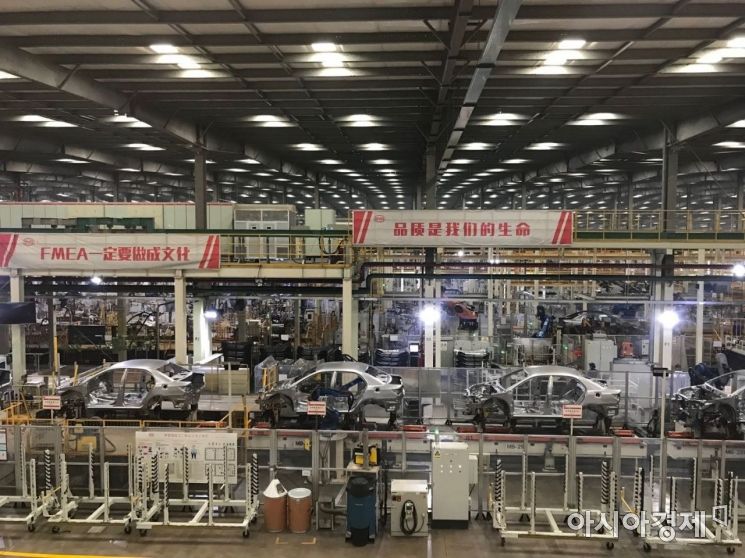
Recently, claims have been made that the pace of EV adoption in the Chinese automotive market is slowing down, while the industry structure is being reorganized around a few key companies. Early this year, EV sales sharply declined within China, and based on the Herfindahl-Hirschman Index (HHI), which measures market concentration, it is argued that the market is being restructured around a small number of firms.
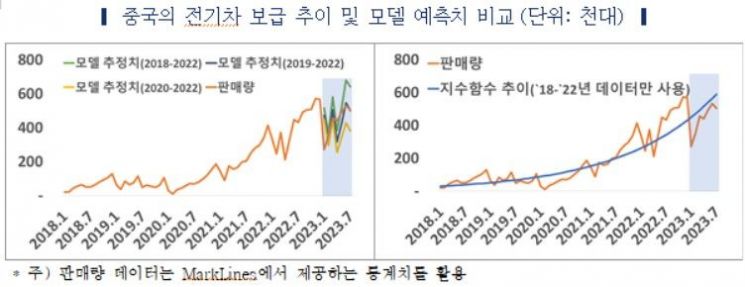
However, sales trends have continued to be maintained for several years even after the subsidy abolition. Lee Ho explained, "Using the Bass Model, which is mainly used to predict the diffusion of innovative products, an analysis of trends up to last year shows that sales volumes until July this year generally align with the model’s predictions." Chinese vehicle sales tend to be sluggish in the first half of the year and strong in the second half, and EVs follow this pattern as well.
Regarding the restructuring around a few companies, Lee Ho argued that although concentration among some firms has increased over the past year, it is unclear whether this trend will continue. Unlike internal combustion engine vehicles, the EV market lacks model diversity, so when popular models emerge from certain companies, the HHI tends to rise sharply. Especially in China, there are many EV manufacturers. Due to the highly competitive market characteristics, when competitors release similar models, the competitive landscape tends to change rapidly. Therefore, it is difficult to view the current situation as a long-term trend.
For example, the Hongguang Mini EV released by Shanghai GM Wuling (SGMW) showed high sales until last year but has seen a significant decrease in sales starting this year. This vehicle was never eligible for purchase subsidies, so the decline cannot be attributed to the subsidy abolition.
Lee Ho cited the maintenance of EV-friendly policies after subsidy abolition and the popularity of low-priced EVs as reasons why the Chinese EV market has not undergone major changes. For instance, the Chinese government prioritizes issuing license plates to EVs and has extended a 10% reduction in acquisition tax. Since low-priced EV models, which were not eligible for subsidies, appeared starting in 2021, the Chinese EV market is shifting from an "early adopter" market to a "mainstream" market.
However, he predicted that if economic uncertainties in China materialize, the impact of restructuring could spread to EV manufacturers as well. If the economic slowdown continues, growth in the EV industry will also decelerate, and intensified competition among companies could lead major firms to undergo restructuring.
© The Asia Business Daily(www.asiae.co.kr). All rights reserved.













