Presentation of 46 Tasks Including Establishment of National Investment Holding Company
Chair of 6 Major Missions Including Investment, Workforce, and Productivity
Former Ministers Choi Joong-kyung and Park Jae-wan, Samsung Electronics Advisor Kim Hyun-seok, etc.
A proposal has been made to establish a national investment holding company to lead South Korea in the global supply chain competition, prepare a talent red carpet (top treatment) support plan, and promote the construction of AI factories. This industrial transformation policy proposal was prepared after more than 80 people from the business community, industrial research institutes, and private experts discussed for 10 months due to concerns that South Korea might be repeating Japan's lost 30 years.
The Korea Chamber of Commerce and Industry (KCCI) announced on the 17th that it will deliver the 'Industrial Transformation Proposal' on the 18th. The Ministry of Trade, Industry and Energy formed the 'Industrial Transformation Forum' in November last year. Four economic organizations including KCCI and three public institutions and government-funded research institutes such as the Korea Institute for Advancement of Technology (KIAT) participated in the discussions. After the discussions, 46 tasks were derived under six missions: investment, workforce, productivity, corporate growth, global, and new business.
The six mission chairs were Choi Joong-kyung, former Minister of Knowledge Economy and Chairman of the Korea-America Association (investment); Kim Woo-seung, President of the Korea Engineering Accreditation Board (workforce); Kim Hyun-seok, Advisor at Samsung Electronics (productivity); Park Jae-wan, former Minister of Strategy and Finance (corporate growth); Lee Sung-yong, Korea Representative of Arthur D. Little (global); and Park Il-pyung, Head of LG Science Park (new business).
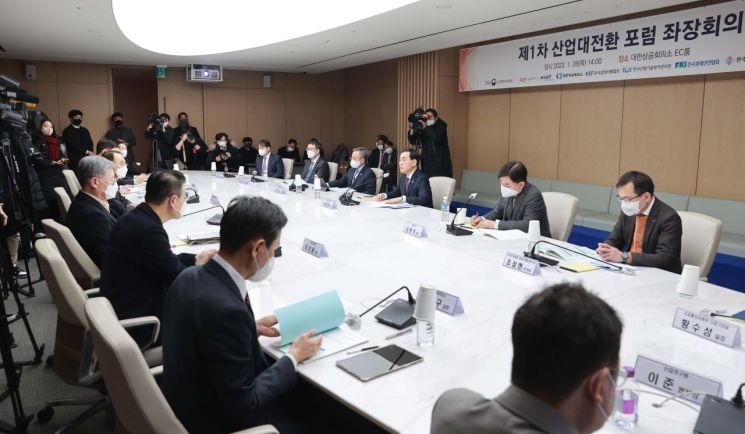 The 1st Industrial Transformation Forum Chairpersons' Meeting held on January 26 [Photo by Ministry of Trade, Industry and Energy]
The secretariat organizations including KCCI stated, "The current state of our economy is such that we feel a crisis, fearing that we might not expect growth but rather repeat Japan's lost 30 years," adding, "The growth model focused on catching up with advanced countries and export-oriented growth centered on intermediate goods and exports to China is no longer effective." They further added, "We agreed that drastic measures are needed to gain an advantage in the global competition in advanced industries and that 'industrial transformation' is necessary as a sustainable growth strategy for our economy."
In the investment sector, the proposal includes establishing a government fully funded national investment holding company to carry out strategic and long-term investments. Considering the characteristics of capital-intensive advanced industries, it suggested implementing a 'Reverse-BTL' system that reverses the existing private investment method of Build-Transfer-Lease (BTL). In this system, the government builds factories, transfers ownership to companies, leases operational rights, and receives rent. It also proposed prioritizing the removal of excessive regulations compared to competing countries through 'global standard regulatory principles' and introducing an 'industrial impact assessment system' to minimize side effects of industrial activities through post-regulation adjustments.
In the workforce sector, the proposal included laying out a 'talent red carpet' to attract world-class talent. It supports the rapid entry of overseas talent and provides exceptional settlement conditions to encourage them to settle in Korea. It also includes strengthening the capabilities of sectoral talent resource development councils (SC) to resolve the shortage of advanced industry personnel. Additionally, it suggested enhancing existing on-the-job skill training to open an era of 'one person, one skill' to respond to the decline in the working population.
In the productivity sector, it was stated that support for the development and commercialization of 'critical technologies' should be increased to nurture the 'second semiconductor.' The focus is on intensively fostering projects that can secure the world's number one market position. They requested expanding large mission-oriented R&D, scale-up R&D for commercialization of marketable projects, and proposed promoting 'AI-based supply chain leading projects' in home appliances, steel, automobiles, and secondary battery industries. The plan is to go beyond creating smart factories centered on industrial complexes and establish an individual company AI factory ecosystem.

In the corporate growth sector, they proposed creating a customized 'growth promotion incentive' system according to company size. This means supporting R&D and investment tax credits regressively (lower rates for larger companies). They also suggested establishing a 'performance-based support system' that increases support for high-performing projects and gradually sunsets underperforming projects.
In the global sector, they proposed building cutting-edge mother factories (core R&D and manufacturing plants) to strengthen domestic industrial infrastructure. The idea is to conduct advanced processes in Korea and establish a system where mass production is done overseas. They also suggested creating advanced R&D clusters and establishing Korea-friendly 'K-Industrial Complexes' in new hub regions.
In the new business sector, they called for resolving regulatory gaps to support the acceptance of new products and services and creating an industrial ecosystem that supports new business.
The mission chairs plan to continuously consult with the Ministry of Trade, Industry and Energy, the main ministry, to ensure that the 'Industrial Transformation Proposal' is reflected in policy. The ministry stated, "We plan to actively review the proposal and coordinate with related ministries to incorporate it into policy."
© The Asia Business Daily(www.asiae.co.kr). All rights reserved.













