Private Taxis, 'Buje' Lifted and 'Jangrong Myeonho' Allowed
Anyone Anytime, Golden Time 'Swept Clean'
Company Taxis Shackled by 'Juhyu' Rules and Work Obligations
If things continue like this, the taxi industry operated by companies is bound to collapse.
The law not only enforces wages but also strictly prohibits elderly workers from working even a little if their health does not permit. Employers must pay drivers who fail to meet the quota at least the salary and severance pay corresponding to 40 hours per week. Neither drivers nor employers feel motivated to work.
At times like this, individual taxis that have received the benefit of 'lifting the day-off system' rush out to the streets during the golden hours and sweep up customers. Even driver's licenses that were kept 'in the drawer' gain 'power' after five years, so the individual taxi premium is stirring again.
The shadow over the taxi industry is deepening as the corporate taxi sector, facing consecutive closures and the threat of bankruptcy, recently experienced an extreme choice by a company CEO.
According to the corporate taxi industry, the CEO of a corporate taxi company in Seoul with 83 licenses, who had been complaining about management difficulties, made an extreme choice on the 13th. Industry insiders unanimously say that there is no way to overcome the management difficulties of corporate taxis under the current system or policies, making the outlook even more pessimistic.
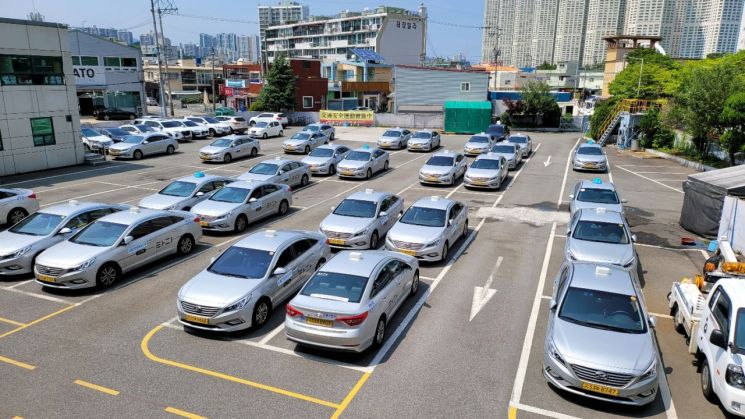
Currently, there are about 90 corporate taxi companies in Busan, but one company has already closed, and about three only remain in name, with operations almost halted. There are no taxi drivers, and only union leaders remain in place.
There are rumors that six companies may close within this year. Two companies in Busan operate in the form of taxi cooperatives, where drivers each pay part of the contract fee to purchase taxi licenses.
One company has about 190 licenses, but fearing depreciation from long-term holding, it is disposing of vehicles one by one, and the actual number of active drivers is known to be only about ten.
A corporate taxi official explained that taxi operations, which were running at about 50% capacity during the direct hit of COVID-19, have recently dropped to 40%. This means companies only hold licenses, and taxi vehicles are gradually disappearing. They are barely covering operating funds with compensation received from local governments for reducing the number of vehicles.
The dominant view in the corporate taxi industry is that the 'main culprit' slowly drying up corporate taxis is actually the current laws and policies.
An official from a corporate taxi association pointed out, "According to current law, a driver who earns 50,000 won a day for the company must be paid a monthly salary exceeding 1.8 million won and also be provided severance pay."
He bluntly stated that since the implementation of the full management system and monthly salary system, the number of taxi drivers has actually decreased, and such systems cannot attract taxi transport workers.
The law also blocks elderly taxi drivers from working moderately for a short time and earning money. The court enforces the worker's time selection agreed upon by labor and management. Even those who want to work 2 to 3 hours must work at least 6 hours and 40 minutes, as the minimum working hours have been set.
The corporate taxi industry also pointed out that granting individual taxi qualifications for the five-year 'drawer license' was a major mistake. The original system, which granted individual taxi licenses after three years of corporate taxi experience to ensure transport labor safety, has completely disappeared.
An official from the Busan Corporate Taxi Association emphasized, "To maintain the transportation safety network, the individual taxi license system must be changed to increase the operating rate of corporate taxis."
It is also known that the lifting of the day-off system for individual taxis has directly impacted corporate taxi operations. Since individual taxis can operate without any day restrictions, the income of corporate taxi workers has relatively decreased, fueling turnover.
A corporate taxi driver complained, "After lifting the day-off system, individual taxi drivers sweep up passengers by choosing days and times with high demand, but we have to follow the weekly holiday regulations, so we are being discriminated against."
Corporate taxis and taxi unions have recently issued urgent appeals and statements one after another.
The Seoul Taxi Transport Business Association, which includes 254 corporate taxi operators in Seoul, recently demanded revival measures for the corporate taxi industry's collapse crisis, driven to extreme choices.
Also, the National Taxi Labor Union Federation issued a statement titled, "The taxi industry driven to extreme choices, the Ministry of Land, Infrastructure and Transport and local governments who only stand by must wake up."
Jang Seong-ho, director of the Busan Corporate Taxi Association, said, "While laws and policies force operators into management difficulties and prevent taxi drivers from returning, passenger safety will be trapped in the 'drawer license'."
© The Asia Business Daily(www.asiae.co.kr). All rights reserved.












