2023 National Tax Administration Forum Held
Loss Due to Legal Interpretation Differences → System Improvement
Loss Due to Fact Judgment → Strengthening Pre-Verification
National Tax Service Strengthens Science-Based Investigation to Combat Marginal Asset Tax Evasion
Over the past five years (2018?2022), it has been revealed that the National Tax Service (NTS) lost more than one-third of high-value tax litigation cases exceeding 5 billion KRW. The NTS plans to link losses due to differences in legal interpretation to system improvements and strengthen pre-verification on frequently recurring issues in cases lost due to factual judgment.
On the 15th, the NTS held the '2023 National Tax Administration Forum' at the Korea Federation of SMEs in collaboration with the National Tax Administration Reform Committee and the Korea Institute of Public Finance. This forum was organized to seek policy alternatives for advancing national tax administration by securing fairness and accountability to gain public trust.
According to the NTS, the loss rate in tax appeal lawsuits over the past five years (769 cases in the final trial) was 11.2% based on the number of cases. Notably, the loss rate for high-value lawsuits exceeding 5 billion KRW reached 33.8%. By tax category, corporate tax had the highest average loss rate over five years at 19.6%, followed by gift tax (17.8%), value-added tax (11.5%), and inheritance tax (11.2%).
An analysis of the causes of losses in 216 final trial cases from 2021 to 2022 showed 81 cases due to legal interpretation and 135 cases due to factual judgment.
The NTS intends to link losses caused by differences in legal interpretation to system improvements, strengthen pre-verification on frequently recurring issues in losses due to factual judgment, and establish measures to prevent repeated losses in cases with significant ripple effects involving the same issues.
Park Jeong-heum, Associate Research Fellow at the Korea Institute of Public Finance, who presented on 'Improving Tax Quality through Analysis of Tax Appeal Status,' suggested that due to the emergence of new asset and transaction types and increased taxpayer awareness of rights, it is necessary to evaluate the effectiveness of current tax quality-related systems and explore improvement measures.
Park emphasized, "For lost cases, we analyze the causes by type and take follow-up actions such as reviewing the need for legal and institutional improvements and conducting thematic education on factual judgment. However, it is necessary to strengthen effectiveness to prevent repetitive appeals and losses. For high-value and important cases, all relevant departments should participate in analyzing the causes of losses and promptly establish fundamental improvement measures and implementation procedures such as legal and institutional reforms."
The forum also discussed countermeasures against tax evasion using virtual assets. As of the end of last year, the market capitalization of virtual assets was 19.4 trillion KRW, with 6.27 million annual users, reflecting rapid growth in the virtual asset-related industry over recent years. However, the NTS views that virtual assets pose a high risk of disputes and tax evasion due to the lack of clear standards on taxable types, transactions, and income classification.
Professor Kim Beom-jun of the Seoul National University School of Law advised, "The Income Tax Act, scheduled to be enforced in 2025, limits taxable virtual asset transactions to transfers and lending, excluding other transaction types from taxation. Given the rapid technological advancement and diverse transaction types of virtual assets, it is necessary to study ways to identify and tax similar income types beyond transfers and lending."
The NTS plans to thoroughly review the various improvement suggestions discussed at this forum and incorporate feasible matters into policy to the greatest extent possible. Legal amendments will be coordinated with related ministries such as the Ministry of Economy and Finance, and matters requiring social consensus will be carefully examined through stakeholder consultations before deciding on improvement measures.
Kim Chang-gi, Commissioner of the NTS, stated, "Since tax quality is directly linked to public trust, it is essential to develop reasonable improvement measures that fully protect taxpayers' rights while maintaining the NTS's legitimate taxation. We will further enhance tax accountability and transparency and strictly respond to malicious tax evasion, including new types of tax evasion based on online platforms."
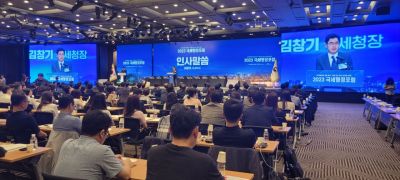 On the 15th, Kim Chang-gi, Commissioner of the National Tax Service, is speaking at the '2023 National Tax Administration Forum' held at the Korea Federation of SMEs.
© The Asia Business Daily(www.asiae.co.kr). All rights reserved.