Major indices on the U.S. New York Stock Exchange showed mixed trends in early trading on the 17th (local time) as investors digested corporate earnings, economic indicators, and the minutes from the July Federal Open Market Committee (FOMC) meeting released the previous day. With expectations of a soft landing and strengthened forecasts of prolonged tightening, the yield on the 10-year U.S. Treasury note surpassed the 4.31% level.
At around 10:04 a.m. at the New York Stock Exchange (NYSE), the Dow Jones Industrial Average, composed of blue-chip stocks, was trading at around 34,865, up 99.79 points (0.29%) from the previous close. The S&P 500 index, which focuses on large-cap stocks, rose 7.41 points (0.17%) to 4,411. Meanwhile, the tech-heavy Nasdaq index fell 16.59 points (0.12%) to 13,458.
Currently, within the S&P 500, materials, real estate, and industrial sectors are rising, while consumer discretionary, healthcare, and technology sectors are declining. Cisco Systems rose about 5% after reporting quarterly earnings that exceeded expectations. Walmart is trading slightly lower despite an earnings surprise. Boeing is up nearly 3% following BAE Systems’ announcement to acquire its aerospace business for $5.6 billion. Hawaiian Electric dropped 17% amid recent concerns related to wildfires on Maui Island.
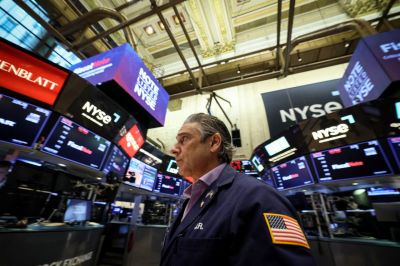
Investors are closely watching corporate earnings including Walmart’s, economic indicators, the Federal Reserve’s monetary policy direction, and movements in Treasury yields.
The minutes from the July FOMC meeting released the previous afternoon revealed that Fed officials expressed significant concerns about inflation and left room for further interest rate hikes. The minutes stated, "Most participants confirmed that inflation remains significantly above the price stability target and that there are substantial upward inflation risks in a tight labor market," adding, "This may require additional tightening of monetary policy." Recent strong economic data also support this cautious stance on tightening, which in turn is pushing long-term yields higher.
In the New York bond market, the benchmark 10-year Treasury yield continued its upward trend after hitting a 15-year high the previous day, reaching as high as 4.312% during the session. Besides expectations of a soft landing and concerns over prolonged Fed tightening, the U.S. Treasury’s increased issuance of bonds is also exerting upward pressure on yields. Former Treasury Secretary Larry Summers previously predicted that the 10-year Treasury yield would rise further. Adam Crisafulli of Vital Knowledge noted, "Treasury yields continue to rise, undermining investor confidence, but I believe the Treasury market weakness is excessive." Treasury yields and prices move inversely.
The weekly initial jobless claims released that day showed a decline, indicating a still-tight labor market. According to the U.S. Department of Labor, initial jobless claims for the week of August 6-12 fell by 11,000 to 239,000, below the Dow Jones estimate of 240,000. Continuing claims, which count those filing for unemployment benefits for at least two weeks, also decreased by 32,000 to 1.72 million compared to the previous week.
The Philadelphia Fed manufacturing index for August rebounded to 12, a significant improvement from the previous month’s -13.5 and well above Wall Street’s forecast of -10. This is the first time in 12 months that the index has entered positive territory, signaling economic expansion. CNBC reported that this rebound was driven by a substantial improvement in the new orders index.
On the other hand, the U.S. Conference Board’s leading economic index for July fell by 0.4%, confirming ongoing recession risks. This was in line with expectations. Justyna Zawisza-Ramonika, senior manager at the Conference Board, stated, "The leading economic index continues to suggest that economic activity will slow over the next few months and that a mild contraction is likely," adding, "A short and shallow recession is expected between Q4 2023 and Q1 2024."
Corporate earnings announcements are ongoing. U.S. retail giant Walmart reported earnings this morning that exceeded Wall Street expectations. Walmart’s second-quarter sales increased 6.3% year-over-year, prompting the company to raise its full-year guidance. TJX and Target, which reported earlier, also raised their guidance for the year. After the market closes today, Ross Stores and Applied Materials are scheduled to release earnings. Meanwhile, weak economic data and concerns over defaults in the real estate sector in China continue to weigh on investor sentiment.
Sam Stovall, chief investment strategist at CFRA Research, commented, "The market and sectors are losing momentum." The New York stock market, which had been rallying, has been in a downtrend since August began. Chris Fasiano, portfolio manager at Commonwealth Financial Network, told CNBC, "After a strong rally through the first half of the year and into July, some caution was warranted," adding, "What is happening now (the market decline) is not unexpected. A modest pullback can ultimately be healthy for the market."
Investors’ attention is now turning to next week’s Jackson Hole forum. The key question is what signals Federal Reserve Chair Jerome Powell will send at the event. Since the last FOMC meeting, some officials, including Patrick Harker, president of the Philadelphia Fed, have drawn a line under the possibility of rate cuts this year while suggesting that rate hikes may be ending. With about a month left until the September FOMC, there are still many inflation and employment indicators to monitor.
Currently, the market still largely expects the Fed to hold rates steady in September. According to the CME FedWatch tool, the federal funds futures market is pricing in an over 86% chance of a rate hold in September. However, the probability that the Fed will raise rates by at least 0.25 percentage points by year-end has jumped from the mid-20% range a week ago to the mid-30% range today. There are three remaining FOMC meetings this year: September, November, and December.
International crude oil prices are rising. The September West Texas Intermediate (WTI) contract is trading above $80.5 per barrel, up more than 1.5% from the previous close. The dollar index, which measures the value of the U.S. dollar against six major currencies, is down nearly 0.2% to 103.2.
European stock markets are declining. Germany’s DAX index is down 0.52% from the previous close. The UK’s FTSE index has fallen 0.33%, and France’s CAC index is down 0.63%.
© The Asia Business Daily(www.asiae.co.kr). All rights reserved.











