Credit Balance Ratio Top Stocks Yield Higher Than KOSPI and KOSDAQ Gains
Extreme Concentration in Secondary Battery Stocks May Cause Significant Volatility, Caution Advised
As the stock market surged last month, breaking previous highs, margin trading?investing with borrowed money?also increased. Thanks to the market's strong rally, the top margin trading stocks in both the KOSPI and KOSDAQ showed favorable returns. However, concerns have been raised about the overall market volatility due to the high fluctuations in secondary battery stocks, which are the main drivers of margin trading, signaling the need for caution.
According to the Korea Exchange on the 3rd, an analysis of the year-to-date returns of stocks with high credit balance ratios as of the 28th of last month showed that most of these stocks recorded significant gains. The top five stocks with the highest credit balance ratios in the KOSPI market were Daeyang Metal, Taekyung BK, UNGEL, Mirae Industry, and Sunny Electronics, in that order. Daeyang Metal rose 17.43% compared to the beginning of the year, Taekyung BK increased by 52.33%, UNGEL by 23.22%, and Mirae Industry surged 215.45%. Only Sunny Electronics declined by 10.94%. The KOSPI index itself rose 16.99% during the same period.
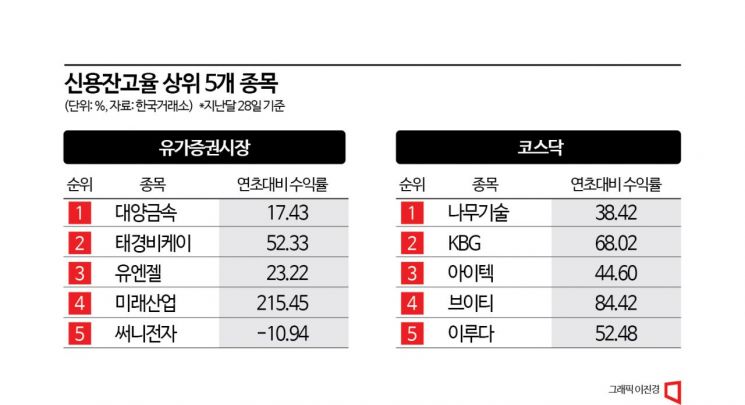
In the KOSDAQ market, the stocks with the highest credit balance ratios were Namu Technology, KBG, I-TECH, VT, and Iruda, respectively. Their year-to-date price increases were 38.42% for Namu Technology, 68.02% for KBG, 44.60% for I-TECH, 84.42% for VT, and 52.48% for Iruda. The KOSDAQ index rose 33.93% over the same period. The significant rise in the stock market this year has contributed to these stocks in both markets achieving solid price returns.
On the 2nd, both the KOSPI and KOSDAQ markets experienced sharp declines due to the downgrade of the U.S. sovereign credit rating by Fitch Ratings. However, as the market has recently resumed its upward trend, margin loan balances, which had decreased following the stock price crash triggered by Soci?t? G?n?rale (SG) Securities in April, have recently surpassed 20 trillion won again, showing an increasing trend. Nevertheless, margin trading has not surged dramatically yet. The number of stocks with double-digit credit balance ratios has decreased compared to the beginning of the year. In the KOSPI market, there were three such stocks at the start of the year, but now there are none, while in the KOSDAQ market, the number dropped from six to one. Although there were more than 20 such stocks combined in both markets in April during the market's strong performance, the SG-triggered crash led to a decline in margin loan balances and a downward trend in credit balance ratios among stocks.
Recently, as secondary battery stocks have shown strength, margin balances have increased mainly among related stocks. The increase was particularly notable among POSCO Group stocks and LS Group stocks, which recently announced plans to enter the secondary battery business and saw significant stock price gains. POSCO Steelion's credit balance ratio rose from 2.89% at the beginning of the year to 5.42%. POSCO Holdings increased from 0.35% to 1.43%, and POSCO Future M from 0.84% to 1.42%. POSCO DX also expanded from 0.89% to 1.05%. Only POSCO M-TEC decreased from 7.69% to 3.36%. Among LS Group stocks, LS rose from 0.35% to 1.78%, LS Cable & System Asia from 1.56% to 2.28%, and LS ELECTRIC from 0.27% to 1.5%. In contrast, EcoPro and EcoPro BM, which have been leading secondary battery stocks since last year, saw declines compared to the beginning of the year.
Although the stock market is showing strength and margin trading is increasing, attention should be paid to the potential expansion of volatility due to concentration effects. Han Ji-young, a researcher at Kiwoom Securities, warned, "It is necessary to prepare for possible aftereffects such as volatility and additional sell-offs of secondary battery stocks triggered by the 'FOMO (Fear Of Missing Out)' phenomenon in a rising market, as well as margin call forced sales." She expressed concern that "a short-term sharp price drop could stimulate buying aimed at a technical rebound, potentially reigniting the FOMO phenomenon."
© The Asia Business Daily(www.asiae.co.kr). All rights reserved.