International Seminar on 'Trends in Online Platform Regulation' Held at COEX Conference Room, Seoul on the 10th
Concerns are emerging in major countries overseas regarding the European-style platform regulation approach toward big tech platform companies. In particular, as the possibility of Samsung Electronics being included under the scope of Europe’s platform regulation law, the DMA (Digital Markets Act), arises, there are increasing challenges to the preemptive regulatory approach. The core of the European-style regulation is to set criteria for target companies in advance to facilitate swift intervention by authorities, but it is criticized for establishing standards that do not sufficiently consider differences in companies’ business models.
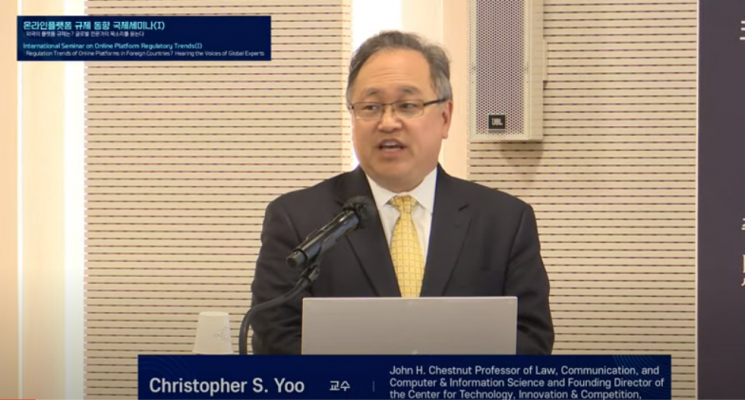
On the 10th, the Korea Internet Corporations Association, in collaboration with Korea University’s ICR Center, held an international seminar on ‘Trends in Online Platform Regulation’ at the COEX conference room in Seoul. The seminar featured global competition law experts such as Professor Christopher Yoo (University of Pennsylvania Law School), Professor Giuseppe Colangelo (University of Basilicata), and Andy Chen, Vice Chairman of Taiwan’s Fair Trade Commission, who shared insights on the situations and policy trends in their respective countries.
Europe is the fastest to put into practice concerns about regulating monopolies of big tech platform companies. The core of the European approach, the DMA (Digital Markets Act), is a shift toward ‘preemptive regulation.’ The key point of the EU law, which has been in effect since May, is to present criteria for companies subject to regulation (gatekeepers) in advance and to introduce obligations and prohibitions they must follow. This aims to eliminate delays caused by continuous disputes with companies over market dominance and market definition under competition law.
While this intends to respond quickly to market monopolies through speedy regulatory enforcement, experts attending the seminar expressed concerns about this European-style preemptive regulatory approach. Professor Christopher Yoo of the University of Pennsylvania Law School pointed out, “There are various companies referred to as platforms, and they have different business models,” adding, “It is inappropriate to group essentially different companies under the definition of ‘platform’ and apply competition law uniformly.” He said, “We need to consider whether it is appropriate to regulate Apple, whose core business is device manufacturing, and Amazon, which operates cloud and online commerce, both equally as ‘platforms.’”
Professor Giuseppe Colangelo of the University of Basilicata diagnosed that the DMA-style preemptive regulation could hinder industrial innovation and cause unintended side effects. In particular, he cited the example that under the current DMA law, ‘Samsung’ could also be subject to DMA regulation as a gatekeeper platform company. According to the EU, the DMA applies not only to social media and cloud services but also to web browsers, so manufacturers like Samsung are also regulated. Samsung’s ‘Samsung Internet,’ applied on smartphones, is evaluated as having a dominant position in the internet browser market.
He said, “According to the criteria presented by the DMA law, this could lead to unintended intervention results,” and added, “It is necessary to consider the unexpected outcomes and effects arising from the ‘gatekeeper’ provisions proposed by the DMA.” He continued, “This kind of pre-defined regulatory approach is merely an attempt by competition authorities to create a ‘shortcut’ for regulation,” and criticized, “The EU is simply trying to send a political signal that it is the ‘leader’ in digital platform regulation markets.”
Andy Chen, Vice Chairman of Taiwan’s Fair Trade Commission, stated that Taiwan’s competition authorities do not take a preemptive regulatory approach to the monopoly issues of platform companies. He said, “Taiwan’s competition authorities do not apply a consistent approach to various cases such as ‘tying’ or ‘self-preferencing’ occurring in the digital platform market,” adding, “They approach issues on a case-by-case basis.” He further noted, “The main concern of Taiwan’s competition authorities is not competition issues but preventing fraud and the spread of illegal information occurring on platforms.”
© The Asia Business Daily(www.asiae.co.kr). All rights reserved.












