The Korean Medical Association announced on the 21st that it held a meeting with leaders of medical education organizations regarding the issue of medical school quotas being promoted by the government.
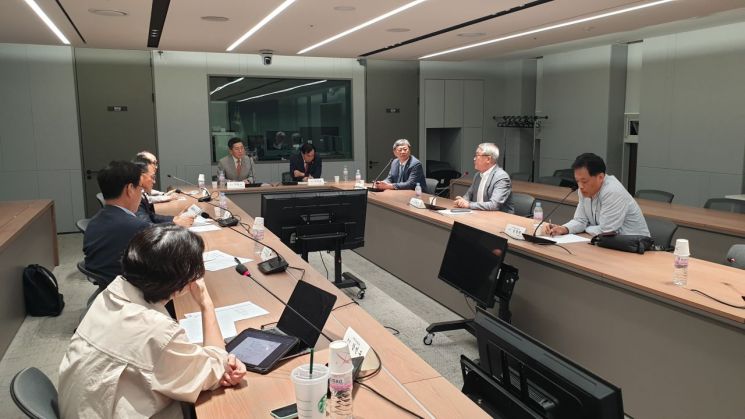 A meeting was held with the Korean Medical Association and leaders of medical education organizations regarding the issue of medical school quotas.
 [Photo by Korean Medical Association]
This meeting was organized to listen to the opinions of the medical education sector on the government's plan to expand the number of doctors as a measure to strengthen essential and regional medical care, which is currently facing a crisis of collapse. Attendees included Lee Pil-su, President of the Korean Medical Association; Lee Kwang-rae, President of the Incheon Medical Association; Wang Gyu-chang, President of the Korean Academy of Medicine; Han Hee-cheol, Chairman of the Korea Institute of Medical Education and Evaluation; Shin Chan-soo, Chairman of the Korean Association of Medical Colleges and Medical Schools; Kim Jang-han, President of the National Association of Medical School Professors; and Kang Min-gu, President of the Korean Intern Resident Association.
The leaders of the medical education organizations reached a consensus that the shortage of essential and regional medical personnel stems from structural problems caused by the poor conditions of essential and regional medical care, and therefore, expanding medical school quotas cannot be a fundamental solution. To immediately expand essential medical care and resolve regional medical disparities, more fundamental solutions such as ▲enactment of a special law on essential medical accident handling and ▲appropriate compensation for essential and regional medical fields are necessary.
Additionally, concerns were raised about the government considering the expansion of medical personnel based on public opinion or policy needs without objective grounds or clear principles for adjusting medical school quotas in a situation where it is difficult to predict appropriate personnel supply and demand. Opinions were also expressed that appropriate supply and demand measures should be discussed through objective and scientific analysis of the current status and future demand of medical personnel in Korea.
Lee Pil-su, President of the Korean Medical Association, emphasized, "To revive essential and regional medical care, it is important to create a stable medical environment where excellent medical personnel can voluntarily enter less preferred fields," adding, "The burden of legal disputes for essential medical personnel should be alleviated through the enactment of the 'Special Act on Essential Medical Accident Handling,' and substantial compensation must follow for less preferred fields such as essential and regional medical care."
Meanwhile, the attendees agreed to promote a forum hosted by the Korean Medical Education Council next month for in-depth discussion on the issue of medical school quotas.
© The Asia Business Daily(www.asiae.co.kr). All rights reserved.












