U.S. Secretary of Defense Lloyd Austin emphasized the need to expand communication between the military authorities of the U.S. and China regarding the Taiwan Strait.
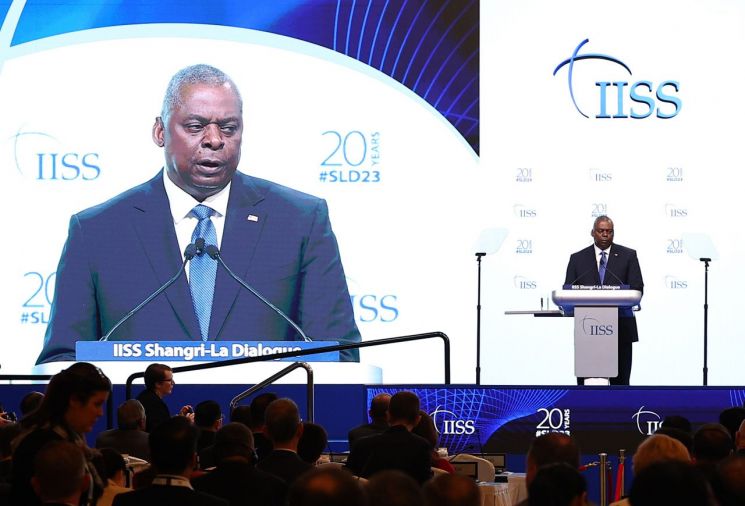
In a speech at the ongoing Asia Security Conference (Shangri-La Dialogue) in Singapore on the 3rd, Secretary Austin addressed China, saying, "Let me be clear," and added, "The Taiwan Strait issue could be fatal." He continued, "The United States is working to ensure that all countries can freely navigate and operate wherever international law permits," and added, "Every country, big or small, should be able to conduct legitimate maritime activities."
He also argued that communication between the U.S. and China is necessary for stability in the Asia-Pacific region. He said, "The more we talk, the more we can avoid misunderstandings and miscalculations that could lead to crises and conflicts," and added, "Responsible defense leaders must always engage in dialogue, and the right time to do so is now."
Despite Secretary Austin’s speech, prospects for expanded communication between the two countries do not look promising. China has demanded the lifting of sanctions on Defense Minister Li, imposed during the Donald Trump administration, as a precondition for dialogue, but the Biden administration is reportedly opposed to this.
During the Shangri-La Dialogue, China also rejected the U.S. proposal for a meeting between Secretary Austin and Chinese State Councilor and Defense Minister Li Xiangfu. According to foreign media reports, Austin and Li shook hands and exchanged brief greetings at the opening dinner the previous day, but did not engage in any meaningful extended conversation.
Meanwhile, in his speech that day, Secretary Austin explained the U.S.’s support for and strengthening of alliances in the Indo-Pacific region. While emphasizing dialogue to resolve conflicts between the U.S. and China, he took a firm stance against provocative actions.
There were also remarks regarding South Korea in relation to issues such as North Korea. Secretary Austin said, "I commend the bold steps taken to improve relations between South Korea and Japan," adding, "The strong ties between the two countries are positive not only for them but also for the region."
He further added that the U.S., South Korea, and Japan are looking for ways to enhance interoperability and share information on North Korean missiles more efficiently.
© The Asia Business Daily(www.asiae.co.kr). All rights reserved.












