Presidential Veto Following the Grain Management Act and Nursing Act?
Ruling Party: "Kim Nam-guk Incident Used to Shift the Situation... Veto Recommendation"
The so-called 'Yellow Envelope Act (Amendment to the Labor Union and Labor Relations Adjustment Act)' was directly referred to the plenary session by the opposition party alone on the 24th, prompting the ruling People Power Party to strongly oppose and announce plans to file a constitutional dispute.
The Democratic Party and the Justice Party maintain that the decision to directly refer the bill to the plenary session followed proper procedures. However, the People Power Party views this as a ploy to induce President Yoon Seok-yeol to exercise his veto power.
If the Yellow Envelope Act passes the plenary session, President Yoon is likely to exercise his veto for the third time, following the amendments to the Grain Management Act and the enactment of the Nursing Act. Although both sides are shifting responsibility to each other, the repeated pattern of 'forcing legislation → exercising veto' is expected to draw criticism from both ruling and opposition parties for the 'disappearance of politics.'
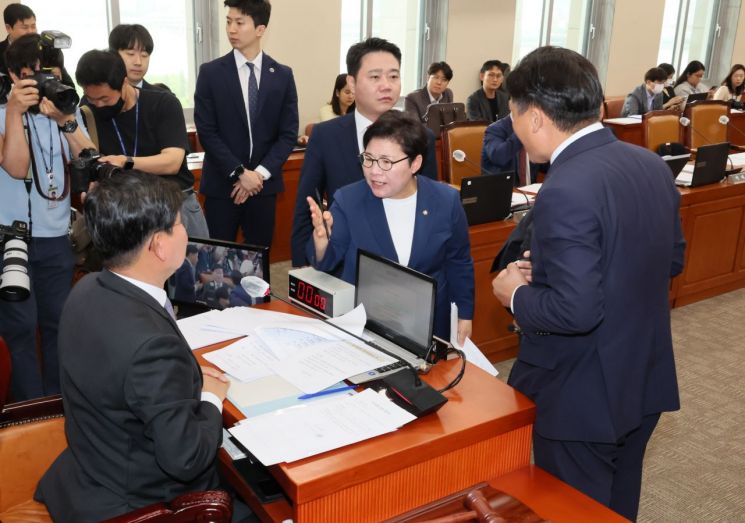 On the morning of the 24th, at the Environment and Labor Committee plenary meeting held at the National Assembly, Im Eija, the ruling party's floor leader from the People Power Party, protested to Chairman Jeon Hae-cheol regarding the proposal to directly submit the "Yellow Envelope Act" to the plenary session.
 [Image source=Yonhap News]
The National Assembly's Environment and Labor Committee held a plenary meeting on the 24th and, through cooperation between the Democratic Party and the Justice Party, resolved to directly refer the Yellow Envelope Act to the plenary session. The Yellow Envelope Act strengthens the responsibility of primary contractors for subcontracted workers and limits indiscriminate claims for damages by companies against striking workers.
Opposition members of the People Power Party, who have opposed the Yellow Envelope Act, walked out when the vote on the direct referral was decided, and the bill was referred to the plenary session with the unanimous support of all 10 opposition members. Im Eui-ja, a People Power Party member and secretary of the Environment and Labor Committee, protested by saying, "This is an attempt to shift the focus from the 'Kim Nam-guk Coin Gate' and the 'Money Envelope Incident,'" and announced plans to file a constitutional dispute with the Constitutional Court.
The opposition claims that they followed procedures and principles. Lee Eun-joo, a Justice Party member of the Environment and Labor Committee, said in an MBC radio interview on the 25th, "There was already much talk last month in the Environment and Labor Committee plenary meeting that the bill should be directly referred. It had already been over 60 days since the Yellow Envelope Act was sent to the Legislation and Judiciary Committee," adding, "The People Power Party refused to even negotiate between secretaries on this issue. Another month passed like that."
She continued, "In that case, according to the National Assembly Act, if three-fifths of the total members vote in favor by secret ballot, the bill goes through the procedure to be submitted to the plenary session. That's why the vote was held yesterday. No one was locked in a room and forced to stamp. The People Power Party thoroughly boycotted the discussion," she rebutted.
The People Power Party stated that if the Yellow Envelope Act passes the plenary session, they will request President Yoon to exercise his veto power. Kim Hyung-dong, a People Power Party member of the Environment and Labor Committee, said on the same broadcast, "If the Yellow Envelope Act goes to the plenary session, various methods such as filibuster (legal obstruction of proceedings) or constitutional dispute adjudication can be considered, and ultimately, I am sorry, but we will also propose the president's veto and re-submission request."
However, Kim added, "Even with a directly referred bill, there is still room for agreement," and "Since the standing committee could not handle it smoothly, I think the leadership of both parties needs to discuss it more deeply once again."
If the Yellow Envelope Act passes the plenary session, President Yoon is likely to exercise his third veto. However, overusing the veto power could be criticized as disregarding the legislative authority of the National Assembly, making it a burdensome decision.
Meanwhile, bills directly referred to the plenary session must be submitted to the plenary within 30 days after agreement between the ruling and opposition parties. If no agreement is reached, the decision to submit the bill will be made by secret ballot in the plenary session. Since the opposition holds a majority of seats, submission and passage in the plenary session are possible solely by the opposition party, even if the People Power Party opposes.
© The Asia Business Daily(www.asiae.co.kr). All rights reserved.












