AI? Data-Driven Intelligent Factory Establishment Support
'Self-Sustaining Regional Ecosystem' Nationwide Expansion Promotion
8 Years of Co-Growth with Over 3,000 SMEs
Samsung Electronics announced on the 24th that it will launch the 'Smart Factory 3.0' project to advance intelligent factories for small and medium-sized enterprises (SMEs) using artificial intelligence (AI) and data technologies. The company plans to expand a 'self-sustaining regional smart factory ecosystem' in collaboration with local governments and beneficiary companies.
This plan aims to revitalize the local economy and contribute to balanced national development by expanding Samsung's representative CSR (Corporate Social Responsibility) project, which embodies Chairman Lee Jae-yong's philosophy of 'walking together.'
Samsung Electronics plans to invest 10 billion KRW annually for three years, totaling 30 billion KRW, to support the establishment and advancement of smart factories in 600 SMEs. The company will fully leverage its eight years of experience supporting the establishment of smart factories in over 3,000 SMEs nationwide, starting with support for SMEs in Gyeongbuk in 2015.
Advancing AI 'Intelligent Factories'
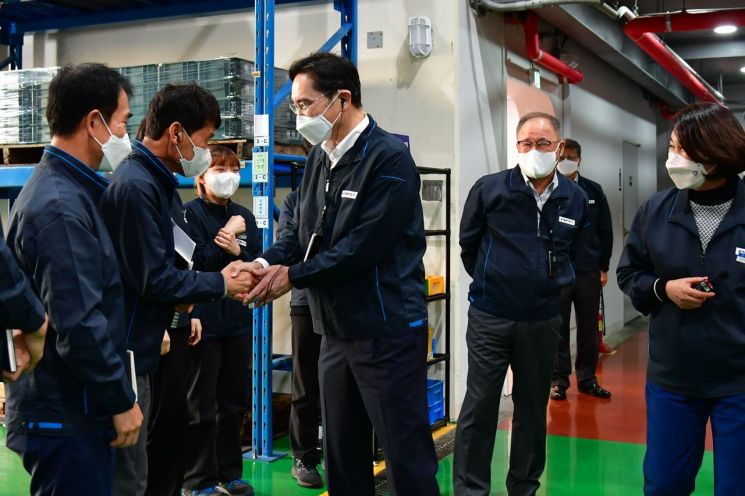 Samsung Electronics Chairman Lee Jae-yong inspecting the manufacturing site of Donga Plating, a plating company based in Busan, which received support for building a Samsung Electronics smart factory on November 8 last year.
 [Photo by Samsung Electronics]
The project plans to enhance AI process levels for participating companies. By utilizing AI technology to analyze production data in real time, the factories will be upgraded to 'intelligent factories' that improve on-site issues.
Regional balanced development is also an important goal of the project. It aims to serve as a catalyst to revitalize regions facing population decline by increasing SME productivity and sales.
A dedicated organization will be formed to support sustainable management (ESG), such as reducing carbon emissions, which SMEs find difficult to handle on their own.
Evolving a 'Self-Sustaining Regional Ecosystem'
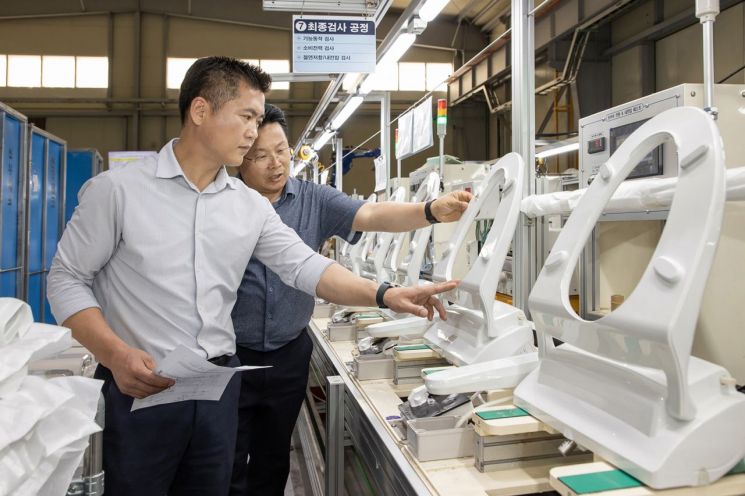 Chungcheongnam-do Asan bidet specialist company 'Ace Life' employee Seo Young-min (left) and Samsung Electronics smart factory manager (right) are inspecting the quality status of bidet products.
 [Photo by Samsung Electronics]
The project is being carried out in cooperation with the Ministry of SMEs and Startups and the Korea Federation of SMEs. Local governments and beneficiary companies will also participate in the Smart Factory 3.0 project.
Jeollabuk-do is the most proactive. This year, Jeollabuk-do is partially supporting the project costs for applicant companies within the province. From next year, it is planning to launch a Jeollabuk-do-type smart factory project separately from Samsung's smart factory.
Samsung Electronics plans to actively cooperate so that cases like Jeollabuk-do, where local governments and beneficiary companies lead the activation of the smart factory ecosystem, spread nationwide. Kim Kwan-young, Governor of Jeollabuk-do, said, "The Jeollabuk-do-type smart factory support project is a project where companies that have achieved results through Samsung's project lead innovation themselves and share the fruits of growth."
SMEs Supported by Samsung Have Grown Rapidly
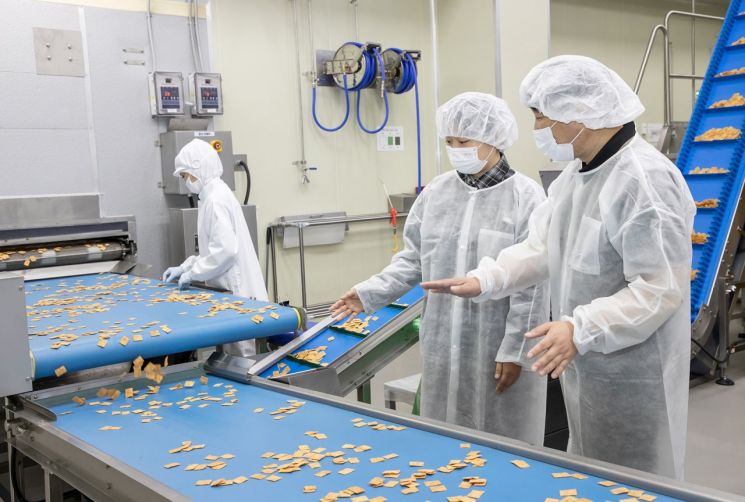 At the food company 'Kukia' in Yeosu, Jeollanam-do, a Samsung Electronics smart factory manager (right) and a Kukia employee are inspecting the quality status of tofu snacks.
 [Photo by Samsung Electronics]
The sales and production capacity of supported companies have improved. According to a study by the Korea Federation of SMEs in September last year, companies benefiting from the smart factory project had an average sales growth rate of 23.7%, employment growth rate of 26%, and R&D investment growth rate of 36.8% higher from 2017 to 2020 compared to companies that did not receive support.
Ace Life, a bidet company in Asan, Chungnam, faced difficulties when the demand for bidets surged to 32,000 units per month during the COVID-19 period due to a toilet paper shortage. The existing production capacity of 20,000 units per month was insufficient. With Samsung's support, they improved the production line imbalance and established an automated inspection system, increasing production capacity to 42,000 units per month.
Cookia, a food company in Yeosu, Jeonnam, experienced an annual waste of tofu snacks worth 150 million KRW due to defective factory equipment. Delivery was delayed, and customer complaints increased. After Samsung's support, products were made at the optimal temperature. Annual sales increased eightfold from 300 million KRW in 2016, when smart factory construction began, to 2.4 billion KRW last year. During the same period, the number of employees grew 2.5 times from 10 to 25. Last year, they also built a new factory twice the size of the existing one.
Realizing Lee Jae-yong's 'Walking Together' Philosophy
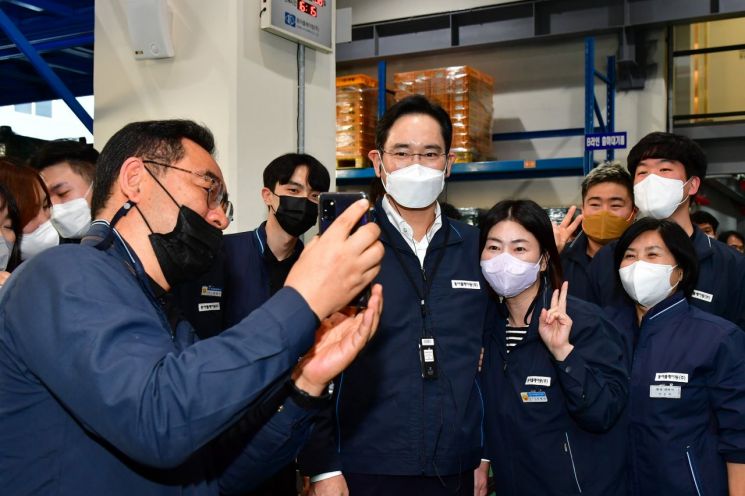 Samsung Electronics Chairman Lee Jae-yong inspecting the manufacturing site of Donga Plating, a plating company located in Busan, which received support for building a Samsung Electronics smart factory on November 8 last year. [Photo by Samsung Electronics]
The project embodies Chairman Lee Jae-yong's philosophy that "sharing together and growing together is the path to becoming the world's best." Companies that employ representatives with disabilities and social enterprises are given preferential treatment in the selection process.
On October 27 last year, just 11 days after his inauguration as chairman, Lee visited Dong-A Plating, a plating company in Busan participating in Samsung's smart factory project. At the site, he said, "We must create a healthy ecosystem to achieve a virtuous cycle of coexistence."
© The Asia Business Daily(www.asiae.co.kr). All rights reserved.














