Hyundai Motor and Kia Record Q1 Earnings Surprise... New Highs Achieved
Parts Stocks Also Gain Attention Ahead of Mass Electric Vehicle Production Era in 2025
As Hyundai Motor and Kia's stock prices soar, auto parts stocks are also set to follow suit. The era of mass production of electric vehicles by global automakers is expected to begin in 2025, raising expectations for orders. Although auto parts stocks have lagged behind the rise in auto stocks so far, the securities industry advises that now is the time to increase their weighting.
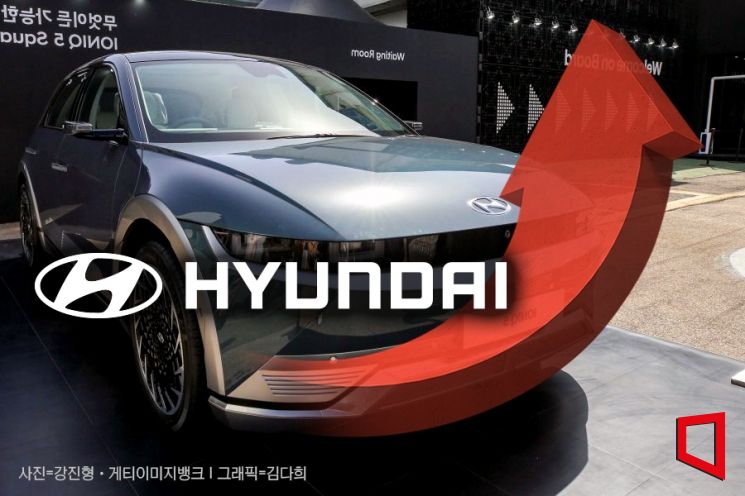
According to the Korea Exchange, Hyundai Motor's stock price rose 35.43% and Kia's increased 48.57% from January 2 to May 17 this year. During the same period, Hyundai Mobis and Hyundai AutoEver, representative auto parts stocks, rose 11.22% and 33.51%, respectively. Hyundai Wia increased by 24.17%.
Hyundai Motor and Kia recorded an 'earnings surprise' in the first quarter of this year, driving their stock prices to new highs. Hyundai Motor's first-quarter sales increased 24.7% year-on-year to KRW 37.7787 trillion, and operating profit rose 86.3% to KRW 3.5927 trillion. The operating profit exceeded market consensus by 23%. Kia's operating profit also rose 78.9% year-on-year to KRW 2.874 trillion, surpassing consensus by 24%. As a result, foreign investors engaged in net buying rallies, pushing Hyundai Motor and Kia's stock prices to new 52-week highs.
In contrast, auto parts stocks posted first-quarter earnings below securities firms' expectations and received relatively less attention compared to auto stocks. Hyundai Mobis recorded an operating profit of KRW 418.1 billion, and Hyundai Wia posted KRW 50.9 billion in the first quarter. These figures fell short of the market forecasts of KRW 550 billion and KRW 54.3 billion, respectively, compiled by financial information provider FnGuide.
However, the securities industry is recommending an 'increase in weighting' for auto parts stocks, saying now is the right time to invest. Global automakers including Tesla, BYD, Hyundai Motor Group, Volkswagen, and Ford have announced mass production targets of 2 to 3 million electric vehicles for 2025-2026, signaling the start of the mass production era for EVs from 2025. Automakers are expected to establish diversified sourcing systems targeting electric vehicle parts suppliers to enhance price competitiveness and mitigate risks ahead of mass production. In this process, Korean auto parts companies are expected to gain a competitive edge in the North American market amid US-China tensions.
Im Eun-young, a researcher at Samsung Securities, said, “Korean auto parts companies have accumulated over 20 years of experience operating overseas factories while entering markets such as North America and India alongside Hyundai Motor and Kia, and have established references by supplying EV parts to Hyundai Motor Group.” She added, “As Hyundai Motor Group grows to become the global leader with 9.2 million units sold by 2026, Korean auto parts companies will also be re-evaluated.” Kim Jin-woo, a researcher at Korea Investment & Securities, said, “The strong performance of automakers is spreading to small and medium-sized parts companies. Especially, companies expanding their business into future car sectors such as batteries are showing steeper sales growth, so it is time to pay attention to these companies.”
© The Asia Business Daily(www.asiae.co.kr). All rights reserved.












