[Battery Material Super-Gap]②
Anode Materials Determining Charging Speed and Lifespan
Graphite Mainly Used... Has Expansion Drawbacks
Active Development of Silicon Anode Materials as Alternatives
If cathode materials generate electrical energy, anode materials serve to store that energy. Anode materials that store lithium ions determine the battery's charging speed and lifespan. The more lithium ions stored in the anode, the larger the usable capacity and the faster the charging speed. Anode materials account for about 15% of the cost of electric vehicle batteries.
Currently, most secondary battery anode materials are made in China. Market research firm ICCSINO reported that the global anode material production volume in 2021 increased by 63% compared to the previous year, totaling 882,700 tons, with China accounting for 92% of total production. Among the top 10 anode material producers, seven are Chinese companies, two are Japanese, and one is Korean.
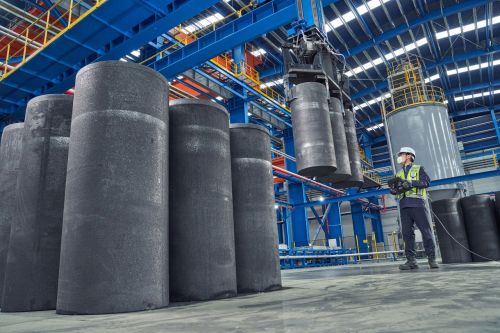
Anode materials serve as the storage source (absorption and release) for lithium ions and consist of anode active materials, conductive agents, binders, and copper foil. The anode active material, which makes up most of the anode material, primarily uses graphite due to its advantages in price and stability. Pencil lead is graphite.
Natural graphite anode materials have the advantages of large capacity and low cost but suffer from short lifespan and slow charging speed. When lithium ions move from the cathode to the anode through the electrolyte during battery charging and remain between the graphite layers in the anode, the material expands and swells.
The alternative proposed by anode material companies is 'silicon anode materials.' Silicon anode materials can store about 10 times more lithium than graphite-based anode materials. The capacity per gram of silicon is up to 4200mAh/g, whereas graphite anodes have about 370mAh/g.
Silicon anode materials can increase battery capacity and shorten charging times. However, silicon also has the characteristic of easily expanding in volume when charged and discharged repeatedly. Currently, the maximum silicon content that can be added to graphite-based anode materials is about 5-10%. Increasing silicon content and improving stability remain challenges.
Silicon anode materials, which accounted for only 1.2% of the anode material market at 6,000 tons in 2020, are expected to increase to about 320,000 tons by 2027. The compound annual growth rate is 76.6%. LG Chem, POSCO Future M, and SK Materials are entering R&D, seeing the potential of the silicon anode material market.
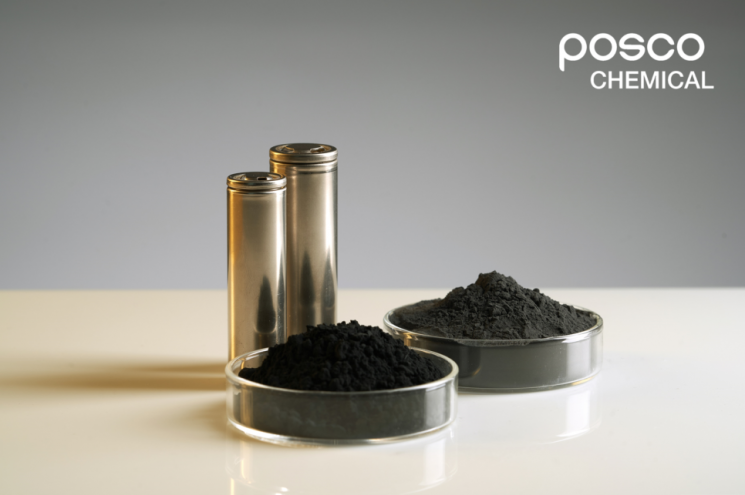 Cylindrical batteries for electric vehicles and POSCO Future M cathode and anode materials (cathode material on the left)
 [Photo by POSCO Future M]
LG Chem is developing 'Pure Silicon' technology made from 100% silicon. Shin Hak-cheol, Vice Chairman of LG Chem, introduced Pure Silicon development as a key task in the growth strategy announced in February last year. It can dramatically increase capacity compared to existing anode materials. LG Chem also announced plans in July 2021 to invest 6 trillion won by 2025 in developing battery materials, aiming to become the world's number one comprehensive battery materials company.
POSCO Future M, which produces graphite anode materials, is also developing silicon anode materials. POSCO Silicon Solution, a subsidiary of POSCO Holdings, plans to invest 300 billion won by 2025 to build a silicon anode material production plant with an annual capacity of 5,000 tons in the Yeongilman Industrial Complex in Pohang. In July last year, POSCO Group acquired silicon anode material developer Terra Technos and renamed it POSCO Silicon Solution.
SK Materials Group14 completed a silicon anode material plant with an annual capacity of 2,000 tons in Sangju, Gyeongbuk Province. Commercial production will begin in the third quarter. With additional expansions, they plan to secure an annual capacity of 10,000 tons by 2025. SK Materials Group14 is a joint venture established by SK Materials and the U.S. battery material technology company Group14 in 2021 to enter the silicon anode material business.
Researcher Cho Jeong-hyun of Hana Securities said, "Growth in the silicon anode material market is inevitable," adding, "In the case of Tesla's 4680 battery, improving energy density through the use of silicon anode materials is key along with cost reduction, so silicon anode material production is expected to increase, led by LG Energy Solution and Japan's Panasonic."
© The Asia Business Daily(www.asiae.co.kr). All rights reserved.