Student Violence Records in School Records Retention Period Extended from 2 to 4 Years
Significant Impact on High School Admissions Including Interview Screening
The government has decided to extend the retention period for records of school violence (hakpok) in elementary and middle schools to up to 4 years after graduation. Accordingly, committing school violence during elementary or middle school will affect not only university admissions but also high school admissions. It is expected that applicants to autonomous private high schools and special-purpose high schools, which include document screening and interviews, will be directly impacted.
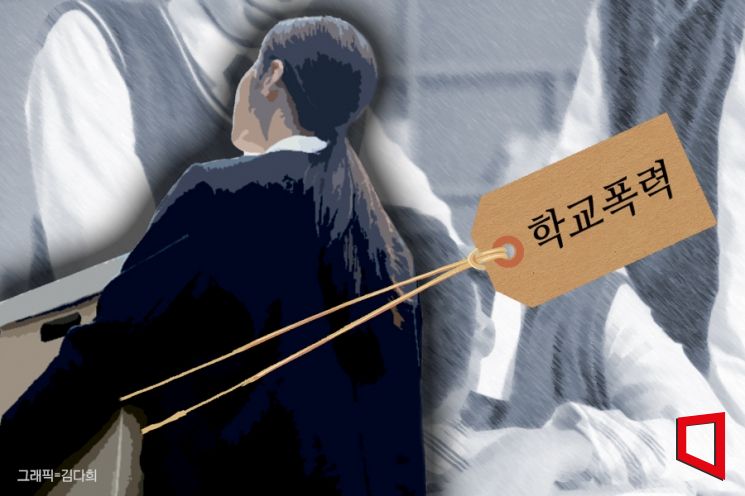
In the 'Comprehensive Measures to Eradicate School Violence' announced on the 12th, the government stated that the retention period for student records concerning serious school violence offenses?specifically disciplinary actions No. 6 (suspension), No. 7 (class transfer), and No. 8 (school transfer)?will be extended from a maximum of 2 years to 4 years after graduation. Suspension and class transfer will generally be retained for 4 years after graduation but may be deleted upon review just before graduation. The government plans to revise related enforcement regulations and implement the extended retention period starting next year.
As a result, middle school school violence records will affect university admissions, and elementary and middle school school violence records will impact high school admissions. Although the Ministry of Education did not explicitly state the connection between high school admissions and school violence records in this measure, Ko Young-jong, the Ministry's Chief Education Policy Officer, said, “Disciplinary actions such as suspension, class transfer, and school transfer due to school violence in middle school can affect high school admissions.”
In fact, if school violence records are reflected in high school admissions, the impact could be greater than on university admissions. A recent analysis by Jongro Academy of the School Violence Countermeasure Committee cases over the past three years (2019?2021) at 389 middle schools in Seoul, as disclosed on the School Information Disclosure System, showed a total of 4,700 cases. This number is more than twice the 2,112 cases at 320 high schools during the same period. Among these, serious school violence cases classified as No. 6 or higher, which result in a 4-year retention period, numbered 1,337 at middle schools?2.7 times more than the 497 cases at high schools.
Lim Seong-ho, CEO of Jongro Academy, pointed out, “Specialized high schools, international high schools, and autonomous private high schools may consider school violence history during interviews, and it is possible to check whether school violence is recorded through student record reviews. Since serious disciplinary actions for school violence are more frequent among middle school students than high school students, it is crucial to provide school violence prevention education starting at the middle school level.”
Meanwhile, through this comprehensive measure, the government has also made it impossible for offending students to withdraw from school before the school violence committee’s decision in order to avoid having disciplinary actions recorded in their student records. If an offending student appeals the committee’s decision by requesting a stay of execution or filing a lawsuit, the victim will be notified, and support will be provided to ensure the victim can exercise their right to testify during the appeal process, including the appointment of a public defender.
© The Asia Business Daily(www.asiae.co.kr). All rights reserved.












